On November 23, 2026, Panasonic announced the ARC6 PRO, a six-blade electric shaver that pairs nano-polished stainless inner blades and redesigned foils with a beard-sensing system that adjusts motor power up to 233 times per second, at $399.99 to $499.99 (Panasonic via PR Newswire).
Key takeaways
- The cutting system is the product. Panasonic frames the blade as "the heart of every great shave," and most of the ARC6 PRO's claimed gains come from blade geometry, foil hole pattern and head articulation, not the handle.
- Sensing now drives power management. The Intelligent Beard Sensor+ shifts between BOOST and SOFT modes automatically, which turns motor control firmware into part of the user experience.
- Performance claims need a defined test baseline. Panasonic's "up to 50%" cutting-efficiency figure is footnoted to in-house testing of one finishing blade against an older one, a useful model for how teams should scope claims.
- Wet and dry use plus an automatic cleaning dock make this a product system, with sealing, consumables and a second appliance to design around the handheld.
What Panasonic announced: the ARC6 PRO at a glance
According to Panasonic's announcement, the ARC6 PRO is the company's most advanced six-blade shaver. The reported specifications are:
- 6-Blade PRO System: four finishing blades and two thick-stubble blades. New finishing foils use a diagonal hole pattern that Panasonic says improves cutting efficiency by up to 50%, based on in-house testing of the ES-L690 finishing blade against the ES-LS9C blade.
- Inner blades: Japanese stainless steel, nano-polished to a 30-degree edge.
- Drive: a linear motor delivering 84,000 cross-cutting actions per minute.
- Intelligent Beard Sensor+: scans beard density up to 233 times per second and automatically adjusts power between BOOST and SOFT modes.
- 22D Flexible Shaver Head: multi-directional head movement combined with individually floating blades.
- Use and care: wet and dry use, a "craft black" finish and an ergonomic grip, with an automatic Clean & Charge System on the ES-L690U only.
- Price and availability: pre-orders opened November 23, 2026 at Shop.Panasonic.com and Amazon, at $399.99 (ES-L661WK) or $499.99 (ES-L671WK).
Panasonic is positioning the launch around holiday gifting. Everything above is the company's description; independent shave testing has not yet been published.
Why a shaver is a precision mechanical product first
A premium foil shaver looks like a simple handheld, but most of its engineering sits in a few cubic centimeters at the top. The outer foil is a thin perforated metal sheet that touches the skin; the inner blades oscillate underneath it, cutting each hair that enters a hole. Closeness depends on how thin the foil can be made while still surviving daily pressure, and comfort depends on how evenly the head spreads that pressure across a jawline.
That is why the ARC6 PRO's headline changes are geometric: blade edge angle, foil hole pattern and the number of degrees of freedom in the head. Each one is a tolerance problem. A floating blade that is a fraction of a millimeter too stiff or too loose changes contact pressure, and a hole pattern that cuts more efficiently also changes how the foil flexes and how long it lasts.
Two terms are worth defining here. Tolerance is the allowed variation in a part's dimensions; in shaver heads it is measured in microns, not tenths of a millimeter. Tooling is the set of molds, stamping dies and fixtures used to make parts at volume; for a product like this, foil forming and blade grinding tooling is often as important as the injection molds for the housing.
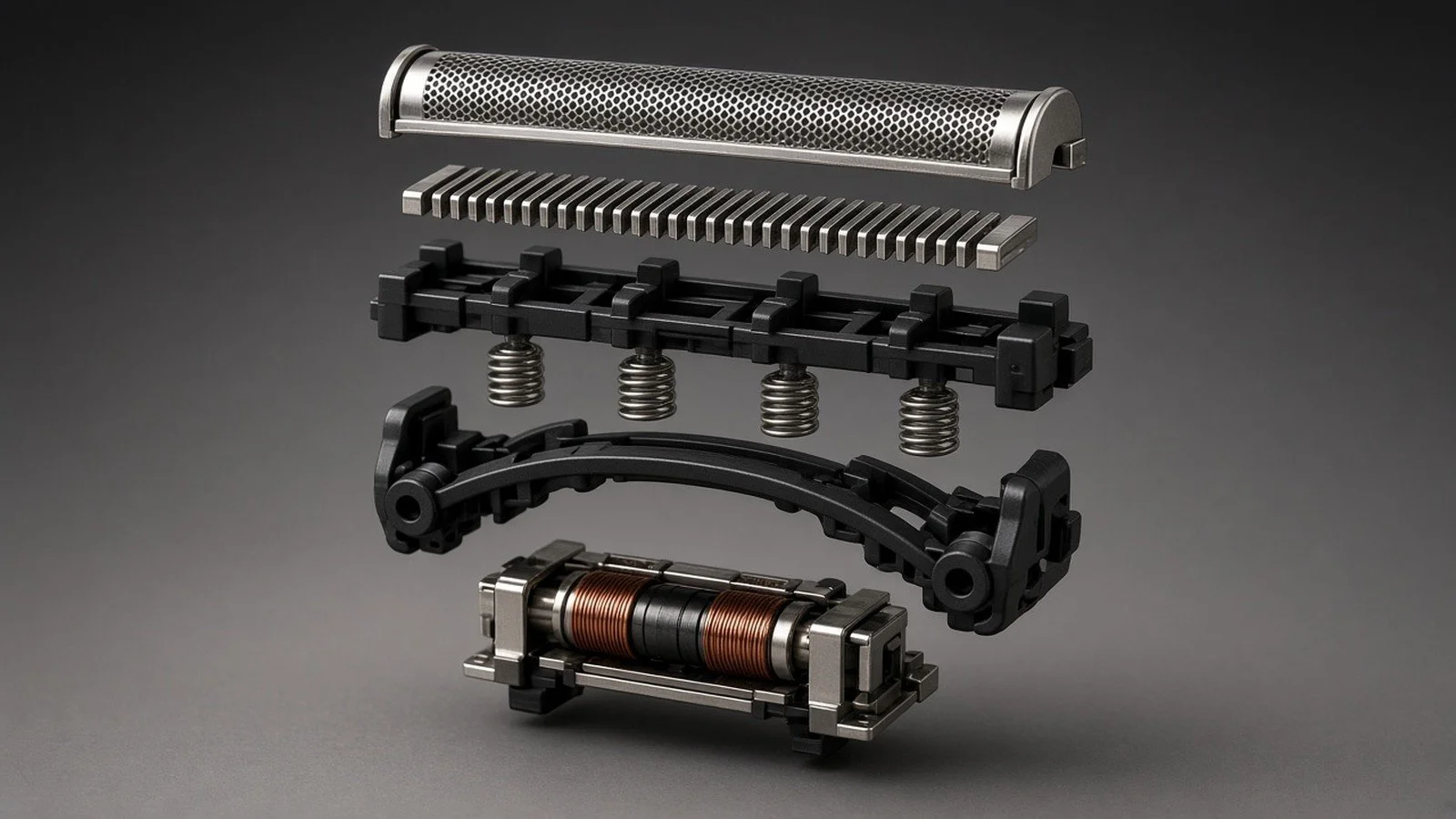
Concept render (illustration) of a generic foil shaver head assembly, not a Panasonic product.
What this means for product teams
The following is Jackson Hedden analysis, not reporting. Personal care devices sit at the intersection of mechanical precision, wet electronics and very personal ergonomics, and the ARC6 PRO announcement illustrates choices any team in this category will face. Working with a product design company on a device like this usually comes down to the following decisions.
Start the architecture at the contact surface. In shavers, trimmers, massagers and skin devices, the part that touches the body defines everything behind it: motor size, head articulation, battery placement and grip. Teams that design the handle first and fit the mechanism later tend to end up with a bulky head or a compromised pivot. Build early works-like prototypes of the contact mechanism alone, then wrap the industrial design around it.
Treat sensing features as a firmware and validation project. A feature like automatic power adjustment based on beard density is only as good as its sensing signal and control logic. Plan for a sensor that works across hair types, skin types, wet and dry conditions and battery states, and budget firmware time for tuning thresholds so the device does not feel like it is "hunting" between modes.
Write performance claims the way you would write a test plan. Panasonic's footnote ties its 50% figure to a specific blade comparison under in-house testing. That is a good habit: define the baseline, the test method and the conditions before marketing writes the claim, and keep the data. It protects the brand and gives engineering a measurable target during EVT and DVT (engineering validation test and design validation test, the build stages where a design is proven to work and then proven to meet its requirements).
Design sealing, drainage and cleaning together. "Wet and dry" means water, foam and hair debris will enter the head every day. Sealing the motor and electronics, letting the head drain and making it easy to rinse are linked decisions. If a cleaning dock is part of the line, as with Panasonic's Clean & Charge System on one model, the head geometry, docking alignment and charging contacts have to be designed as one system.
Plan the consumable from day one. Foils and blades wear out. Replacement head design, packaging, pricing and availability affect long-term satisfaction as much as the first shave. Making the wear parts easy to swap without tools also supports repairability. For another personal care example where the internal system shapes the whole form, see our analysis of Therabody's acquisition of Embr Labs' thermal technology.
Prototyping a personal care device: what to build and when
For a handheld grooming or personal care product, a practical prototype sequence looks like this:
- Mechanism rigs: bare cutting or contact mechanisms on a bench fixture, used to compare geometries and measure force, noise and heat before any housing exists.
- Looks-like models: foam, SLA or CNC models in several grip sizes, tested in real hands for balance, reach around the jaw or body, and control placement.
- Works-like integrated builds: motor, battery, PCB and sensor in a 3D-printed or clear housing, used for firmware tuning and early water exposure tests.
- Production-intent builds: parts from production tooling and processes, used to verify tolerances, sealing, drop performance and the finish that customers will actually touch.
Each stage answers different questions, and skipping one usually means discovering a problem at a more expensive stage. Our prototyping services page covers how we stage these builds with suppliers.
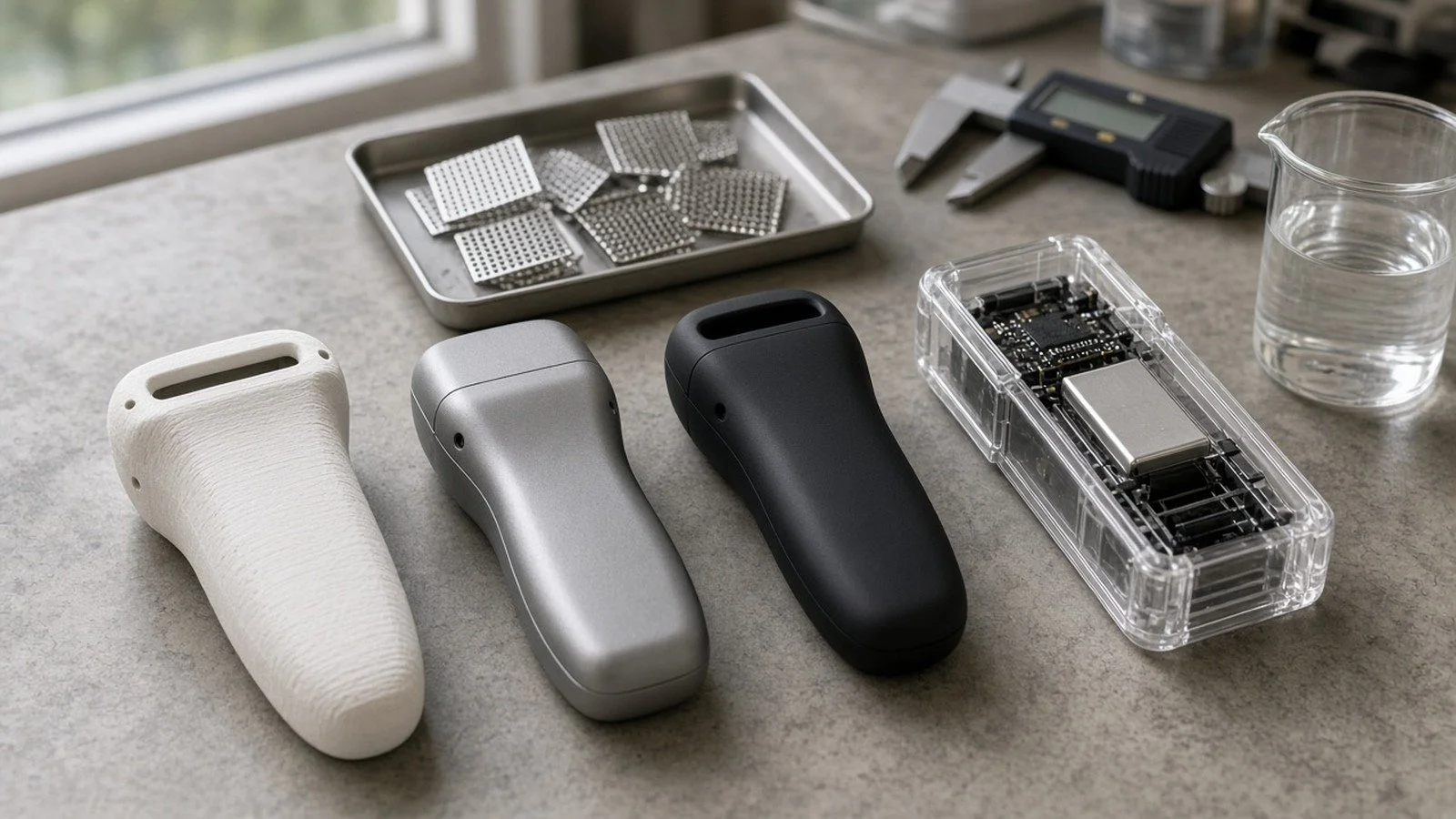
Concept render (illustration) of staged handheld prototypes, not a Panasonic product.
Frequently asked questions
What is new about the Panasonic ARC6 PRO? Panasonic says the ARC6 PRO combines a six-blade cutting system with redesigned diagonal-pattern finishing foils, a linear motor running 84,000 cross-cutting actions per minute, and an Intelligent Beard Sensor+ that adjusts power up to 233 times per second. It went up for pre-order on November 23, 2026 at $399.99 or $499.99.
Why do electric shavers need so much precision engineering? The cutting happens between a thin perforated foil and oscillating inner blades, so small changes in foil thickness, hole pattern, blade angle or spring force change closeness, comfort and durability. These parts are held to very tight tolerances and often need specialized forming and grinding tooling.
How does a product design company approach a personal care device? A good team starts at the part that touches the body, prototypes that mechanism on its own, then builds the industrial design, electronics and firmware around it. Sealing, cleaning, consumables and test-backed performance claims are planned early rather than added at the end.
What are EVT and DVT? EVT (engineering validation test) is the build stage where engineers confirm the design works as intended. DVT (design validation test) uses production-intent parts to confirm the product meets its requirements, including reliability, safety and water resistance, before mass production.
Thinking about a personal care or grooming product?
If you are developing a handheld personal care device and want help turning the contact mechanism, electronics and industrial design into one manufacturable product, see our product design services or contact us to talk through your project.
Jackson Hedden is a product design, development and manufacturing firm helping founders and product teams take consumer and industrial products from concept to production.
Sources
- Panasonic Corporation of North America, "Panasonic Introduces the ARC6 PRO Its Most Advanced Six-Blade Electric Shaver," PR Newswire, November 23, 2026.