On November 23, 2026, the LEGO Group announced it will build a roughly €1 billion, 115,000 m² factory in Estarreja, Portugal, which it expects to open in 2030 to mould, process and pack LEGO products for Europe, the Middle East and Africa (LEGO Group).
Key takeaways
- LEGO is adding capacity close to its customers, not just adding capacity. Its stated strategy is region-based manufacturing that shortens supply chains and lets it respond faster to demand.
- New capacity takes years, not months. Construction starts in the first half of 2027 and production in 2030, roughly four years after the announcement, which is why product teams should plan sourcing well ahead.
- Multi-site production is a design problem as much as an operations problem. Making the same part identically in several factories depends on tooling, tolerances and process documentation decided during design.
- Automation rewards parts designed to be handled by machines. LEGO says Estarreja will be its most automated site; parts that feed, orient and pack easily are cheaper to automate.
What LEGO announced: the Estarreja factory at a glance
According to the LEGO Group's announcement, made at an event in Estarreja and dated November 23, 2026, the reported details are:
- Scope: end-to-end production, including moulding, processing and packing, plus a high-bay warehouse (a tall, automated storage building).
- Scale: about €1 billion invested over several years, a 115,000 m² building on a 60-hectare site, and more than 1,000 jobs once fully operational.
- Timeline: construction expected to start in the first half of 2027, with production projected to begin in 2030.
- Technology: LEGO calls it its "most automated and advanced site," with connected systems intended to support productivity and operational resilience.
- Environment: the company aims to source 100% renewable energy for annual needs, about 80% of it from on-site solar and battery storage, and to achieve LEED Platinum certification.
- Network: it will be LEGO's eighth factory worldwide and fourth in Europe. Euronews reports the other European plants are in Denmark, Hungary and Czechia.
Chief Operations Officer Carsten Rasmussen said Portugal "stood out to us given its proximity to markets, access to transport links, commitment to sustainability and skilled local workforce."
Why a toy factory matters to product teams
LEGO describes its approach as "producing close to market," which it says shortens the supply chain, speeds response to changes in demand and reduces its environmental footprint. The release lists a run of recent investments that follow the same pattern: a factory in Vietnam that opened in April 2025, a U.S. factory and regional distribution center due in 2027, plans to expand in Mexico, and expansions in Hungary and China.
LEGO bricks are injection-molded plastic parts. Injection molding forces molten plastic into a steel mold, cools it and ejects the finished part. The molds, usually called tooling, are among the most expensive and slowest items in any hardware program. A brand that makes the same product in several regions has to make the same part, to the same standard, in every one of them.
That is the part of this story that applies well beyond toys. Most consumer products that reach meaningful volume eventually face the same question: one factory or several, and how close to the customer.
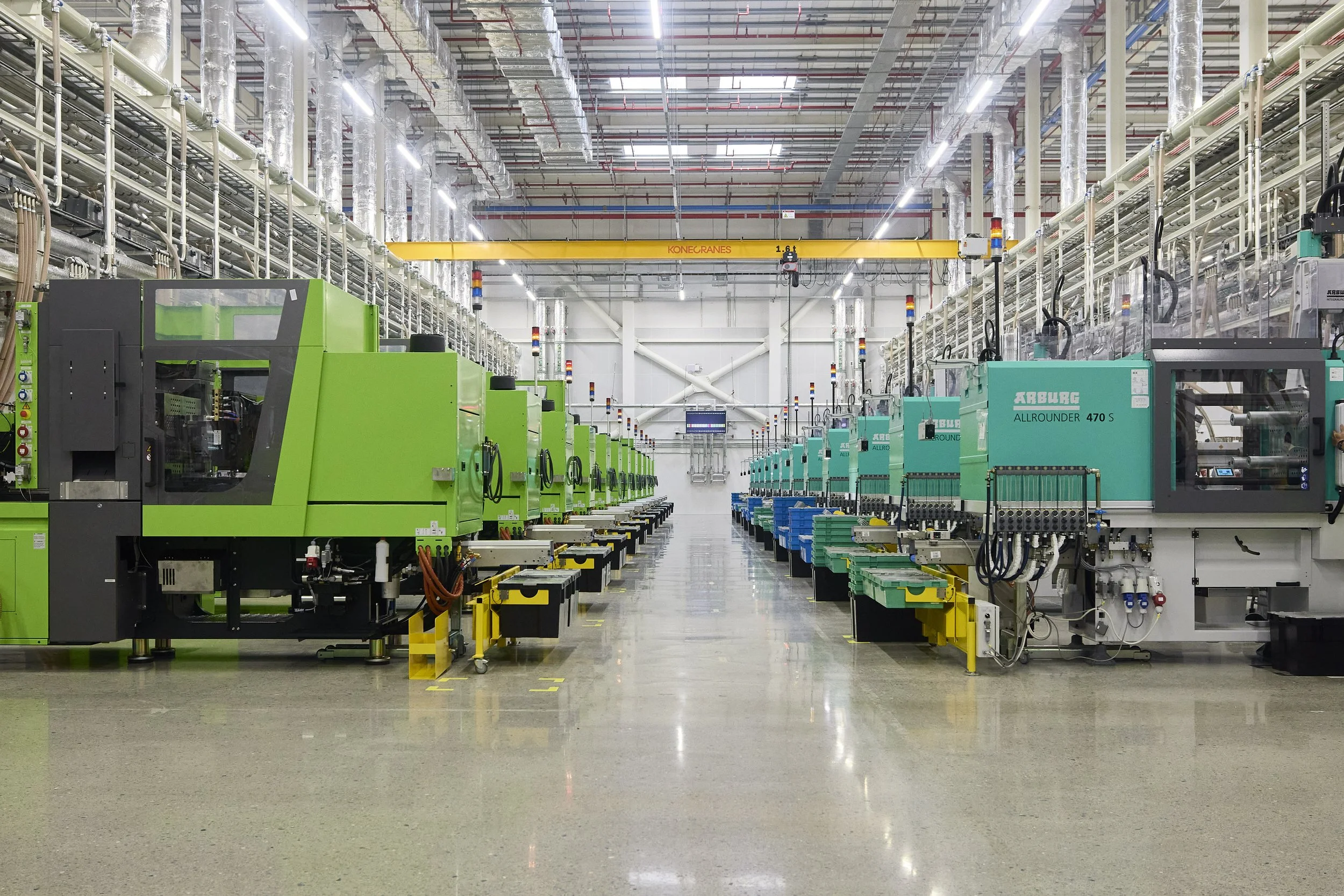
Injection moulding hall at LEGO Manufacturing Vietnam, which opened in April 2025. Image: LEGO Group
What this means for product teams
The following is Jackson Hedden analysis, not reporting. It draws on general product development practice and is not a description of LEGO's internal methods.
Design for the second factory, not just the first. Design for manufacturing, or DFM, means shaping parts, materials and tolerances around how they will actually be made. When a product may later be built in another region, DFM also means writing down why each choice was made. Critical dimensions, cosmetic standards, approved resins and inspection methods should live in drawings and specifications, not only in one supplier's experience. If you are working through those choices, our design for manufacturing and sourcing services start from exactly that documentation. The same discipline applies to packaging, where a new format has to run on existing filling lines, as our analysis of Tetra Pak's Tetra Reva spoonable-food carton shows.
Treat tolerances as a cost you pay in every plant. A tolerance is the allowed variation in a dimension. Tight tolerances are sometimes essential, as with parts that must click together the same way every time, but each one has to be held by every tool and every process window (the range of temperature, pressure and timing that makes good parts). Reserve tight tolerances for the features that need them.
Plan tooling as an asset you can copy. A second site usually needs its own molds. Teams that own their tool designs, keep steel and cavity data organized, and specify standard mold components can duplicate tools faster than teams that rely on a single toolmaker's files.
Design parts that machines can handle. Highly automated lines favor parts that orient themselves, do not tangle, and pack in predictable ways. Symmetry, clear datum features and robust gate locations make robotic handling and inspection simpler.
Match the sourcing plan to your volume. LEGO can justify a billion-euro plant. A startup cannot, but it can choose a molder with facilities in more than one region, qualify a second resin source early, or keep production-intent CAD clean enough to move. Our look at Welly's reshoring of tumbler production to Pittsburgh shows how much know-how sits in machines and process recipes.
A practical checklist for multi-region readiness
- Lock a single source of truth. Keep released CAD, 2D drawings with critical-to-function dimensions, and a cosmetic specification under revision control.
- Specify materials by grade and alternates. Name the exact resin and color standard, then qualify at least one alternate before you need it.
- Define acceptance tests. Write measurable checks for fit, function and appearance so a new factory can prove it matches the first.
- Validate the new line like a new product. Run pilot builds, often called PVT (production validation test), and compare first-article inspection results against the original site before shipping.
- Account for lead time. New tooling, new lines and new buildings take months to years. Our Formnext coverage of 3D-printed mold inserts covers one way to learn about molded behavior before steel is cut.
The tradeoff is real. Regional production adds tooling cost and validation work, and it only pays back when volume, freight, tariffs or lead times make a single source risky. Deciding early keeps the option open without paying for it all on day one.
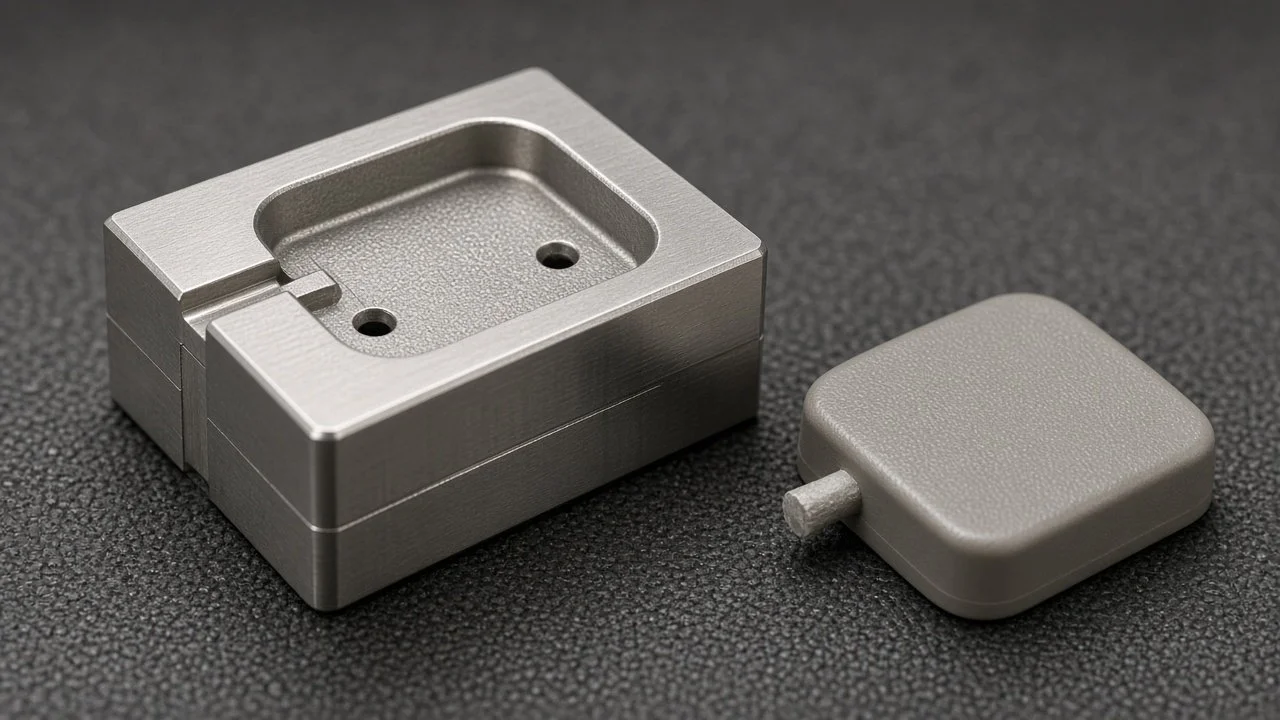
Concept render (illustration) of a generic mold cavity insert and molded part, not LEGO tooling.
Frequently asked questions
What did LEGO announce in Portugal? On November 23, 2026, the LEGO Group announced a new factory in Estarreja, Portugal, representing about €1 billion of investment. The 115,000 m² site is expected to open in 2030 and will handle moulding, processing and packing for Europe, the Middle East and Africa.
Why do companies build factories close to their markets? Producing near customers can shorten supply chains, cut transport time and emissions, and help a company respond faster to changes in demand. The tradeoff is higher investment in duplicate tooling, equipment and validation.
What is design for manufacturing (DFM)? DFM is the practice of shaping a product's parts, materials and tolerances around how they will be made, so they can be produced reliably at the target cost. It includes choices such as draft angles, wall thickness, part count and inspection methods.
Can a small company make the same product in more than one factory? Yes, but it takes preparation. Clean CAD and drawings, defined acceptance tests, qualified alternate materials and tooling the company controls make it far easier to add or move production later.
Preparing a product for scale?
If you are planning tooling, sourcing or a move between factories, see how our manufacturing and DFM team works, or contact us to talk through your production plan.
Jackson Hedden is a product design, development and manufacturing firm helping founders and product teams take consumer and industrial products from concept to production.
Sources
- LEGO Group, "The LEGO Group to build new factory in Estarreja, Portugal," LEGO.com, November 23, 2026.
- Doloresz Katanich, "LEGO to build €1bn factory in Portugal, creating more than 1,000 jobs," Euronews, November 23, 2026.
- LEGO Group, "The LEGO Group opens new state-of-the-art factory in Vietnam," LEGO.com, April 9, 2025 (source of the factory photographs).