On November 16, 2026, Bloomberg News reported that Pittsburgh drinkware maker Welly is bringing insulated bottle and tumbler production home by importing a factory, machines and Chinese engineers included, into a building in Leetsdale, Pennsylvania.
Key takeaways
- Welly's reshoring effort shows that moving production is a process-transfer project as much as an equipment purchase.
- Chinese engineers had to install the line and train U.S. technicians, and reported start-up problems included weld defects after the first domestic tumbler came off the line in September 2026.
- Tariffs, building power capacity, visas and thin machine documentation all slowed the timeline, according to summaries of the Bloomberg report.
- Process knowledge, such as machine programs, mold and die know-how, and inspection limits, is easy to leave behind when production moves.
- Product teams can make future moves easier by documenting tolerances, process windows and tooling ownership while the product is still being designed.
What Welly's factory shows about design for manufacturing when production comes home
That discipline, usually shortened to DFM, means shaping a product's parts, materials and tolerances around how they will actually be made. Welly's story is a useful real-world test of it, because the product is simple and the production process is not. Below we separate what was reported from our analysis.
What was reported
The setup. Bloomberg's Shawn Donnan describes Chinese engineer Fane Hu training two U.S. technicians from Welly on an automated machine in Building 18 at Leetsdale, near Pittsburgh. "Everything will be automatic," Hu explains through an interpreter. "This is how you can test every component individually and at different speeds as well." Engineers traveled from China to help set up the line.
The background. According to a Headliner summary of the Bloomberg report (in Dutch), founder Ben Kander launched Welly in 2015 with production in Yongkang, China, and began planning to move manufacturing to Pittsburgh after pandemic supply disruptions in 2020. The facility covers 80,000 square feet.
The obstacles. Both Headliner and a Phoenix New Media summary (in Chinese) report that tariffs on the Chinese machinery at one point reached 150%, with a refund coming after the Supreme Court struck down many of the duties. Many candidate buildings lacked the electrical capacity the line needs, so Welly signed its lease in October 2025 and missed its original first-quarter 2026 start. Phoenix adds that the only U.S. equipment quote Welly received was about five times the price of comparable Chinese machines.
The start-up. The equipment arrived in early 2026. Visa limits capped how many Chinese engineers could come to install it and train staff on hydroforming (shaping metal with high-pressure fluid) and ceramic coating, and documentation was minimal. The first tumbler made entirely by the U.S. team came off the line in September 2026, but weld defects and start-up problems followed. Phoenix's summary says Kander described owning the machines while their programming and mold know-how remain Chinese expertise.
The market. Headliner reports retail launches with Dick's Sporting Goods and Whole Foods planned for 2027. Welly's website currently lists 12 oz and 20 oz bottles and a 32 oz handled tumbler for pre-order under the line "Made in the USA."
A contrasting model. In a Tennessee announcement on November 12, Taiwan-based toothbrush maker Acumen said it will invest $20.2 million in its first U.S. plant, with production expected in 2027. The state notes that Acumen designs its own production equipment and molds.
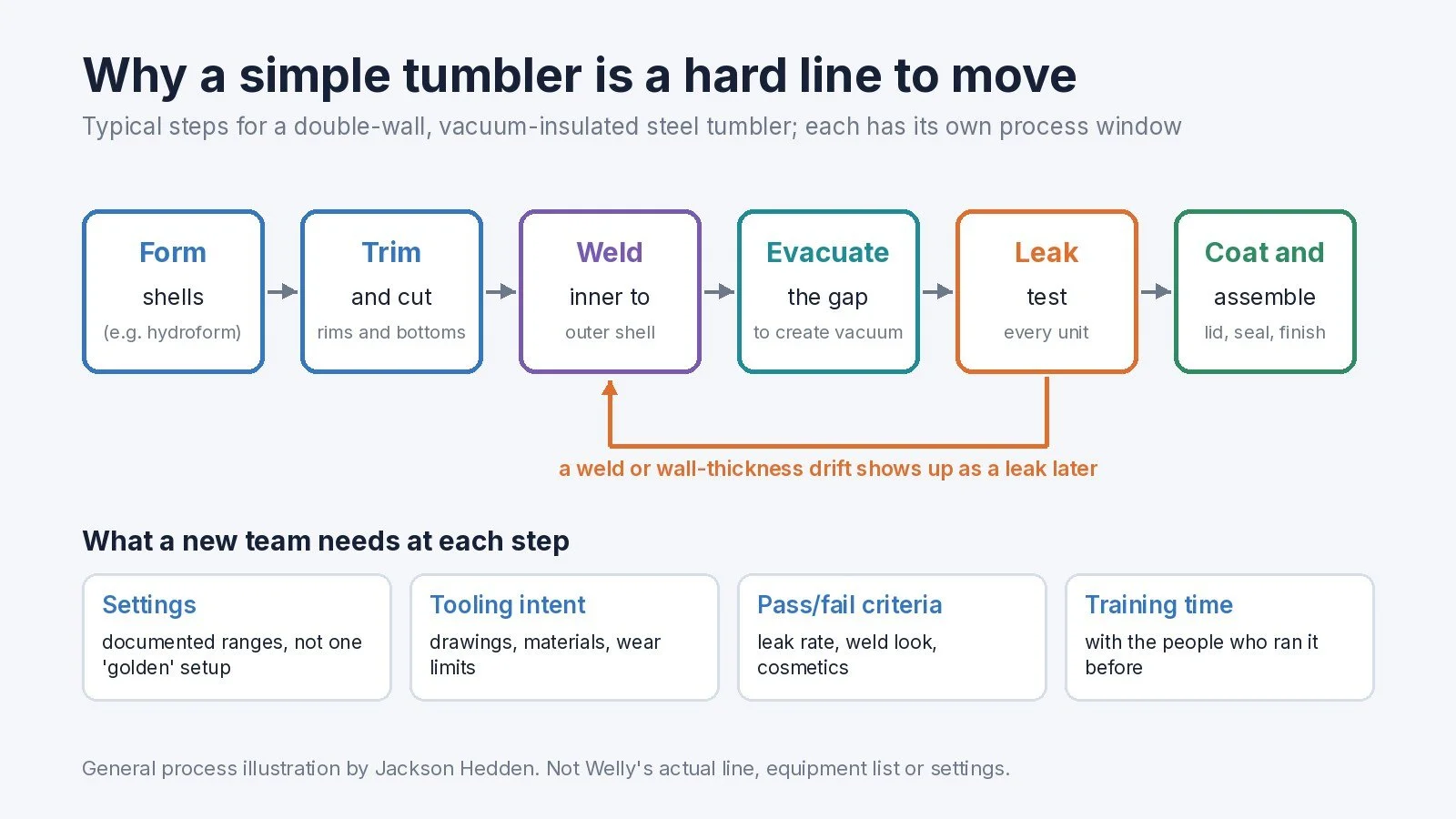
Typical steps for a double-wall vacuum-insulated tumbler and the knowledge each needs. General process illustration by Jackson Hedden; not Welly’s actual line or settings.
Why the hard part is process knowledge, not machines
This section and the next are Jackson Hedden analysis based on general product development and manufacturing practice, not a description of Welly's internal processes.
A vacuum-insulated tumbler looks like a commodity, but it is a chain of tightly coupled processes. Inner and outer stainless shells are formed, trimmed and welded, the gap between them is evacuated to create the vacuum, and every unit needs leak testing before coating and assembly. A small change in wall thickness, weld parameters or forming pressure can show up as a failed vacuum weeks later.
Machines arrive; recipes don't always. Every forming, welding and coating step runs on a process window, meaning the range of settings (pressure, speed, temperature, power) that reliably makes good parts. Those windows live in machine programs, setup sheets and the heads of experienced technicians. When documentation is thin, a new team has to rediscover them through scrap.
Tooling is where knowledge hides. Tooling means the molds, dies and fixtures that shape and hold parts during production. Whoever designed the tooling usually understands why a radius, draft angle or weld land is the way it is. If drawings and design intent stay with the supplier, every tooling repair becomes a long-distance support ticket. Good design for manufacturing documentation records that intent so another shop can maintain or rebuild the tools.
Utilities are design inputs. Welding, heating and vacuum equipment can need serious electrical power. Welly's building search shows that power, compressed air and floor space belong in the production plan as early as material choices do.
Startup is a validation phase. A first good part is not a stable line. Teams typically run pilot builds, sometimes called PVT (production validation test), to prove the line makes good parts consistently, then track yield (the share of units that pass inspection) before committing to retail volumes. Acumen's model of designing its own equipment and molds is one way to keep that knowledge in-house.
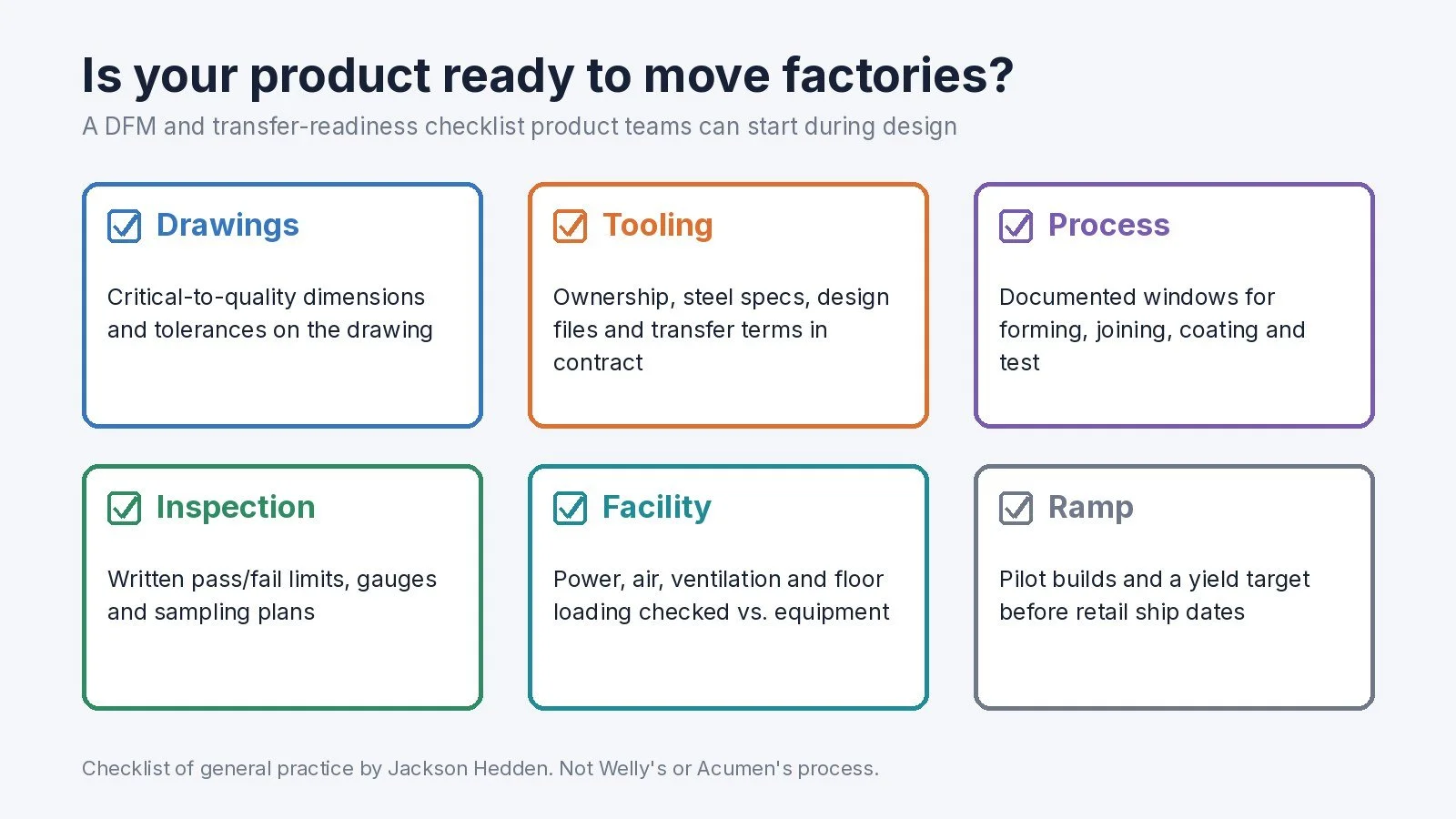
A DFM and transfer-readiness checklist teams can start during design. General practice by Jackson Hedden; not Welly’s or Acumen’s process.
What this means for product teams
Whether you plan to reshore, nearshore or simply qualify a second factory, these practices help:
- Write the process down while you design. Capture critical-to-quality dimensions, weld or bond requirements, and test limits in the drawing package, not only in a supplier's files.
- Own your tooling and its design intent. Contracts should cover tooling ownership, steel specifications, drawings and transfer terms.
- Design for the processes available where you will build. A part that is easy to form in a mature cluster may need different tolerances or a different process elsewhere.
- Budget for knowledge transfer. Plan for supplier engineers on site, interpreters, translated work instructions and training time.
- Check utilities before signing a lease. Confirm power, air, ventilation and floor loading against real equipment specifications.
- Plan a validation runway. Schedule pilot builds and a yield ramp before promising retail ship dates.
Our post on Section 301 tariff exclusions looks at how sourcing and tariff exposure shape design decisions, and our analysis of LightMake's trial production run shows what pilot builds catch before launch.
If you are weighing a domestic or second-source production plan and want help with design for manufacturing, tooling packages and supplier handoff, see how we approach manufacturing or contact our team to talk through your project.
Frequently asked questions
What is Welly doing in Pittsburgh? Welly is setting up its own production line for vacuum-insulated stainless steel bottles and tumblers in Leetsdale, Pennsylvania. Bloomberg reported on November 16, 2026, that Chinese engineers helped install the machines and train U.S. technicians.
Why is reshoring consumer product manufacturing so hard? Equipment, tariffs, power and permits are only part of it. The harder part is moving process knowledge, such as machine settings, tooling know-how and inspection limits, that took years to build at the original factory.
How does DFM help with reshoring? DFM keeps a product's critical dimensions, materials and processes explicit and documented. That makes it easier to qualify a new factory or region without re-learning everything through scrap and delays.
Who should own production tooling? In most cases, the brand should own its tooling and have the drawings and transfer rights in the contract. Without them, moving production can mean rebuilding tools from scratch.
Jackson Hedden is a product design, development and manufacturing firm helping founders and product teams take consumer and industrial products from concept to production.
Sources
- Shawn Donnan, "To Make in America, Start by Importing a Factory From China," Bloomberg News via Bloomberg Law, November 16, 2026: https://news.bloomberglaw.com/immigration/to-make-in-america-start-by-importing-a-factory-from-china
- Headliner, "Welly-oprichter Ben Kander wil productie van geïsoleerde flessen terugbrengen naar Pittsburgh" (Dutch summary of the Bloomberg report), November 16, 2026: https://www.headliner.nl/artikelen/welly-oprichter-ben-kander-wil-productie-geisoleerde-flessen-terugbrengen-pittsburgh-256268
- Phoenix New Media (ifeng.com), Chinese-language summary of the Bloomberg report on Welly, November 16, 2026: http://original.ifeng.com/c/8y6iyufTOe1
- Welly USA, homepage, accessed November 17, 2026: https://www.wellyusa.com/
- Tennessee Department of Economic and Community Development, "Acumen to Establish First U.S. Manufacturing Location in Sumner County," November 12, 2026: https://tnecd.com/news/acumen-to-establish-first-u-s-manufacturing-location-in-sumner-county/