On November 10, 2026, Palo Alto startup Mondo Robotics made its first product, the Beni camera robot, available to buy at $799, roughly two months after a Kickstarter campaign that raised just over $5 million closed.
Key takeaways
- Beni's Kickstarter campaign ran from July 8 to September 6, 2026 and drew $5,003,232 from 7,926 backers against a $50,000 goal; PetaPixel reports Mondo shipped more than 5,000 robots to backers in October.
- Moving from backer units to open retail is a different manufacturing problem: steady yield, repeatable testing, multi-region compliance and spare parts, not just a first build.
- A robot that jumps 10 inches and rights itself after falling turns drop, impact and fatigue testing into core design requirements rather than late checks.
- Accessories such as extra batteries, off-road wheels and protection plates are a product-architecture decision that has to be designed in early, not bolted on after launch.
- For founders, the lesson is to plan design for manufacturing (DFM) before the campaign, because the campaign sets a delivery promise the factory has to keep.
What Mondo Robotics announced
According to Mondo's November 10 press release, Beni is a portable, wheeled camera robot that follows a user, avoids most obstacles and records video without a camera operator. The company lists these headline capabilities:
- Auto-tracking with a motion tracker and wristband, plus obstacle avoidance.
- Jumps of up to 10 inches, which Mondo says lets it climb stairs, and a top speed of 17.9 mph.
- A self-recovery system that lets the robot pick itself back up after it topples over.
- Setup in under five minutes, 32 GB of internal storage plus a microSD slot, and filming and tracking processed entirely on the robot.
Beni ships to North America, the EU, the UK, Australia, New Zealand and China. The Standard Combo costs $799 (€799, £699) and includes the robot, motion tracker and wristband, a hat, a chest protection plate and one battery. The Explore Combo costs $959 and adds two more batteries, off-road wheels and a charging hub. PetaPixel reports 4K video at up to 60 frames per second and a vertical 3K mode for social video, and Talk Android notes the company was founded in 2025 and Beni is its first product.
Why crowdfunding-to-retail is a manufacturing story
A crowdfunding campaign proves demand. It does not prove that a product can be built repeatably, at cost, in the thousands. Those are separate milestones, and many hardware startups have learned the difference the hard way when delivery dates slipped after a successful campaign.
Mondo's reported timeline, a campaign closing in early September, backer shipments in October and public sales on November 10, compresses several stages that usually take longer. We don't know how much of Beni's engineering and tooling was finished before the campaign launched, and the company hasn't published that. What the timeline does show is the shape of the problem every founder in this position faces.
It helps to define the stages. In consumer hardware, EVT (engineering validation test) checks that the design works, DVT (design validation test) checks that production-intent parts made from real tooling pass reliability and compliance testing, and PVT (production validation test) checks that the factory line can build the product at rate with acceptable yield. Tooling means the steel molds and fixtures used to make parts in volume, and it is usually the largest up-front manufacturing cost.
A backer run is often the first real test of PVT. Open retail is the test of whether the line keeps working after the launch team moves on: whether yield stays stable, whether returns reveal a weak part, and whether replacement batteries and wheels are in stock when customers want them.
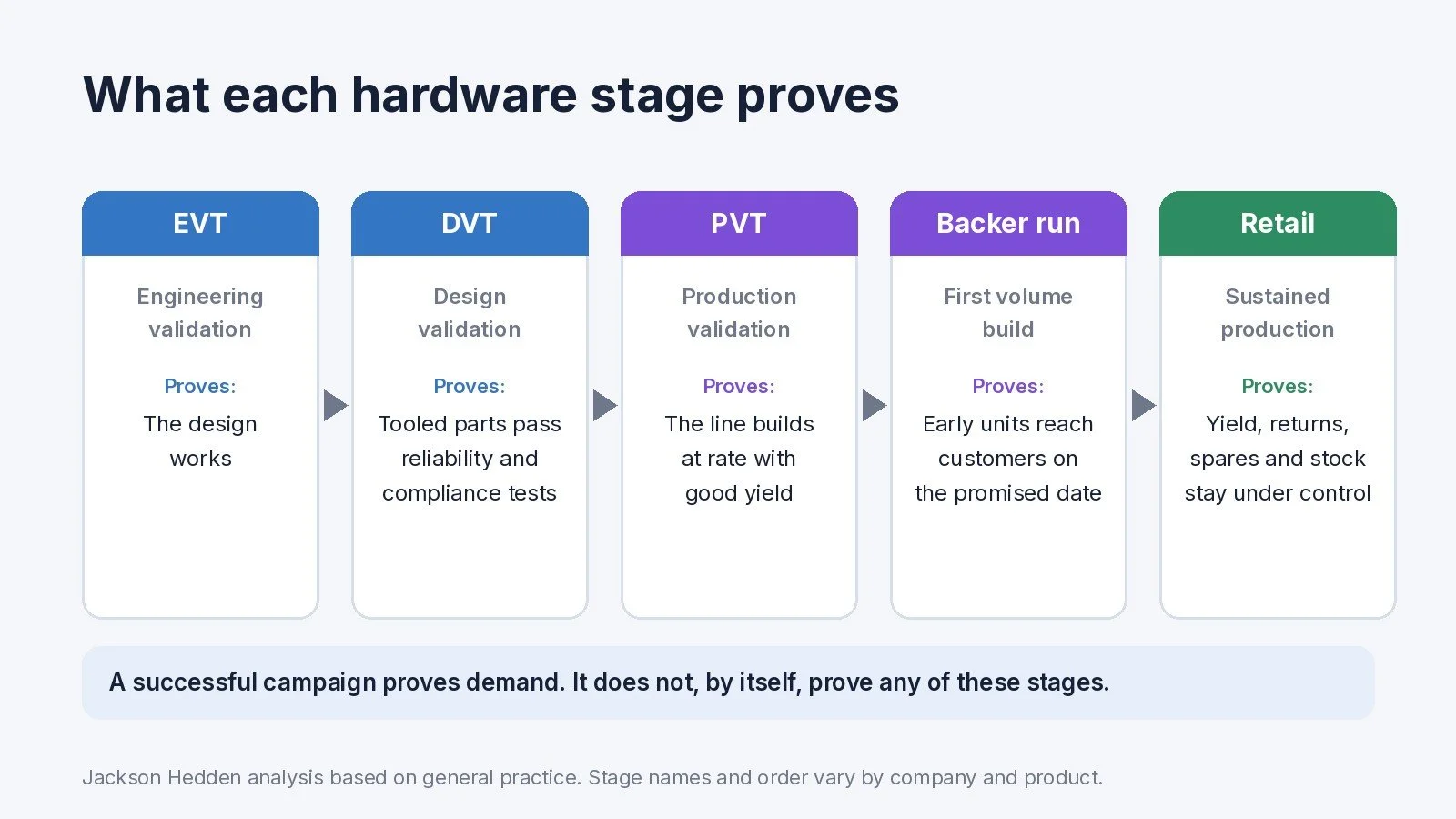
Jackson Hedden analysis of what each hardware stage proves, based on general practice. A successful campaign proves demand, not these stages.
What this means for product teams
This section is Jackson Hedden analysis based on general product development practice, not a description of Mondo's internal process.
Do design for manufacturing before the campaign, not after it. A campaign page sets a price, a feature list and a delivery month in public. If the design has not been through a design for manufacturing review by then, the team is negotiating against its own promise. Lock the architecture, the main materials and the parts that need steel tooling before quoting backers a date.
Treat dramatic features as test plans. A robot that jumps 10 inches and rights itself will land hard thousands of times. That makes impact on wheels, axles, motor mounts, battery retention and camera glass a design requirement. Teams should write drop, tumble and cycle tests early, run them on DVT parts made from production tooling, and design wear parts (such as wheels or protective plates) to be replaceable.
Design the accessory system as part of the product. Beni's Explore Combo adds batteries, off-road wheels and a charging hub. Extra batteries and add-on wheels need defined interfaces, retention features that survive repeated use and impact, and tolerances that work across tool changes. Deciding this early also simplifies packaging and inventory, because each combo is a different box to forecast and build.
Plan certification and shipping by market. Selling into North America, the EU, the UK, Australia, New Zealand and China means radio, electrical safety and battery transport requirements for each region. Lithium battery shipments, for example, generally need UN 38.3 transport testing. These tests take lab time and can force design changes, so they belong on the schedule before tooling is final.
Keep the out-of-box promise honest. A claim like setup in under five minutes is a design target that touches packaging, charging state on arrival, pairing and the first-run app flow. It is worth testing with people who have never seen the product.
Plan for the second build, not just the first. After backer units ship, the factory has to keep yields up, manage component substitutions and handle returns. Tariff and sourcing changes can also move costs mid-run, which we discussed in our post on what the Section 301 exclusion extension means for sourcing.
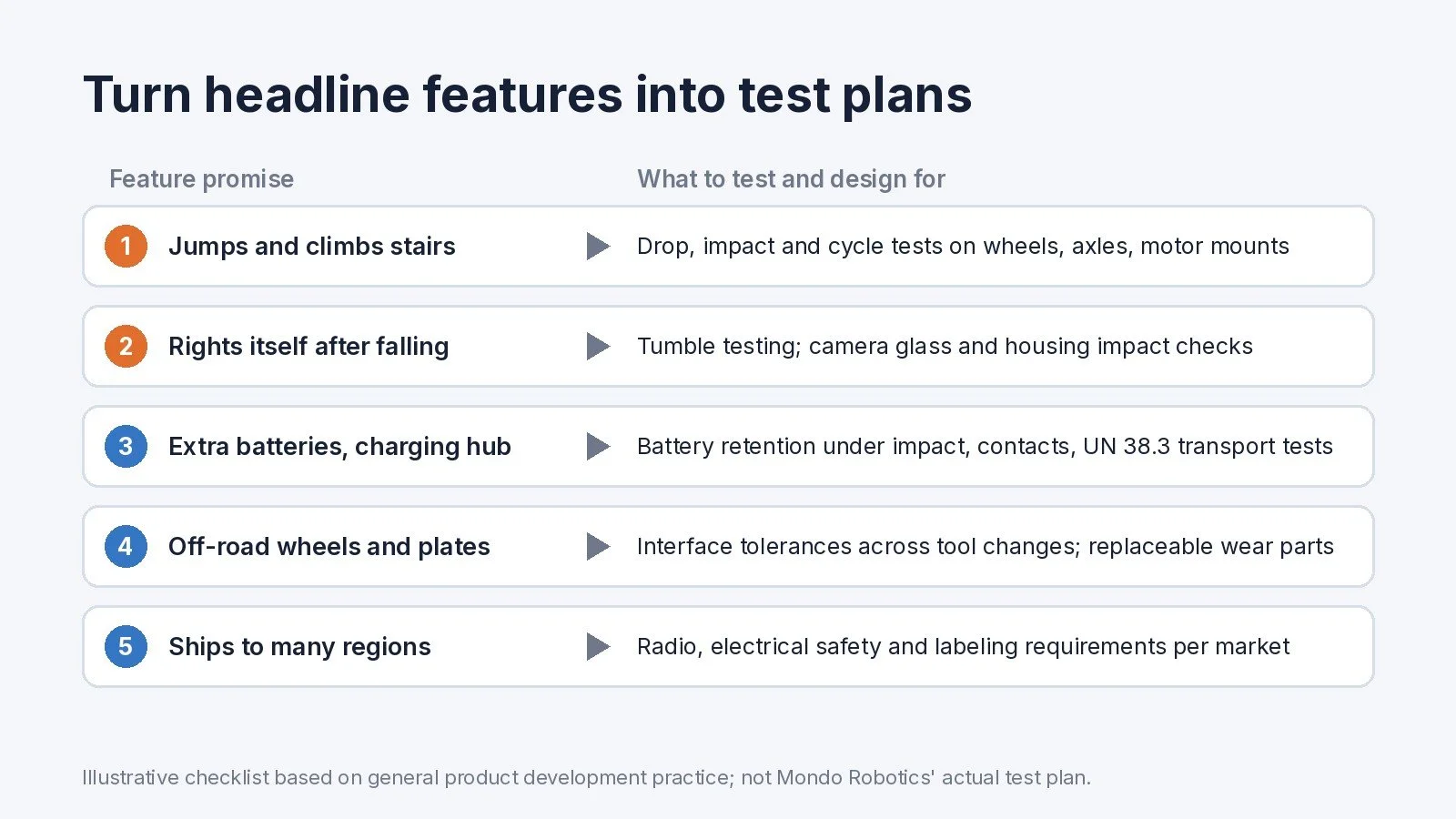
Illustrative checklist based on general product development practice. It is not Mondo Robotics' actual test plan.
Where prototypes fit before the campaign
The prototypes shown in a campaign video answer different questions from the units that ship. Looks-like and works-like prototypes, often 3D printed, prove the concept and help sell it. They do not prove molded-part strength, battery safety or yield. Our recent article on what large-format 3D printers mean for prototypes and production aids covers where printed parts stop being representative. Founders should be clear with themselves, and with backers, about which stage the product is really in.
Frequently asked questions
How long does it take to go from Kickstarter to shipping a hardware product? It varies widely with how finished the design is when the campaign starts. If tooling and validation are already underway, shipping can follow within months; if the campaign funds the engineering, a year or more is common. PetaPixel reports Mondo shipped more than 5,000 backer units in October, the month after its campaign closed.
What is design for manufacturing (DFM)? DFM is the practice of shaping a product's parts, materials and assembly so it can be made reliably and at the target cost in the chosen process, such as injection molding. It is most valuable before tooling is ordered, when changes are still cheap.
What testing does a consumer robot need before launch? Typically functional, drop and impact, cycle and wear, thermal and battery safety testing, plus regulatory testing for radio emissions and electrical safety in each market. Products that move fast or fall over, like a jumping robot, need especially thorough impact and fatigue testing.
Should a hardware startup crowdfund before or after tooling? Many teams crowdfund after the design is stable and DFM is done, using campaign funds to pay for tooling. Launching earlier can validate demand, but it increases the risk of missed delivery dates and design changes after backers have paid.
Getting a product ready for production
If you are preparing a consumer product for a campaign or retail launch and want help with DFM reviews, tooling and supplier selection, our manufacturing and sourcing team can help. You can also contact Jackson Hedden to talk through your production plan.
Jackson Hedden is a product design, development and manufacturing firm helping founders and product teams take consumer and industrial products from concept to production.
Sources
- Mondo Robotics, "Mondo Robotics' Debut Robot, Beni, Available for Consumers," November 10, 2026: mondorobotics.com
- Kickstarter, "Meet Beni, Your First All-Terrain Camera Robot" campaign page (funding period July 8 to September 6, 2026): kickstarter.com
- PetaPixel, "You Can Now Buy Beni the Jumping Robot Cameraman for $799," November 10, 2026: petapixel.com
- Talk Android, "Mondo's $799 Beni Robot Is on Sale and Ready To Chase You in 4K," November 11, 2026: talkandroid.com
Jackson Hedden is not affiliated with Mondo Robotics. Product details, prices and shipment figures are as reported by the sources above.