On November 10, 2026, 3D printer maker Raise3D announced a US$15 million funding round and two large-format printers, the T450 and T700, aimed at prototyping, tooling and low-volume production.
Key takeaways
- Raise3D's new T450 ($4,999) and T700 ($15,999) printers have build volumes of 450 x 350 x 400 mm and 700 x 500 x 1,000 mm, large enough to print many housings, fixtures and patterns in one piece.
- The company cites battery maker CATL, which it says cut production time for 3D printed cell-transport trays from about 40 days to 10 and tray weight from about 8 kg to 2 kg.
- For product teams, larger desktop-class printers mainly change the speed of early prototypes and of production aids such as jigs and fixtures, not the need for production-intent processes like injection molding.
- A one-piece print avoids seams and glue joints, but it still behaves differently from a molded part, so teams should be clear about which questions each prototype is meant to answer.
What Raise3D announced
According to Raise3D's November 10 announcement, both new printers use fused filament fabrication (FFF), the common 3D printing process that builds parts by extruding melted plastic filament layer by layer. The reported details include:
- T450: 450 x 350 x 400 mm build volume (63 liters), a chamber actively heated to 70°C and a standard 0.4 mm nozzle, priced at US$4,999. Raise3D positions it for jigs and fixtures, casting patterns, large prototypes and production aids.
- T700: 700 x 500 x 1,000 mm build volume (350 liters), a chamber heated to 60°C and a 0.6 mm nozzle, priced at US$15,999, aimed at large tooling and patterns.
- Nozzle temperatures up to 420°C, a 120°C build plate and a wear-resistant silicon carbide nozzle tip, with supported materials including ABS, ASA, TPU and carbon-fiber-filled polymers such as PET CF, PPA CF and PPS CF.
Raise3D also announced a taller build height for its RMS220 selective laser sintering (SLS) printer, which fuses nylon powder with a laser. The company says the funding will support product development and new applications, and it will show the printers at Formnext 2026 in Frankfurt from November 17 to 20. Trade coverage from 3DPrinting.com reported the same specifications and prices.
Why build volume matters in product development
Raise3D's announcement makes a practical point: when a part is bigger than the printer, it has to be split, printed in sections, then aligned, bonded and finished, which adds labor and can introduce assembly error. Seams can hide fit issues, add stiffness that won't exist in production and take hours of sanding before a model is ready for users or investors.
A larger build volume does not make a print more accurate, but it removes one common source of error and delay. That matters most for products where size itself is a design question: countertop appliances, outdoor equipment, furniture components, power tools and many industrial enclosures.
Where large prints fit in a product development workflow
The points below are Jackson Hedden's analysis based on general product development practice, not claims Raise3D has made about specific customer programs.
Hardware programs usually move through stages. Early concept and "looks-like" models test size, proportion and ergonomics. "Works-like" prototypes test mechanisms and electronics. Then come engineering validation testing (EVT), which checks that the engineering design meets requirements; design validation testing (DVT), which tests production-intent parts against reliability and compliance requirements; and production validation testing (PVT), which proves the factory process at volume.
Large-format printing earns its keep at different points along that path:
Concept and ergonomics. Full-scale, one-piece models of a large product let teams judge proportion, reach, grip and footprint in a real room rather than on a screen. Speed and size matter more than surface finish here.
Works-like rigs. Big printed frames can hold motors, batteries and boards in position while the enclosure is still changing.
Test fixtures during EVT and DVT. Drop-test cradles, fatigue test arms, environmental chamber trays and cable-routing guides are often large, one-off and needed quickly. Printing them in fiber-filled materials can be faster than waiting for machined parts.
Production aids. Jigs (which guide a tool or operation) and fixtures (which hold a part in place) for assembly, inspection and packing are exactly the high-mix, low-volume parts Raise3D highlights in its CATL example. Lighter fixtures are also easier for line workers to handle.

Jackson Hedden analysis of where large-format prints typically fit across prototype and validation stages, based on general practice.
What a large FFF print can and can't tell you
FFF parts are built in layers, so they are typically weaker between layers than within them, and their surface shows layer lines. Wall thickness, ribs and bosses that print well may not mold well, and the reverse is also true. Large prints also take a long time, which Raise3D acknowledges by listing monitoring and power-loss recovery features.
That means a large printed housing is excellent for checking size, assembly sequence and internal packaging, but it is not a stand-in for an injection-molded part when testing snap fits, drop performance, cosmetic finish or tolerance stack-ups. For those questions, teams usually move to processes closer to production, such as SLS nylon, urethane casting from silicone molds, CNC machining or soft tooling.
Tooling, in this context, means the molds, dies and fixtures used to make production parts. It is usually one of the largest upfront costs in a hardware program. Design for manufacturing (DFM) is the practice of shaping parts so they can be produced reliably and economically with the chosen process. A printer that makes big parts easily can quietly encourage designs that would be expensive or impossible to mold, so DFM reviews should happen before a printed prototype hardens into "the design."
What this means for product teams
If you are planning a physical product, especially a large one, a few practical lessons apply:
- Name the question before you print. Decide whether a prototype is answering a size, ergonomics, mechanism, test-fixture or manufacturing question, and choose the process to match.
- Use one-piece prints to remove false signals. Fewer glue joints mean fit and stiffness problems you see are more likely to be real.
- Budget for fixtures, not just parts. Test cradles, assembly jigs and inspection fixtures are often on the critical path during EVT and DVT. Printing them in-house or through a partner can shorten waits.
- Keep DFM in the loop. Review draft angles, wall thickness, parting lines and assembly direction with the production process in mind, even while prototypes are printed.
- Plan the handoff to tooling. Use printed parts to settle architecture early, then move to production-representative prototypes before committing to steel molds.
Our earlier look at AI-designed electronics prototypes covers why fast prototypes still need real-world validation, and our article on Section 301 tariff exclusions explains how sourcing and timing decisions interact with the EVT, DVT and PVT schedule.
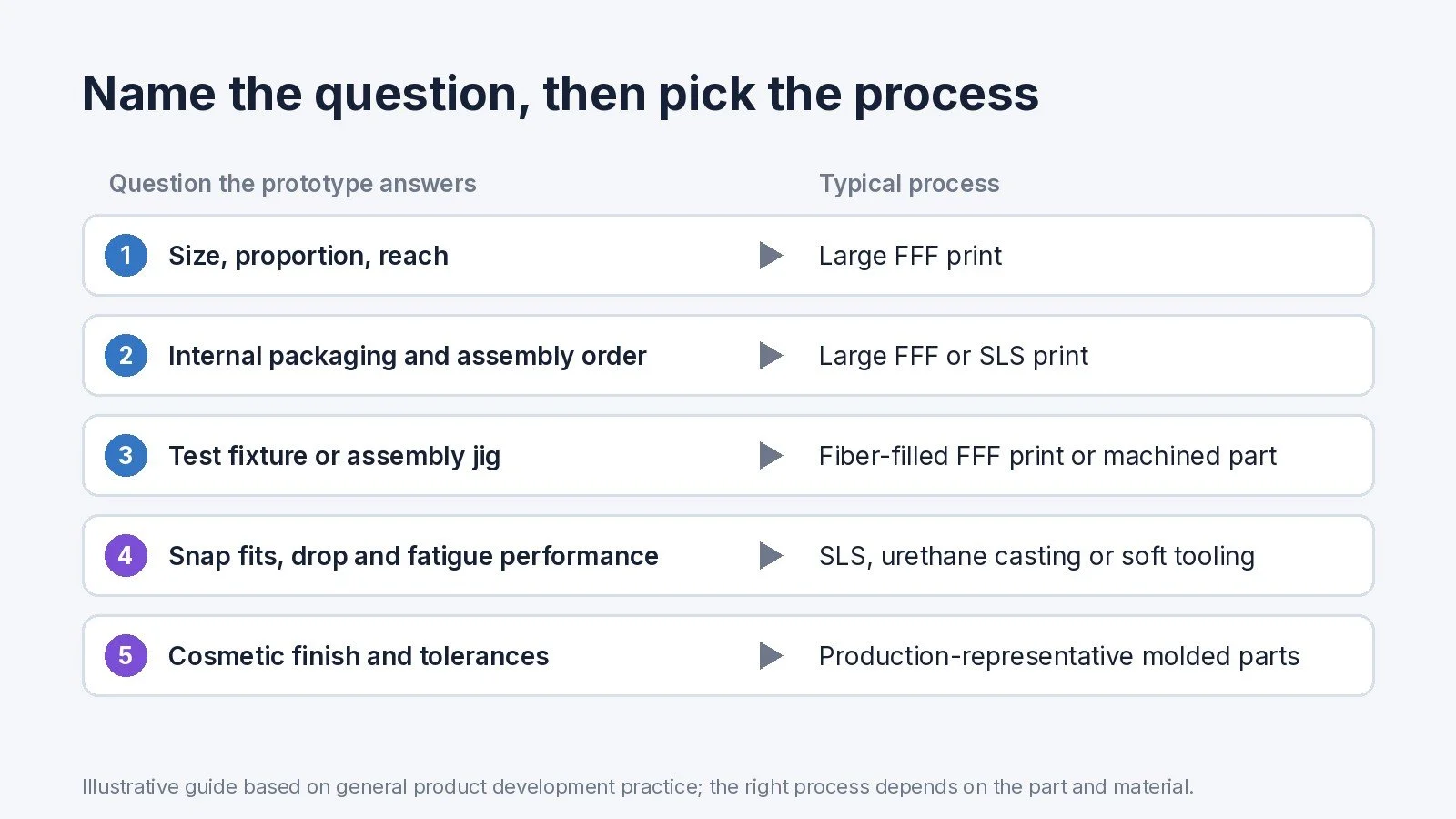
Illustrative guide to matching each prototype question with a process, based on general product development practice. The right choice depends on the part and material.
Frequently asked questions
What is large-format 3D printing? It generally refers to printers with build volumes big enough to make parts roughly half a meter or more in one piece. Raise3D's new T700, for example, can print parts up to 700 x 500 x 1,000 mm using fused filament fabrication.
Can a 3D printed prototype replace an injection-molded part for testing? For size, layout and ergonomics, often yes. For strength, snap fits, drop testing, cosmetics and tolerances, usually not, because layered FFF parts behave differently from molded ones. Teams typically move to production-representative processes before DVT.
What are jigs and fixtures in manufacturing? Jigs guide a tool or operation, and fixtures hold a part in a fixed position during assembly, machining, testing or inspection. They are often custom, low-volume parts, which makes them a strong use case for 3D printing.
When should a product team move from 3D printed prototypes to tooling? Usually once the architecture, key dimensions and critical features are stable and the design has passed a DFM review for the production process. Committing to tooling too early makes later changes expensive, while waiting too long delays EVT and DVT.
Prototyping larger products
If you are developing a consumer or industrial product and need help planning prototypes, test fixtures or the move to production tooling, our prototyping services and manufacturing team can help. You can also contact Jackson Hedden to talk through your product.
Jackson Hedden is a product design, development and manufacturing firm helping founders and product teams take consumer and industrial products from concept to production.
Sources
- Raise3D, "Raise3D Secures $15 Million C2+ Funding Round and Introduces T450 and T700 Large-Format 3D Printers," November 10, 2026: raise3d.com
- 3DPrinting.com, "Raise3D Closes $15 Million Round and Introduces T450 and T700 Large-Format 3D Printers," November 10, 2026: 3dprinting.com
- Formnext 2026 trade show, Frankfurt, November 17-20, 2026: formnext.mesago.com
Jackson Hedden is not affiliated with Raise3D or CATL. Product details and the CATL figures are as reported by the sources above.