On November 12, 2026, Appliance Retailer reported that Cuisinart has launched its ClearView air fryer range in Australia, pairing glass cooking vessels and viewing windows with PFAS-free ceramic-coated surfaces, three days after US brand Magnifique launched a glass air fryer and multi-cooker combo.
Key takeaways
- Two glass air fryer launches in one week show that the material food touches has become a headline feature in countertop appliances, not a spec-sheet footnote.
- Cuisinart's own marketing lead says shoppers "are now looking beyond size and speed to the materials their food is cooked in."
- Several US states now restrict cookware with intentionally added PFAS: Minnesota since January 1, 2025, Colorado since January 1, 2026, and Connecticut with a full ban due January 1, 2028.
- Swapping a nonstick coating for glass or ceramic is not a drop-in change. It affects heat transfer, weight, drop risk, cleaning, cost and the test plan.
- For consumer product design firms and in-house teams, the practical move is a material audit of every food-contact surface, then a test plan that proves the new material survives real kitchens.
Glass air fryers and PFAS-free coatings: what consumer product design firms are weighing
The news itself is simple. What makes it worth a product team's attention is that two brands at very different price points reached for the same answer in the same week: let people see the food, and make the materials that touch it part of the pitch.
What Cuisinart launched
According to Appliance Retailer and Cuisinart's own ClearView 3.8L product page, the range has two models:
- ClearView 3.8L Glass Air Fryer (A$199). Food cooks in a removable glass bowl with a ceramic-coated crisper plate. The bowl doubles as a serving and storage dish, with a BPA-free storage lid. It has six functions, including Air Fry, Roast, Grill, Bake, Keep Warm and Recrisp.
- ClearView 9-in-1 8.5L Air Fryer (A$229). A larger drawer model with a PFAS-free ceramic-coated basket and crisper plate, plus Max Crisp and Dehydrate modes.
Both models are rated at 1,800 W, reach 230°C, adjust in 5°C steps, include viewing windows and an interior light, use dishwasher-safe parts and carry a three-year warranty. Cuisinart head of marketing Laura Conlon told Appliance Retailer that "shoppers are now looking beyond size and speed to the materials their food is cooked in."
What Magnifique launched
T3 reported on November 9, 2026 that California brand Magnifique launched the Combo 12-in-1 Air Fryer and Multi-Cooker at $249.99. An "AirCrisper" heating and control unit attaches to the top of a 4.5-quart glass pot for air frying. The same pot sits on a separate multi-cooker base for slow cooking, steaming, rice and other modes. T3 describes the materials as glass and stainless steel with no coatings, and notes that Cuisinart, Dreame and Salter have also released glass air fryers since Ninja's glass Crispi model arrived about a year earlier.
The regulatory backdrop
These launches land in a market where coating chemistry is no longer only a marketing choice. PFAS (per- and polyfluoroalkyl substances) are a large family of fluorinated chemicals, and PTFE, the material behind many traditional nonstick coatings, is a fluoropolymer that many state laws count within that family.
- Minnesota has prohibited cookware with intentionally added PFAS since January 1, 2025, under Amara's Law, according to the Minnesota Pollution Control Agency. The agency notes temporary exemptions for internal and electronic components that end in 2032.
- Colorado added a sales ban on cookware with intentionally added PFAS on January 1, 2026, as summarized by Morgan Lewis.
- Connecticut has required labeling and prior notification for PFAS-containing cookware since July 1, 2026, with an outright ban from January 1, 2028, per the state's Department of Energy and Environmental Protection.
Whether a given appliance part counts as "cookware" under each law is a legal question for counsel, not a design guess. The direction of travel, though, is clear enough to plan around.
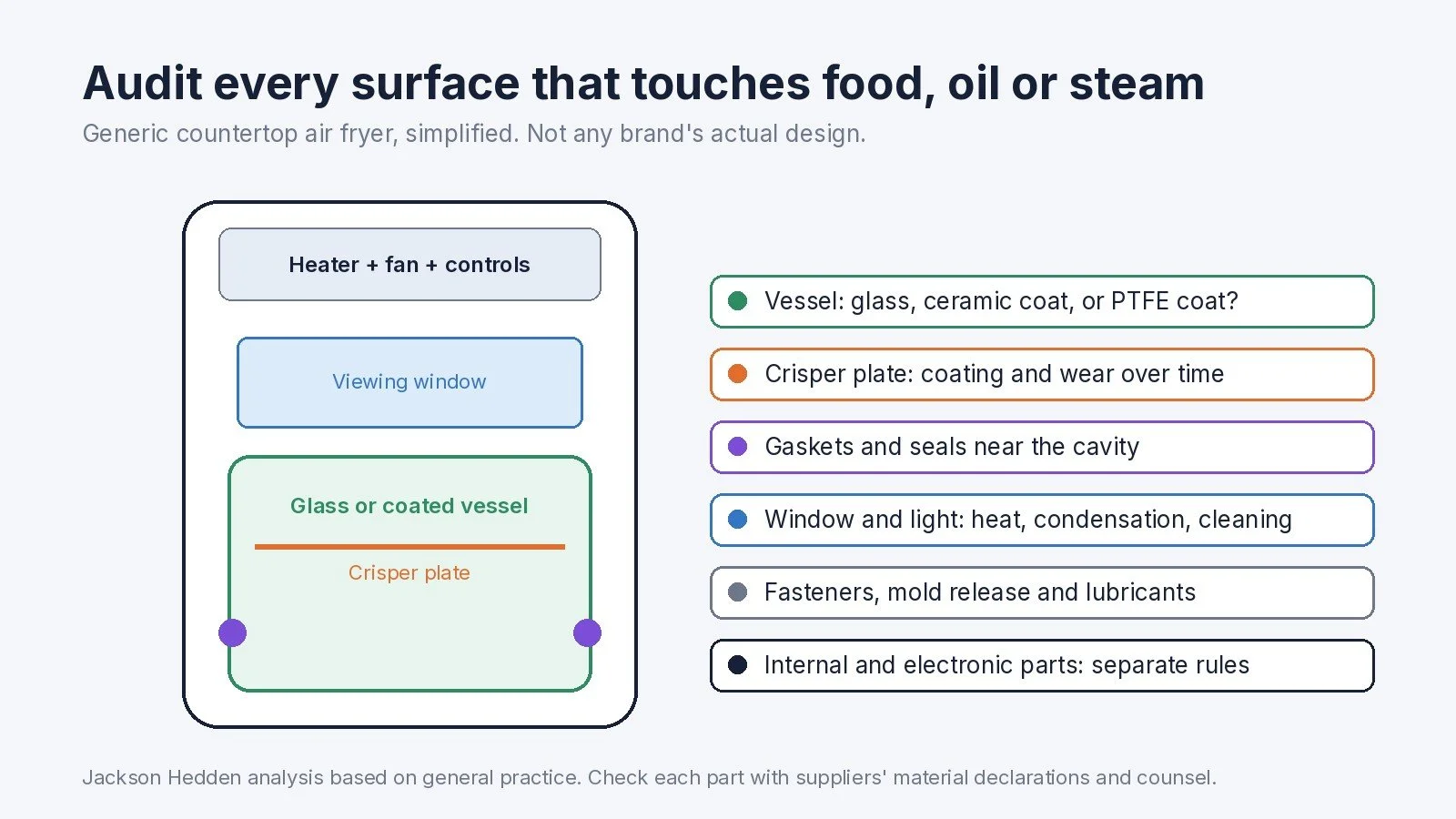
Generic, simplified air fryer used to illustrate a food-contact material audit. Jackson Hedden analysis; not any brand’s actual design.
What this means for product teams
The rest of this article is Jackson Hedden analysis, based on general product development practice rather than any brand's internal process.
Start with a food-contact material audit
Before anyone redesigns a basket, list every surface that touches food, oil or steam: the vessel, the crisper plate, gaskets, the lid, fasteners inside the cavity and any sensor probe. Then list what touches those parts during manufacturing, such as mold release agents and lubricants. Many teams find that "PFAS-free" claims fail on a small part nobody reviewed, not on the main coating. Ask each supplier for a written materials declaration, and keep it with the bill of materials so it survives supplier changes.
Glass changes the whole architecture, not just the bowl
A glass vessel is heavier than an aluminum basket, holds heat longer and behaves very differently when dropped or rinsed hot. That pushes decisions upstream:
- Thermal shock. Glass that goes from a 230°C cavity to a cold sink can crack. Teams typically specify heat-resistant glass grades and test hot-to-cold cycles that mimic real use, not just steady-state heat.
- Heat transfer and airflow. Glass and ceramic do not conduct heat like coated aluminum. Fan speed, element placement and preset times may all need retuning, and crisping performance should be measured, not assumed.
- Handling and retention. A heavier, hotter, more fragile vessel needs handles, latches and a seat in the base that hold it securely and keep fingers away from hot edges.
- Visibility as a design feature. Windows and interior lights only help if the user can actually see the food from a normal countertop angle, which affects window size, light placement and condensation control.
Magnifique's approach, where a top-mounted heating unit moves between the glass pot and a separate base, is a reminder that material choices can reshape the product's whole system architecture, including what the user plugs in, stores and cleans.
Ceramic coatings need their own validation plan
Ceramic nonstick coatings are a common PFAS-free alternative, but they are a different material with different failure modes. Plan tests for release performance over many cycles, dishwasher exposure, scratching from utensils and high-heat use, and decide early what the warranty promises. A three-year warranty, like Cuisinart's, is only sustainable if the coating's wear has been characterized before launch.
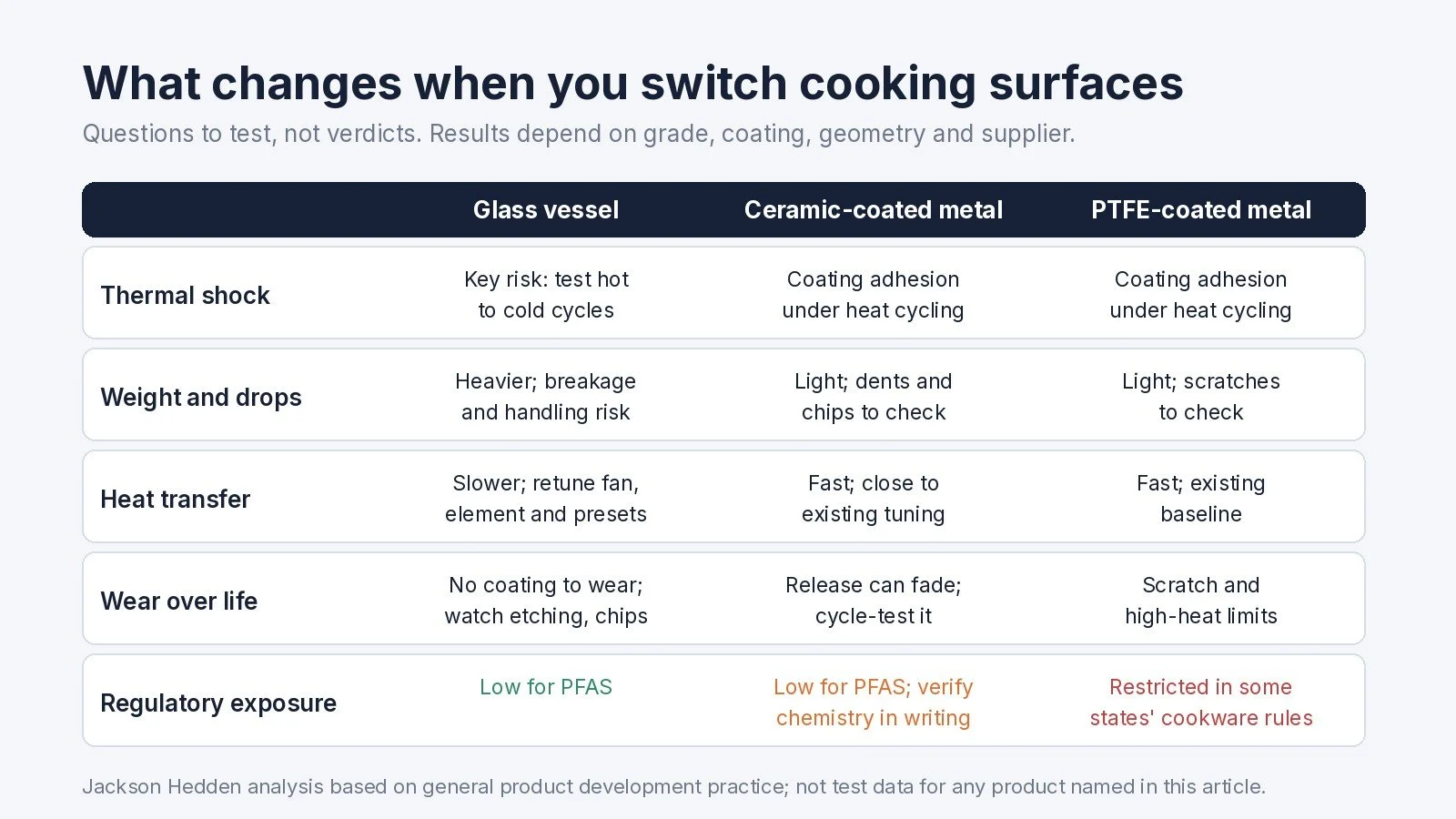
Questions to test when switching cooking surfaces, based on general practice. Not test data for any product named in this article.
Design for manufacturing still decides the margin
DFM (design for manufacturing) means shaping parts so they can be made reliably and affordably at volume. Glass vessels are typically pressed or blown and then annealed, which brings different tolerances, minimum wall thicknesses and supplier pools than stamped, coated aluminum. Tooling, the molds and dies that form production parts, is expensive to change, so lock the vessel geometry only after thermal and drop testing. Teams sourcing glass and ceramic-coated parts for the first time should build extra time for supplier qualification and sampling into the schedule, because a new material usually means a new supplier base.
Make claims you can prove
"Non-toxic" and "PFAS-free" are claims that retailers, regulators and reviewers can check. Tie every material claim to documentation and, where needed, third-party testing, and keep the wording precise. "PFAS-free ceramic-coated crisper plate" is a defensible statement. A vague "chemical-free" is not.
For brands planning a countertop appliance, the lesson from this week is that experienced consumer product design firms now treat materials as a core part of industrial design, user experience and compliance at the same time. Earlier program articles on Vitamix's first cordless blender and EU repairability rules show the same pattern: in kitchen products, small material and architecture choices drive cost, durability and trust.
Frequently asked questions
Why are glass air fryers suddenly popular? Glass lets people watch food cook without opening the drawer, and it avoids nonstick coatings on the main cooking vessel. Cuisinart and Magnifique both launched glass models in November 2026, and T3 notes that other brands, including Dreame and Salter, have followed Ninja's glass Crispi.
Is PTFE nonstick banned in cookware in the US? There is no nationwide ban, but several states restrict cookware with intentionally added PFAS, a category that state laws commonly treat as including PTFE. Minnesota's ban took effect January 1, 2025, Colorado's on January 1, 2026, and Connecticut's full ban is due January 1, 2028. Whether a specific appliance part is covered should be checked with regulatory counsel.
What should a product team test when switching to glass or ceramic surfaces? At minimum, test thermal shock from hot cavity to cold water, drop and handling risk, cooking performance with the new heat-transfer behavior, and coating wear over repeated cooking and dishwasher cycles. Results should feed the warranty terms and the marketing claims.
When should a brand bring in a consumer product design firm for a material change? Ideally before the vessel geometry and tooling are locked. A material change touches industrial design, thermal engineering, sourcing and compliance at once, so an outside team is most useful while those trade-offs are still cheap to change.
If you are planning a countertop appliance or rethinking the materials in an existing one, see our consumer product design services or contact our team to talk through the trade-offs.
Jackson Hedden is a product design, development and manufacturing firm helping founders and product teams take consumer and industrial products from concept to production.
Sources
- Appliance Retailer, "Cuisinart launches two new glass air fryers," November 12, 2026: https://www.applianceretailer.com.au/cuisinart-launches-two-new-glass-air-fryers/
- Cuisinart Australia, ClearView 3.8L Glass Air Fryer product page: https://www.cuisinart.com.au/cuisinart-clearview-3.8l-glass-air-fryer/AFC-4XA.html
- Cuisinart Australia, "Which ClearView air fryer is right for you?": https://www.cuisinart.com.au/Blog-which-ClearView-air-fryer-is-right-for-you.html
- T3, "This air fryer takes on the Ninja Crispi with its glass, non-toxic design," November 9, 2026: https://www.t3.com/home-living/air-fryers/this-air-fryer-takes-on-the-ninja-crispi-with-its-glass-non-toxic-design-and-it-adds-on-a-multi-cooker
- Minnesota Pollution Control Agency, "PFAS use prohibitions and reporting": https://www.pca.state.mn.us/air-water-land-climate/pfas-use-prohibitions-and-reporting
- Morgan Lewis, "State Regulation of PFAS in Consumer Products Continues to Gain Momentum in 2026," January 2026: https://www.morganlewis.com/pubs/2026/01/state-regulation-of-pfas-in-consumer-products-continues-to-gain-momentum-in-2026
- Connecticut DEEP, "PFAS in Products": https://portal.ct.gov/deep/p2/pfas-in-products