On November 16, 2026, Nike unveiled Tuned Air, a new way of making its Air cushioning units with a proprietary digital print and selective lamination process, and said the method has cut prototype time for new Air units from three weeks to three days, with the first running shoe due in late 2027.
Key takeaways
- Nike's Tuned Air is a manufacturing innovation first: the inside shape of each Air unit is set by where a special ink is printed, not by a dedicated mold shape.
- Nike reports that average development time for new Air units at its Advanced Product Creation Center has dropped by 70 percent, with prototypes that took three weeks now made in three days.
- When a design change becomes a file edit instead of a tooling change, a team can run many more build-and-test cycles in the same calendar time.
- Faster builds only pay off if testing and decisions keep pace. Nike paired its new units with athlete wear testing before announcing them.
- Most product teams will never own a proprietary process like this, but they can find and remove the slowest step in their own prototype loop.
What Nike's Tuned Air shows about prototype development
Prototype development is the cycle of building, testing and refining physical versions of a product before production. Nike's news is not a new shoe but a new way to make a component, and its headline claim is about iteration speed. Below we separate what was reported from our analysis.
What was reported
The platform. In its Tuned Air press release, Nike says the units are made with "a proprietary digital print and selective lamination process." Everywhere a proprietary ink is printed on the unit's internal core, the core will not bond to the unit; everywhere there is no ink, it bonds. Nike says this removes the need for the pins and rigid zones that traditionally give Air units their shape, and that engineers are "no longer constrained mechanically by the height of the Air unit."
The process. A Nike feature on how Tuned Air was made describes five machines at the company's Advanced Product Creation Center in Beaverton, Oregon, including a digital printer so large engineers call it "the bus," and a specialty ink that took 10 years to develop. The TPU (thermoplastic polyurethane, a tough, flexible plastic) is heated, stretched and clamped into the unit's shape, cooled, then filled.
The speed claim. Nike says the average development time for new Air units has dropped by 70 percent and that prototypes that once took three weeks can now be made in three days. "We can move from athlete insight to new Air solutions faster, create them with greater precision for different sports, and deliver that experience more consistently across sizes," Phil McCartney, Nike's chief innovation, design and product officer, said in the release.
The testing. The same feature describes marathoner Charles Hicks wear-testing a covered Nike prototype at Hayward Field in Eugene, Oregon, before seeing the Tuned Air unit inside.
The timeline. Nike says Tuned Air will be available for runners in late 2027. In an interview with Dezeen, McCartney said the shoe is still in development and the concept renders are "pretty representative" but "not the final design." He added that the process "creates this canvas for all the design explorations that we've always wanted to do, but the limitations of the manufacturing process didn't allow." Dezeen describes the units as 3D printed; Nike's own materials describe digital printing and lamination.
Tuned Air was one of several reveals at Nike's World of Athletes showcase.
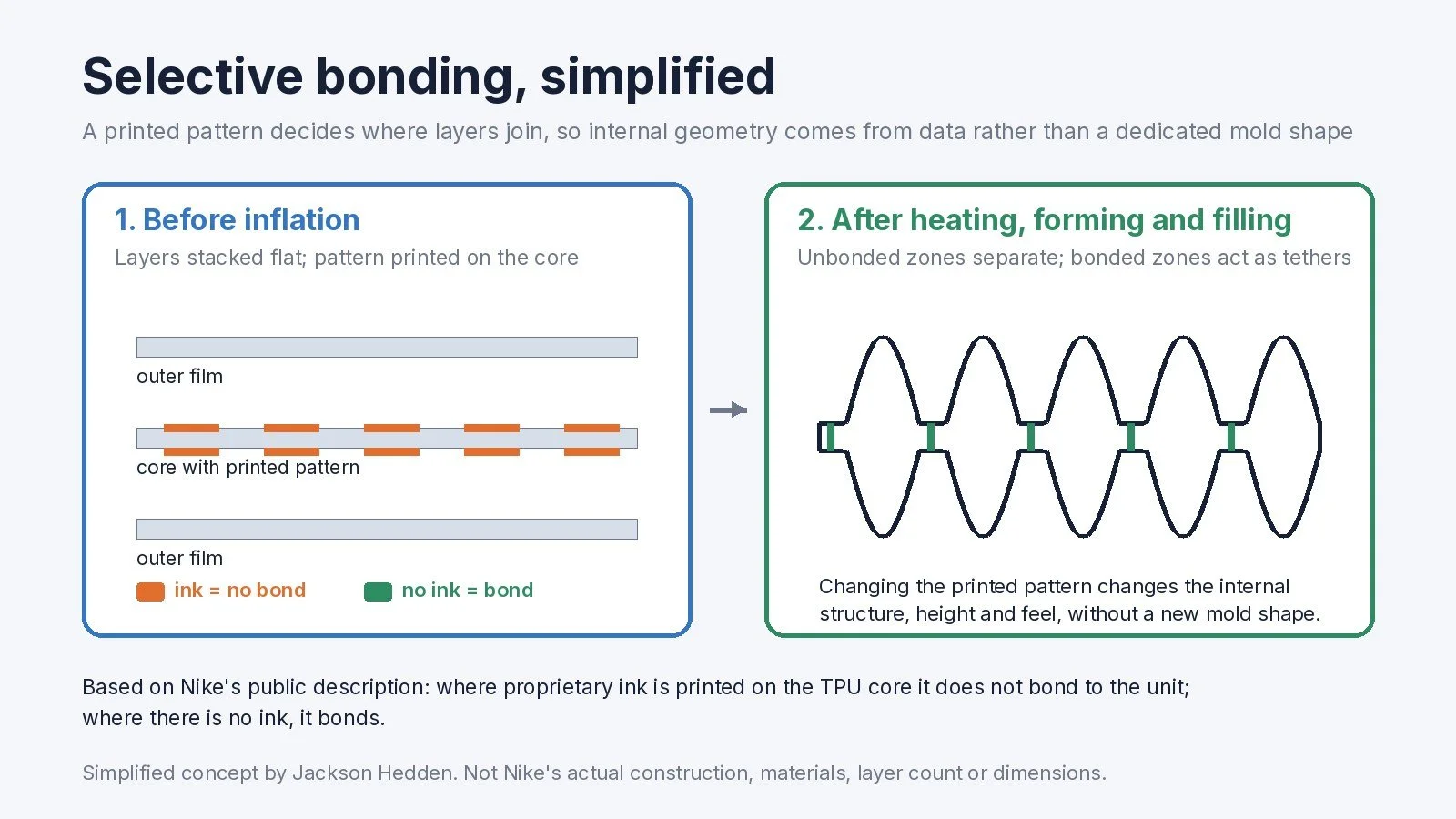
Selective bonding, simplified from Nike’s public description of Tuned Air. Concept illustration by Jackson Hedden; not Nike’s actual construction, materials, layer count or dimensions.
Why the method of make sets the pace of design
This section and the next are Jackson Hedden analysis based on general product development practice, not a description of Nike's internal processes.
Geometry that lives in a file is cheap to change. In most physical products, the shape of a part is locked into tooling, meaning the molds, dies and fixtures that form it. Changing that shape means modifying or remaking a tool, which is where weeks disappear. Tuned Air moves the part's internal structure into a printed pattern. Simple arithmetic shows why that matters: a three-week build allows roughly four tries in a quarter, while a three-day build allows dozens, if testing and decisions keep up.
Prototypes are more useful when they come from the production process. Many teams prototype with stand-in processes, such as 3D printing a part that will later be injection molded. That is fast, but the stand-in can behave differently from the final part. Nike describes Tuned Air as a way to create Air "at scale," which suggests its fast prototypes share a process with production. That closes the gap between what is tested and what ships. As we noted in our look at large-format 3D printing for prototypes and fixtures, the right prototype process depends on which question it needs to answer.
Size consistency is a design problem too. Scaling a design across a size range, called grading, can change how a part flexes or fits at the smallest and largest sizes. Nike's claim of more consistent feel across sizes points to that challenge; a process that tunes each size from data makes it easier to test.
The bottleneck moves to testing. Faster builds expose slower steps. If test rigs, user panels or review meetings take a week, a three-day build does not produce a three-day loop. Good prototype development plans test capacity and decision-making alongside build capacity.
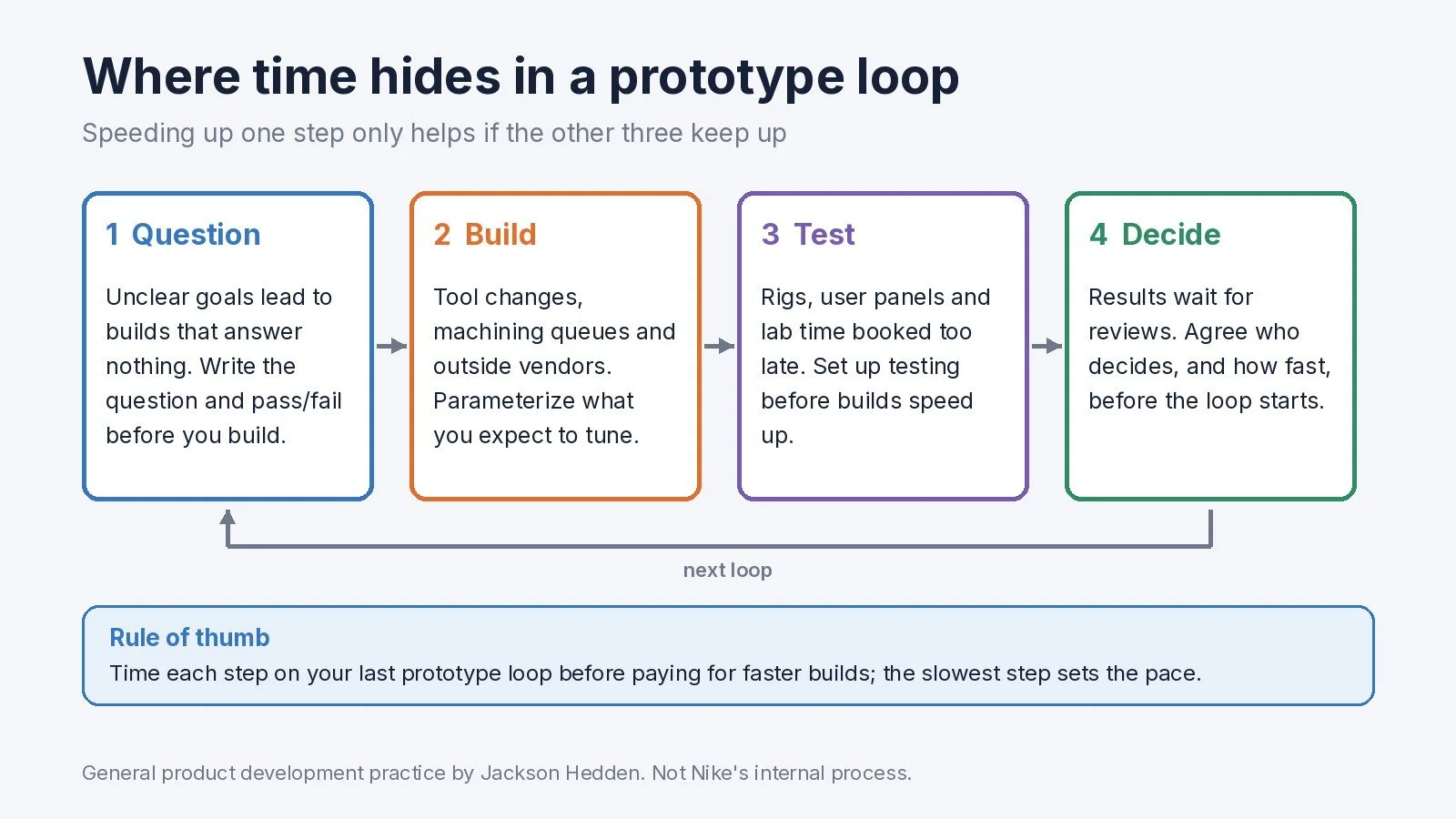
Where time hides in a prototype loop. General product development practice by Jackson Hedden; not Nike’s internal process.
What this means for product teams
Few teams will invent a proprietary process, but the same logic applies to almost any physical product:
- Time your last prototype loop. Break it into question, build, test and decide, and find the step that took longest. That step, not the build, is often the real constraint.
- Put what you expect to tune into parameters. Design features you plan to adjust, such as rib stiffness, wall thickness, foam density or lattice patterns, so they can change without a new tool. Interchangeable mold inserts and modular test fixtures help.
- Move toward production-intent processes early. During EVT (engineering validation test, the first builds that prove the design works), stand-in processes are fine. By DVT (design validation test, which proves the design meets requirements with production-intent parts), prototypes should come from the process you will ship with, or something close to it.
- Set up testing before you speed up builds. Define pass/fail criteria, build test rigs and line up user testers so results come back as fast as parts do.
- Test the extremes of your range. Build the smallest and largest sizes or configurations early. Our article on K2's women's-specific ski boot looks at why edge sizes reveal problems the middle size hides.
If you are planning prototype development for a sporting, outdoor or other consumer product and want a faster, better-structured build-and-test loop, see how we approach prototyping or contact our team to talk through your project.
Frequently asked questions
What is Nike Tuned Air? Tuned Air is a Nike Air cushioning platform announced on November 16, 2026. Its units are made with a proprietary digital print and selective lamination process that controls their internal geometry, and Nike says the first running shoe using it arrives in late 2027.
How does selective lamination work in Tuned Air? According to Nike, a proprietary ink is printed on the unit's internal core. Where there is ink, the core does not bond to the unit; where there is no ink, it bonds, which creates the internal structures that shape how the unit cushions.
Why does prototype speed matter if the shoe will not launch until 2027? More build-and-test cycles before launch mean more chances to fix problems while changes are still cheap. Going from three weeks to three days per prototype allows far more iterations in the same window.
How can smaller teams prototype faster without a proprietary process? Time each step of your current loop and fix the slowest one first. Parameterized features, modular tooling and fixtures, and test setups ready before builds arrive usually help more than faster equipment.
Jackson Hedden is a product design, development and manufacturing firm helping founders and product teams take consumer and industrial products from concept to production.
Sources
- NIKE, Inc., "Nike Tuned Air Unlocks a New Era of Precision Cushioning for Athletes Across Sports," November 16, 2026: https://about.nike.com/en/newsroom/releases/what-is-nike-tuned-air
- NIKE, Inc., "Nike Air Has Scaled Across Sports for Decades. Its Next Era Is Infinite." (Beck Salgado), November 16, 2026: https://about.nike.com/en/magazine/how-nike-made-tuned-air
- NIKE, Inc., "NIKE, Inc. Unveils the Next Generation of Innovation Across Performance Sports and Sportswear," November 16, 2026: https://about.nike.com/en/newsroom/releases/nike-inc-unveils-the-next-generation-of-innovation-across-performance-sports-and-sportswear
- Tom Ravenscroft, "Nike Tuned Air 'a huge stride forward' in air-filled trainer design says innovation lead," Dezeen, November 16, 2026: https://www.dezeen.com/2026/11/16/nike-tuned-air-new-era/