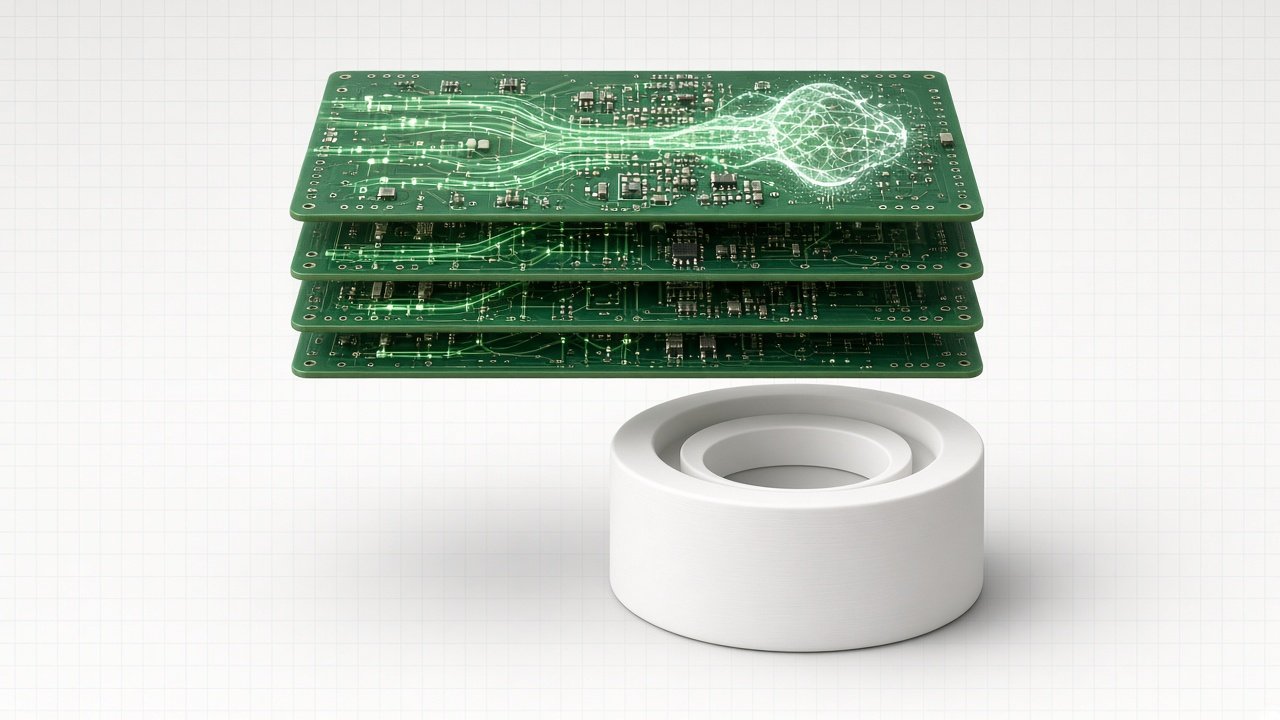
Conceptual illustration of AI-assisted PCB and enclosure design. Not an image of Anthropic’s or Diode’s prototypes.
On November 9, 2026, Anthropic published results showing its Claude model designing three working electronic prototypes (a USB speakerphone, a voice-assistant hub and a handheld virtual pet) from short prompts through circuit boards, enclosures and firmware, built with circuit-board maker Diode Computers.
Key takeaways
- AI can now take a simple consumer electronics brief through schematic, PCB layout, a 3D-printable enclosure, firmware and a parts list, and Diode says all three boards were manufactured from the AI's files without rework rounds.
- Anthropic is explicit that the devices have not been through electrical validation, antenna tuning, thermal testing or certification, and were not designed for mass production.
- The bottleneck in hardware is shifting from drawing the first board to validating it: testing, compliance, tooling and supply chain still decide whether a product ships.
- Product teams should treat AI-generated prototypes as faster EVT inputs, not as production-ready designs, and invest the saved time in earlier testing and industrial design decisions.
What Anthropic reported
According to Anthropic's post, the team gave Claude (the model is named Claude Fable 5.2 in the write-up) a short prompt for each device. The speakerphone prompt asked for "a puck that plugs into a computer over USB-C and includes microphones and a speaker, supporting Bluetooth with a PCB antenna." From there the model wrote specifications, drew schematics, placed components on a printed circuit board (PCB), routed the copper connections, designed a 3D-printable enclosure, wrote firmware and prepared a bill of materials (BOM, the parts list a factory buys against). Diode assembled the boards and ran the firmware under the model's direction, and Anthropic says all three devices still work after weeks of use.
A few details stand out for anyone who designs physical products:
- Layout quality. On Diode's internal PCB Gym benchmark, which asks a model to re-place and re-route boards whose layouts have been removed, Anthropic reports a score of 69% versus 25% for the previous model.
- Self-correction. When routing got tangled, the model ripped up traces and started over, swapped interchangeable pins and re-laid a whole corner of a board rather than patching it with extra layer changes.
- Mechanical awareness. It found that the speakerphone board could not drop straight into its enclosure because the mute switch hit the back wall, worked out that a roughly 25-degree tilt would let it fit, and added that step to the assembly instructions.
- Acoustics. For the hub, it calculated that a 25 mm microphone port would resonate near 3.4 kHz, in the voice band, and proposed a wedge-shaped enclosure that shortened the ports to about 10 mm.
- Manufacturing checks. It ran design-for-manufacturing (DFM) checks, which compare a board's geometry against a factory's capabilities, plus sourcing checks on part availability, fixing six solder-mask slivers that were too thin to build.
Anthropic also discloses that it has a commercial relationship with Diode, and that the work is a research demonstration rather than a product launch.
The same day, Design News reported that CELUS, which makes an AI electronics design platform, now shows Mouser pricing, stock and order quantities directly in its BOM view. Taken together, the two stories show AI moving into both the layout and the sourcing ends of electronic product design.
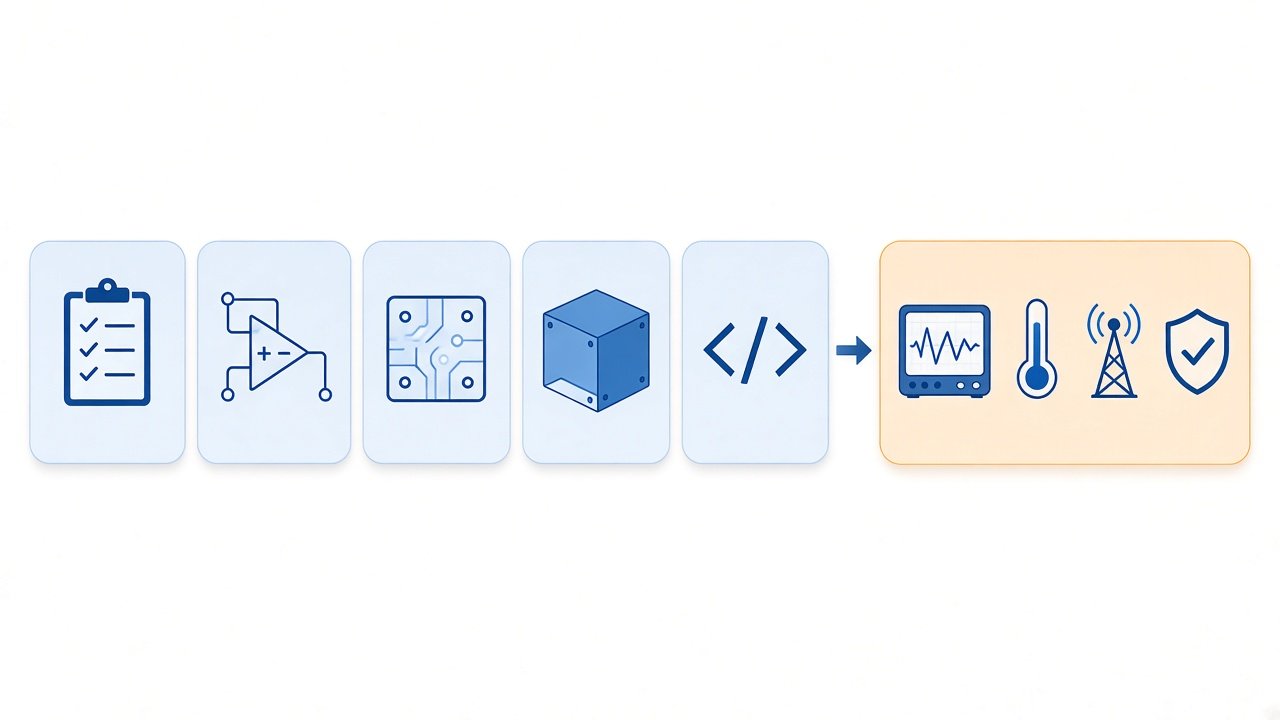
Conceptual diagram: AI now reaches through spec, schematic, layout, enclosure and firmware (blue), while electrical validation, thermal, antenna and certification work (orange) remains hands-on.
Why this matters for consumer product design
For founders and product teams, the honest reading is that the cost and time of a first functional prototype is falling. A team that used to wait weeks for a first board spin may soon get a plausible board, enclosure and firmware stack in days. That is a real change for early-stage feasibility work.
But a working prototype has never been the hard part of shipping a consumer product. The expensive surprises usually come later, in stages engineers call EVT, DVT and PVT:
- EVT (engineering validation test) proves the electronics and mechanics work as designed across a small batch.
- DVT (design validation test) proves the product meets its requirements, including drop, thermal, battery and regulatory testing, using parts from production-intent tooling.
- PVT (production validation test) proves the factory can build it repeatably at rate and yield.
Anthropic's own limitations list maps neatly onto those later stages: no electrical validation, no antenna tuning, no thermal testing, no certification and no design for mass production. Across hardware product development generally, those are exactly the areas where schedules slip, because they involve physical measurement, test labs, injection-mold tooling and supplier negotiation rather than files.
There is also an industrial design gap. A 3D-printable enclosure that fits a board is not the same as a molded housing with draft angles, wall thickness control, snap fits that survive repeated assembly, a cosmetic parting line and a finish that customers want to hold. The wedge-shaped hub enclosure in Anthropic's write-up is a good example of acoustics driving form, and that is precisely the kind of decision a product design team should be making on purpose, with the user, the brand and the factory in view.
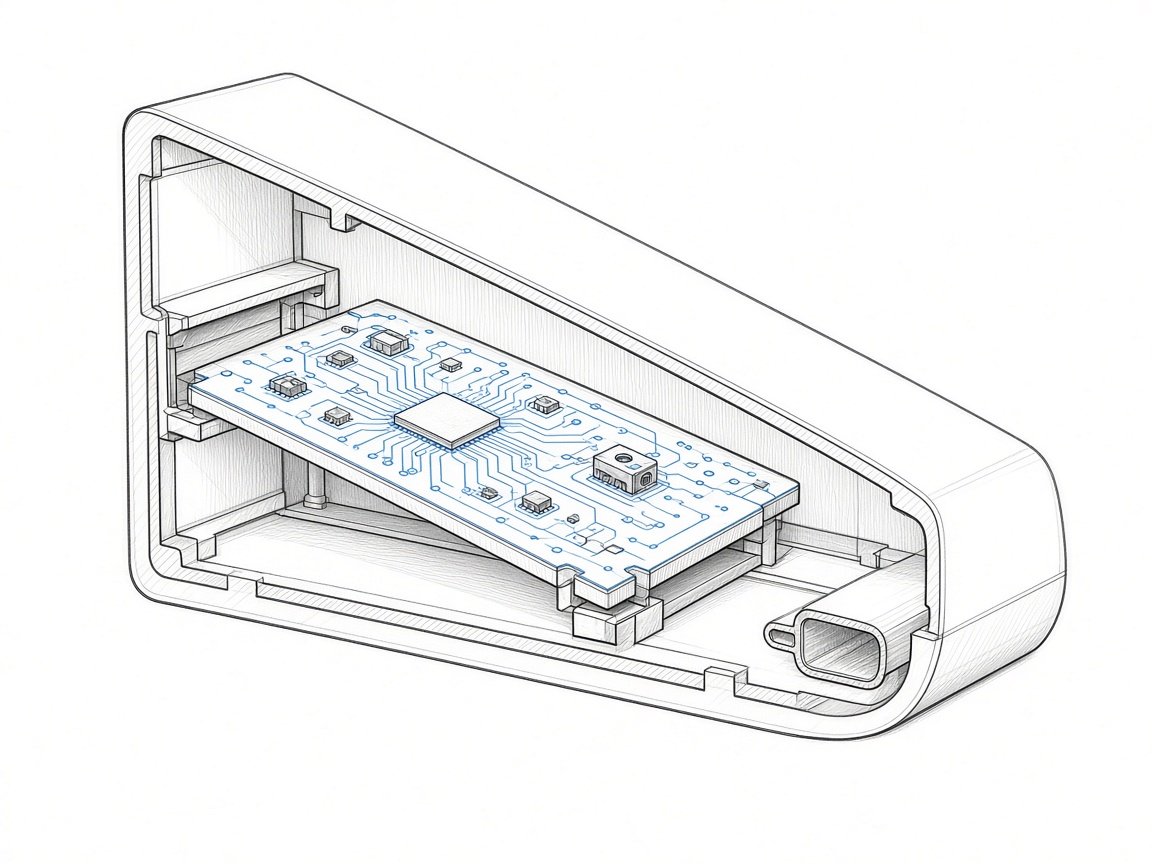
Conceptual sketch of the kinds of enclosure decisions described in Anthropic's write-up, such as board insertion angle and microphone port length. Not a reproduction of the actual prototype.
What this means for product teams
The practical move is to use AI to compress the front of the process and spend the saved time where risk actually lives. Specifically:
- Write a sharper brief. The prompts in Anthropic's test were short, but the outputs depended on clear functional requirements (USB-C, mics, speaker, Bluetooth with a PCB antenna). Teams should define use cases, target cost, battery life, environment and certifications up front, because an AI will optimize for whatever it is told.
- Run more concepts, earlier. If a functional prototype costs less, build two or three architectures and test them with users before freezing industrial design. That is where cheaper prototyping pays off most.
- Keep a human review gate on layout and safety. Anthropic notes that the model correctly ignored one DFM flag it judged intentional. Judgement calls like that need an experienced engineer to confirm, especially around power, batteries, RF and anything touching skin or mains.
- Pull validation forward. Book pre-compliance scans for emissions, antenna measurements and thermal checks on the first AI-generated boards, not after the enclosure is tooled.
- Design for the production process, not the printer. Translate a printed enclosure into molded, cast or machined parts early, with a DFM review from the factory that will build it.
- Treat the BOM as a sourcing plan. Tools like the CELUS and Mouser integration help surface price and stock early, but lifecycle status, second sources and minimum order quantities still need a human sourcing strategy.
Where AI-assisted electronics design still falls short
Based on what Anthropic disclosed, a few limits are worth stating plainly. The boards were relatively simple four-layer designs. The enclosures were 3D printed rather than tooled. Nothing was certified for FCC or CE, and nothing was built at volume. Anthropic says its next step is to test denser, faster boards, check them in simulation and learn from measurements on finished devices, which suggests the closed loop between design and physical test is still the open problem.
That matters when you are choosing partners. The strongest industrial design firms and consumer product design firms are not the ones that can produce the first render or the first board fastest; they are the ones that can carry a design through validation, tooling and manufacturing without losing what made it good.
Frequently asked questions
Can AI design a consumer electronics product by itself? AI can now produce a working early prototype, including schematics, PCB layout, a printed enclosure and firmware, as Anthropic's November 2026 test showed. It cannot yet replace validation, certification, tooling and manufacturing work, which still require physical testing and experienced engineers.
Does an AI-designed PCB still need DFM review? Yes. Anthropic's model ran its own DFM and sourcing checks, but it also made judgement calls about which warnings to ignore. A qualified engineer and the board house should still review the design before any production order.
What does AI-assisted design change for hardware startups? It lowers the cost of early feasibility prototypes and lets teams compare more concepts before committing. The budget and time that saves are best spent on user testing, pre-compliance testing and design for manufacturing.
Should I hire a product design firm if AI can build prototypes? For anything heading to production, yes. A product design and engineering partner turns a working prototype into a manufacturable, certifiable product with the right materials, tooling, suppliers and quality plan.
Related reading
If you are planning connected hardware, our electronic product development guide walks through requirements, prototypes and production, and our PCB design for consumer products guide covers layout decisions in more depth. For a recent example of hardware architecture shaping a product, see our analysis of Aina's AI ring.
If you have an AI-generated or early prototype and need it validated and engineered for production, explore our electrical design services or contact Jackson Hedden to talk through your project.
Physical process development is often the slower half of the job, as our analysis of Arc'teryx's nearly stitch-free Alpha SL harness shows.
Jackson Hedden is a product design, development and manufacturing firm helping founders and product teams take consumer and industrial products from concept to production.
Sources
- Anthropic, "Testing Claude on real-world electronics design," published November 9, 2026: anthropic.com/research/claude-electronics-design
- Rob Spiegel, "CELUS Integrates Mouser Supply Chain Data into AI Design Platform," Design News, November 9, 2026: designnews.com