On November 10, 2026, oral care brand TAO Clean launched the UV Water Flosser, a cordless water flosser with a built-in UV-C cycle meant to sanitize its water tank between uses.
Key takeaways
- TAO Clean's first water flosser adds a 10-minute UV-C sanitizing cycle for the tank, with the light shutting off automatically if the tank is opened.
- The launch targets a real weak point: a flosser's reservoir holds standing water, and a February 2026 CDC journal report traced a case of Legionnaires' disease to a contaminated water flosser.
- Designing hygiene into a product means more than adding a UV LED. Geometry, materials, safety interlocks, battery budget and claims testing all have to work together.
- Any "kills 99.99% of bacteria" claim depends on what was tested and where, so product teams should define the test and the wetted parts it covers early, not at launch.
- Reusing a proven subsystem and a shared color palette across a product line can lower the risk of a new category for a small brand.
What TAO Clean announced
According to TAO Clean's November 10 press release, the UV Water Flosser uses the same "BioShield" UV-C technology found in the company's sonic toothbrush bases. With the tank closed, the user selects UV mode and presses the power button to start a 10-minute cycle. The company says independent lab testing found the cycle kills 99.99% of bacteria in the reservoir, including Streptococcus mutans and Porphyromonas gingivalis. If the tank is opened mid-cycle, the UV-C light switches off. The flosser tip can be removed and stored inside the tank during the cycle.
Other reported specifications:
- Four modes (Clean, Soft, Pulse and Jet) with five intensity levels each, shown on a front-facing illuminated display.
- Four tips: standard jet, orthodontic, periodontal and tongue scraper.
- Cordless use, USB-C charging and up to three weeks of use from a four-hour charge.
- A size of 80 x 185 mm (3.1 x 7.3 in) and a weight of 0.64 lb without packaging.
- Six colors, each matched to a TAO Clean sonic toothbrush.
It is the company's first water flosser, sold in the U.S. at taoclean.com with a limited-time launch price of $89 for email subscribers. The release says TAO Clean has sold nearly 2 million units globally.
Why the water tank is the design problem
A water flosser (also called an oral irrigator) pumps a pulsed stream of water through a tip to clean between teeth and along the gumline. Its reservoir often sits partly filled in a warm bathroom between uses, which is a good environment for biofilm, the slimy layer bacteria form on wet surfaces.
The risk is documented. A report in the CDC's Emerging Infectious Diseases journal, published in February 2026, describes a hospitalized, immunocompromised patient in France whose Legionnaires' disease was traced to his own water flosser, brought from home and used with tap water. The strains from the patient and the device had identical genomes, and the authors noted that the reservoir "showed signs of fouling." They also observed that most manufacturers recommend regular cleaning and disinfection rather than sterile water.
That is a single case in a high-risk patient, not evidence that home flossers are broadly dangerous. But it shows why the tank, not the motor or the nozzle, is where a design team can make the biggest difference to hygiene.
Designing UV-C into a wet, handheld product
UV-C is short-wavelength ultraviolet light that damages the DNA and RNA of microbes. It is a well-established disinfection method, but putting it inside a small, battery-powered tank raises several engineering problems. The points below are Jackson Hedden's analysis based on general product development practice, not details TAO Clean has disclosed about its design.
Line of sight and shadowing. UV-C only works where light reaches. Corners, ribs, threads, seals and a stored tip can all cast shadows. Tank geometry, LED placement and the position of anything stored inside need to be designed together, ideally checked with optical simulation and then with microbial testing on real parts.
Water and surface condition. Water absorbs some UV, and dissolved minerals, toothpaste residue or film on the walls reduce dose further. A cycle that works on clean lab water can underperform after weeks of real use, so test protocols should include fouled and partly filled tanks.
Material compatibility. Many common plastics yellow, crack or lose strength under repeated UV exposure. Tank, lid and seal materials have to survive years of cycles while still blocking stray UV-C from reaching the user's eyes and skin.
Safety interlocks. TAO Clean says the light shuts off if the tank is opened. That kind of interlock, usually a switch or sensor tied to the lid, belongs in the core architecture and in the failure analysis, including what happens if the sensor fails or gets wet.
Power budget. A 10-minute LED cycle draws from the same battery that runs the pump. Teams need a realistic usage model, including how often people will actually run the cycle, to make a battery-life claim such as "up to three weeks" hold up.
Sealing a charging port. A cordless device that is filled with water and used over a sink needs ingress protection around its USB-C port, buttons and display. Seal design, port placement and drain paths drive both reliability and cost.
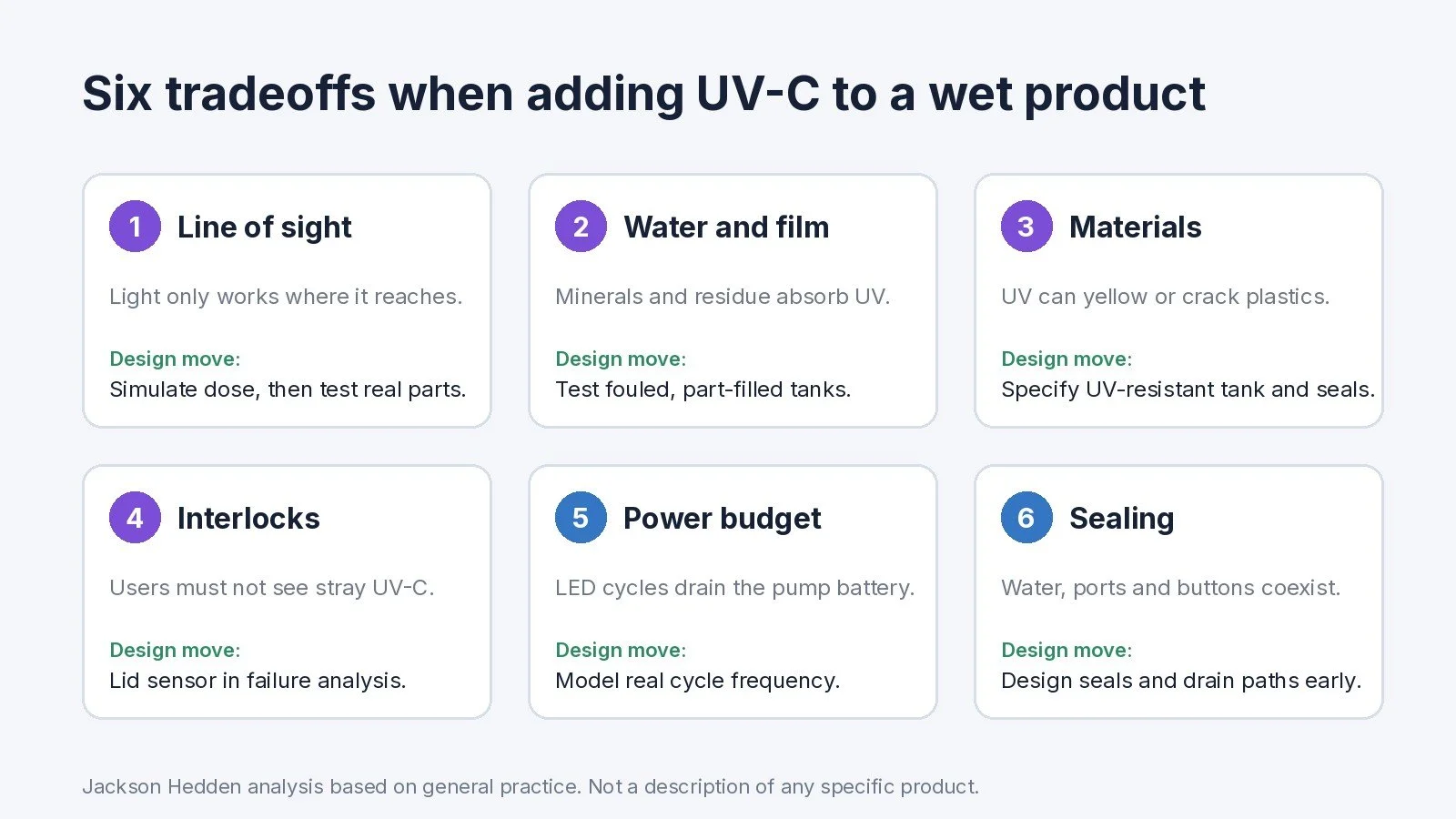
Jackson Hedden analysis of common tradeoffs when adding UV-C sanitizing to a wet consumer product, based on general practice.
Claims, testing and regulation
"Kills 99.99% of bacteria" is a common marketing line, and its credibility depends on details: which organisms, what starting concentration, what water, what exposure time and which surfaces. TAO Clean's claim, as stated, covers the reservoir. The press release does not say the pump, hose or internal flow path are treated, and a product team building something similar should be precise about which wetted parts a claim covers.
Regulation adds another layer. In the U.S., the FDA classifies an "oral irrigation unit" as a Class I device under 21 CFR 872.6510. Separately, the EPA treats instruments that use physical means like UV light to destroy or mitigate pests, including microbes, as pesticide devices under FIFRA, with rules on how they can be labeled and advertised. How either applies to a specific product depends on its design and claims, so teams should bring in regulatory expertise when they first draft hygiene claims, not after packaging is printed.
Platform thinking: reusing a proven subsystem
Strategically, the most interesting part of this launch may be reuse. TAO Clean carried its UV-C sanitizing approach from toothbrush bases into a new category and matched the flosser's six colors to its existing toothbrush line. For a small brand, that lowers risk: some supplier relationships, test know-how and brand recognition carry over, and the color, material and finish (CMF) palette is already proven in customers' bathrooms.
Reuse is not free, though. A UV system designed for a dry toothbrush head may need real rework for a water-filled tank, and matched colors still need to be checked across different plastics and part shapes so the flosser and brush look like a set on the counter.
What this means for product teams
If you are designing a personal care, kitchen or home product that holds water or touches the body, a few practical lessons apply:
- Map the wetted path early. List every surface that touches water or the body, and decide which ones the user cleans, which ones the product protects, and which ones you design out entirely.
- Design for cleaning first, and sanitizing second. Wide openings, removable tanks, smooth internal corners and parts that drain fully reduce biofilm before any UV or chemistry is involved.
- Prototype the hygiene feature, not just the look. Build test rigs early that measure UV dose at the worst-shadowed spot and run microbial challenge tests on fouled, real-world parts.
- Write claims alongside requirements. Define the claim, test method and covered parts as product requirements during engineering, so marketing language matches what the evidence supports.
- Treat safety interlocks as core features. Include them in failure analysis and reliability testing, especially in wet environments.
Our earlier look at the Suri Pro 2.0 electric toothbrush covers how second-generation oral care products evolve, and our medical device development guide explains when health-related claims start to change the regulatory picture.
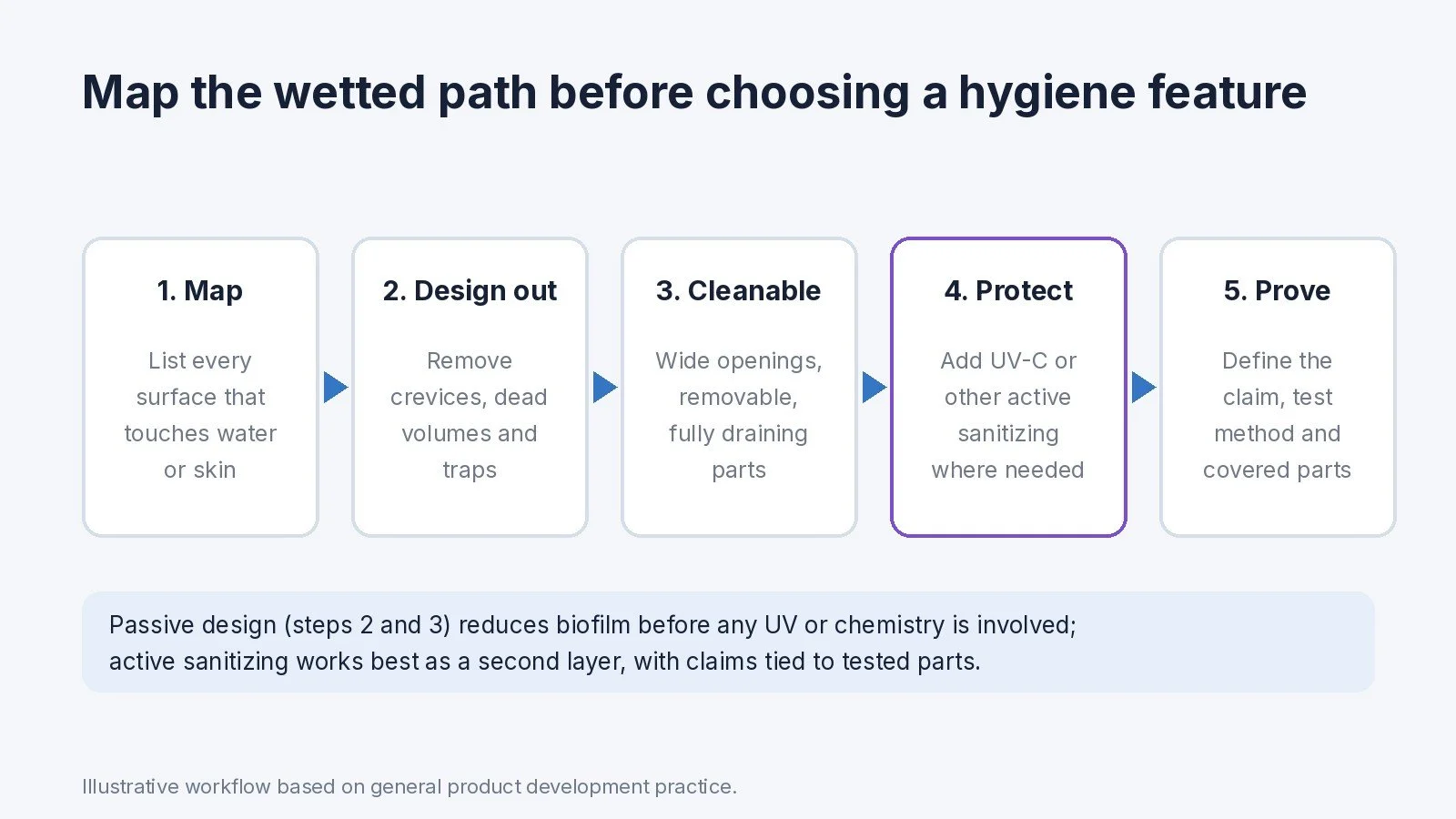
Illustrative hygiene design workflow based on general product development practice. Steps vary by product.
Frequently asked questions
How does a UV water flosser sanitize its tank? It uses UV-C LEDs that shine into the closed reservoir for a set time, damaging the genetic material of bacteria on the water and surfaces the light reaches. TAO Clean's version runs a 10-minute cycle and shuts the light off if the tank is opened.
Do water flosser tanks really grow bacteria? They can, especially when water sits between uses and the tank is not cleaned regularly. A February 2026 report in the CDC's Emerging Infectious Diseases journal linked a Legionnaires' disease case to a fouled water flosser, though that involved a single high-risk hospital patient.
What does "kills 99.99% of bacteria" mean on a product? It usually means a lab test showed a 4-log (10,000-fold) reduction of specific organisms under specific conditions. The claim is only as strong as the test method, the organisms chosen and which parts of the product were tested.
What should product teams consider when adding UV-C to a consumer product? Light coverage and shadowing, water and surface fouling, UV-resistant materials, user safety interlocks, battery impact and how hygiene claims will be tested and regulated. These are best addressed during early design and prototyping, not after tooling.
Designing personal care and health products
If you are developing a personal care or home health device and need help with industrial design, engineering for wet environments or prototyping hygiene features, our product design services and prototyping team can help. You can also contact Jackson Hedden to talk through your product.
Jackson Hedden is a product design, development and manufacturing firm helping founders and product teams take consumer and industrial products from concept to production.
Sources
- TAO Clean via PR Newswire, "Clean Water, Cleaner Gums: TAO Clean Unveils UV Water Flosser with a Self-Sanitizing Reservoir Tank," November 10, 2026: prnewswire.com
- Emerging Infectious Diseases (CDC), "Case of Legionella pneumophila Serogroup 1 Infection Linked to Water Flosser, France," Volume 32, Number 2, February 2026: cdc.gov
- U.S. Code of Federal Regulations, 21 CFR 872.6510, Oral irrigation unit: ecfr.gov
- U.S. EPA, "Pesticide Devices: A Guide for Consumers": epa.gov
- TAO Clean website, accessed November 11, 2026: taoclean.com
Jackson Hedden is not affiliated with TAO Clean. Product details are as reported by the sources above.