On November 24, 2026, COROS announced the VERTIX 4, a $799 GPS expedition watch that replaces the VERTIX 2 and 2S and adds the brand's first integrated flashlight, a 1.47-inch AMOLED display and a thinner case, with sales starting November 27 (COROS press release).
Key takeaways
- The display changed technology, and the battery numbers moved with it. COROS swapped the VERTIX 2S's memory-in-pixel screen for an LTPO AMOLED panel. Its claimed standard GPS life falls from 118 to 105 hours, while dual-frequency life rises from 43 to 60 hours.
- The flashlight sits on the side of the case. COROS says it points where the wearer's hands are working and runs with no thermal cutouts.
- The titanium bezel is also the GPS antenna. That turns a styling part into an RF (radio frequency) component.
- COROS says the case is 14% thinner than the VERTIX 2S, yet it adds a light, microphones, a speaker and twice the storage. That takes electrical and mechanical design planned together.
What COROS announced
According to the COROS press release dated November 24, 2026, the VERTIX 4 costs $799, goes on sale November 27 and replaces both the VERTIX 2 and VERTIX 2S. COROS calls the light its first integrated flashlight. Hardware details below come from the VERTIX 4 product page and spec sheet:
- Display: 1.47-inch LTPO AMOLED, 466 x 466 pixels, sapphire glass, up to 3,500 nits. The COROS Switzerland launch blog adds that it dims to 2 nits at night. COROS's spec comparison lists the VERTIX 2S with a 1.4-inch, 280 x 280, 64-color always-on memory LCD, a memory-in-pixel (MIP) screen.
- Flashlight: 5700K cool white, 90° beam, three output levels, up to 100 hours on level one with the screen off, and "no throttling or forced cooldowns, even while running on an external charger." The Swiss blog places it at 3 o'clock on the side of the case and lists SOS and strobe modes.
- Case: titanium bezel that "doubles as the GPS antenna" for L1 + L5 dual-frequency GNSS (satellite positioning), plus a fiber-reinforced composite core, skeletonized hollow lugs, recessed flush side buttons and an offset dial and button layout for use with heavy gloves.
- Size: 49.4 x 49.4 x 13.8 mm (height excludes the heart rate sensor), 60 g body, 14% thinner than the VERTIX 2S, which the spec comparison lists at 16 mm.
- Battery (manufacturer claims): 105 hours standard GPS, 60 hours all-systems dual-frequency, 30 days daily use. With the always-on display enabled, those drop to 75 hours, 48 hours and 10 days. The VERTIX 2S is listed at 118 hours, 43 hours and 36 days.
- Other hardware: 64GB storage (the 2S has 32GB), dual noise-cancelling microphones, a speaker, 10 ATM water resistance and a -30 °C to 50 °C operating range.
We have not handled or tested the VERTIX 4, and COROS has not published teardown or internal design details. Everything below is Jackson Hedden analysis based on general product development practice.
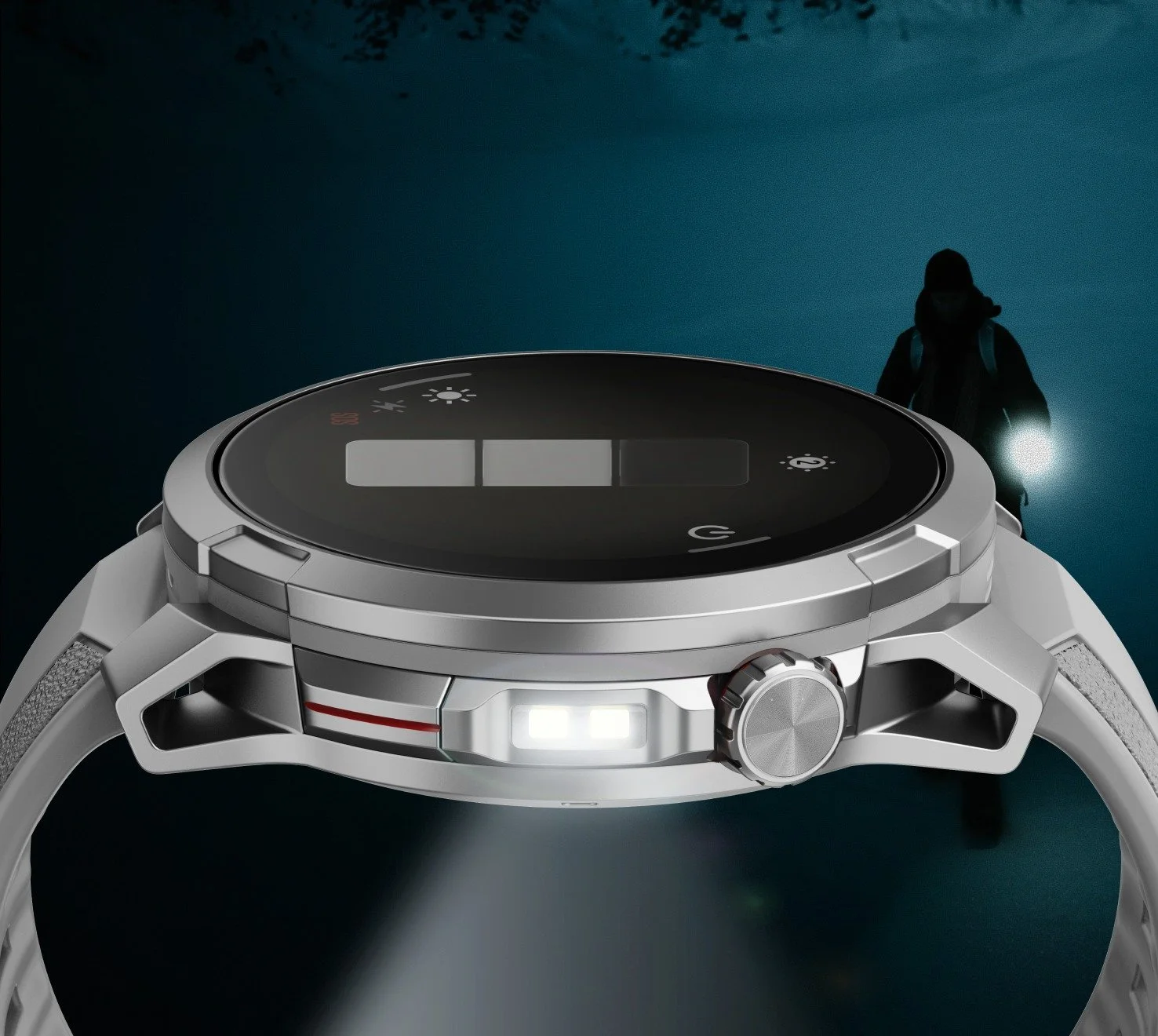
The VERTIX 4’s integrated flashlight sits in the side of the case, next to the digital dial. Image: COROS
How electronic product design teams read the VERTIX 4
Inside a watch, every feature competes for the same volume, battery charge and seal. Five tradeoffs stand out.
Display versus endurance. A memory-in-pixel (MIP) screen is a reflective LCD whose pixels hold their state, so it draws very little power and stays readable in sunlight, at the cost of dull color. AMOLED pixels emit their own light, so power depends on brightness and on how much of the screen is lit. LTPO (low-temperature polycrystalline oxide) is a display backplane, the transistor layer behind the pixels, that can refresh very slowly on static screens to save power. The claimed numbers show the trade: standard GPS life dips, the always-on mode costs a lot, and dual-frequency life still rises. That suggests savings elsewhere in the system, though COROS has not said where.
A light is a heat and power load. An LED turns much of its power into heat, and a watch case has little room to shed it. Claiming no thermal cutouts, even while charging, implies the light's drive current, the case's heat path and the skin-contact temperature were budgeted together. Putting the LED on the side also keeps its window away from the display stack, but it adds an opening in the wall that must stay sealed at 10 ATM.
Metal and radio waves do not mix easily. A metal enclosure blocks and detunes antennas. Making the titanium bezel the antenna turns that problem into an asset, but only if the bezel's isolation from the rest of the case, its feed point and the effect of a wrist under it are tuned together. Later changes to bezel geometry or finish can shift performance.
Thinner with more inside. Losing about 2 mm while adding a light, microphones and a speaker forces a tight stack-up, the layered order of display, board, battery and sensor. COROS says the composite core sheds weight while the titanium bezel provides structural integrity, a split that puts metal only where strength and the antenna need it.
Ergonomics touch the sensors. Recessed buttons trade accidental presses against glove use, so travel and force need testing with real gloves. COROS links the hollow lugs to keeping the watch close to the skin for heart rate accuracy. For an optical sensor, how a watch sits on the wrist is part of the measurement.
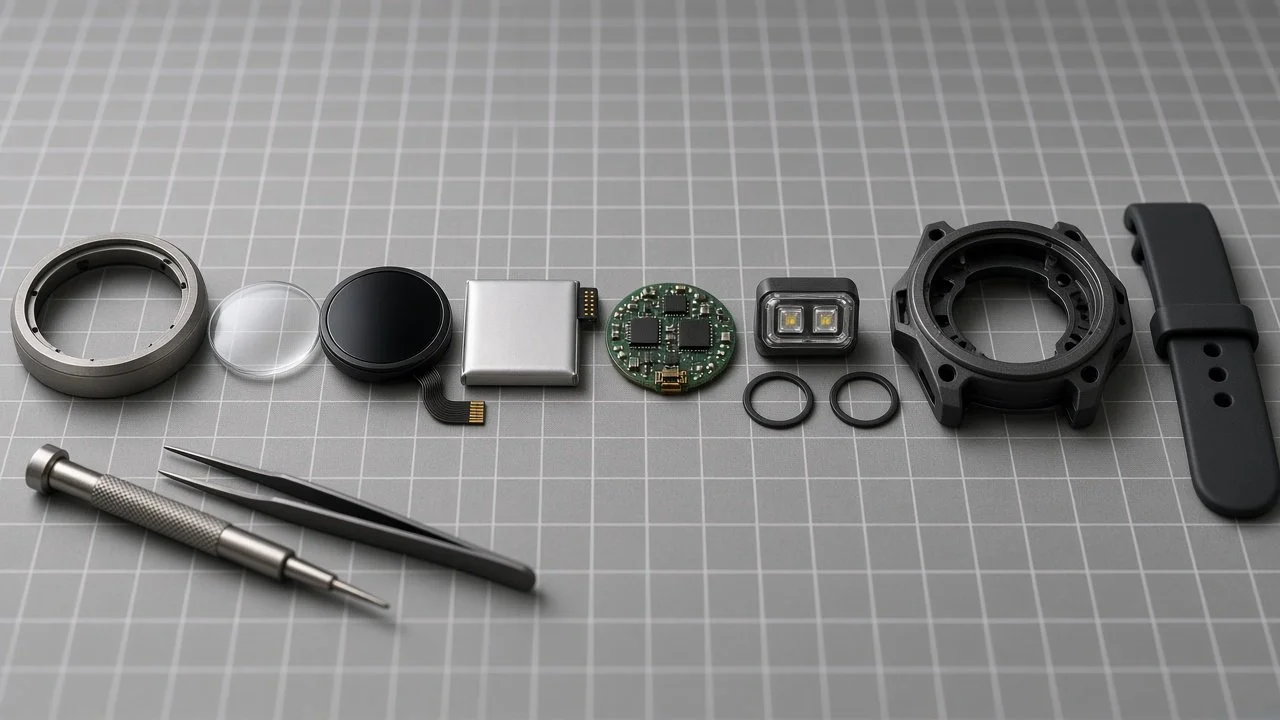
Concept render (illustration) of a generic outdoor GPS watch disassembled on an engineering bench, not COROS hardware.
What this means for product teams
These lessons apply to any battery-powered wearable or handheld that packs a display, lighting and radios into a sealed case.
- Write the power budget before choosing the display. List every load and how long it runs in each mode. Then decide whether the display technology fits the battery you can actually package. Our NC° Band 2 analysis shows how wear habits shape that budget.
- Co-design the antenna with the enclosure. If metal is part of the look, bring RF engineering into industrial design from the first sketches. Test antenna prototypes on a wrist or phantom (a tissue-equivalent test fixture), not just in free air.
- Treat every new opening as a sealing project. A light window, microphone port or speaker grille each needs its own gasket or membrane design, plus pressure, immersion and temperature-cycling tests before tooling.
- Validate thermals at the worst case. Run the light at full output while charging, in a hot room, against a skin-temperature limit. Decide early whether the product will throttle or must never cut out.
- Gate the risks at EVT and DVT. EVT (engineering validation test) proves the design works; DVT (design validation test) proves production-intent parts meet requirements. Check sensor contact, button force with gloves and seal performance at both gates. Our smart ring analysis lays out gates for compact sensing wearables.
FAQ
What is new in the COROS VERTIX 4? COROS announced it on November 24, 2026, as a $799 replacement for the VERTIX 2 and 2S. It adds a 1.47-inch LTPO AMOLED display, COROS's first integrated flashlight, a titanium bezel that works as the GPS antenna, and a case COROS says is 14% thinner than the VERTIX 2S.
Does the AMOLED screen reduce battery life? By COROS's own claims, standard GPS drops from 118 hours on the VERTIX 2S to 105 hours, and daily use drops from 36 to 30 days. Dual-frequency GPS rises from 43 to 60 hours. The always-on display shortens every figure, and results vary with use.
What is the difference between MIP and AMOLED displays? MIP (memory-in-pixel) is a reflective LCD that uses very little power and reads well in sunlight but shows limited color. AMOLED pixels make their own light for richer color and contrast, so power use depends on brightness and content.
Why put a flashlight on the side of a watch? COROS says the side position aims the beam where the wearer's hands are working. It also separates the light from the display, but adds a sealed opening in the case wall.
Work with us
Packing a display, lighting, radios and a battery into a sealed wearable? Our electronic product design team helps product teams set power budgets, co-design antennas with enclosures and plan sealing and thermal tests before tooling. Contact us to talk through your project.
Jackson Hedden is a product design, development and manufacturing firm helping founders and product teams take consumer and industrial products from concept to production.
Sources
- COROS (via Endurance Sportswire), "Rise Before Dawn with the COROS VERTIX 4," press release, November 24, 2026: https://www.endurancesportswire.com/rise-before-dawn-with-the-coros-vertix-4/
- COROS, VERTIX 4 product page: https://coros.com/vertix4
- COROS, VERTIX 4 specs and comparison: https://coros.com/vertix4/specs
- COROS Switzerland, "VERTIX 4" launch blog (French): https://ch.coros.com/fr/actualite/vertix_4-392/