On November 24, 2026, Porsche introduced the Dashcam Gen. 2, a multi-camera accessory installed beneath the rear-view mirror that automatically records driving and parking events and, for the first time, offers an interior view (Porsche Newsroom).
Key takeaways
- The Dashcam Gen. 2 is designed into the car, not stuck onto the glass. Porsche says it mounts centrally beneath the rear-view mirror, outside the driver's field of view, across the model range.
- Sensors decide when it records. A G-sensor and radar trigger recordings of driving and parking events, and GPS logs where each recording starts.
- A brand detail doubles as a status light. Porsche says the illuminated logo also shows the camera's operating mode.
- Accessories inherit the host product's constraints. Mounting, power, heat, optics behind glass and dealer installation are set by the vehicle, so the real work is in the interfaces.
What Porsche announced
According to Porsche's newsroom release dated November 24, 2026, the reported facts are:
- Placement: the dashcam is installed centrally beneath the rear-view mirror across the model range, positioned outside the driver's field of vision.
- Cameras: the multi-camera system records the vehicle's surroundings and the interior in QHD resolution with HDR (high dynamic range, which keeps bright and dark areas visible in the same frame). An integrated polarizing filter reduces reflections from glass surfaces.
- Triggers: a G-sensor (an accelerometer that detects impacts and sudden movement) and radar detect relevant driving and parking events and automatically start recording. GPS data documents the car's location when recording begins.
- Storage: a 64 GB storage medium is included and can be expanded to up to 512 GB.
- Controls: recordings and settings are managed in the My Porsche app. An illuminated Porsche logo provides a brand accent and indicates the camera's operating mode.
- Fitment: the dashcam works in all models equipped with the necessary camera preparation. Cabriolet and Targa models get a front camera; all other vehicles can have front and rear cameras. It is ordered through the Porsche Vehicle Accessories Finder or a Porsche Centre, and installation is carried out at a Porsche Centre.
Georg Kuhn, Director Product Development Accessories at Porsche, said: "The new dashcam combines discreet integration with intelligent recording technology. The result is a modern accessory that integrates into a Porsche both functionally and elegantly."
We have not handled or tested the Dashcam Gen. 2, and Porsche has not published its internal design or test process. Everything below the next heading is Jackson Hedden analysis based on general product development practice.
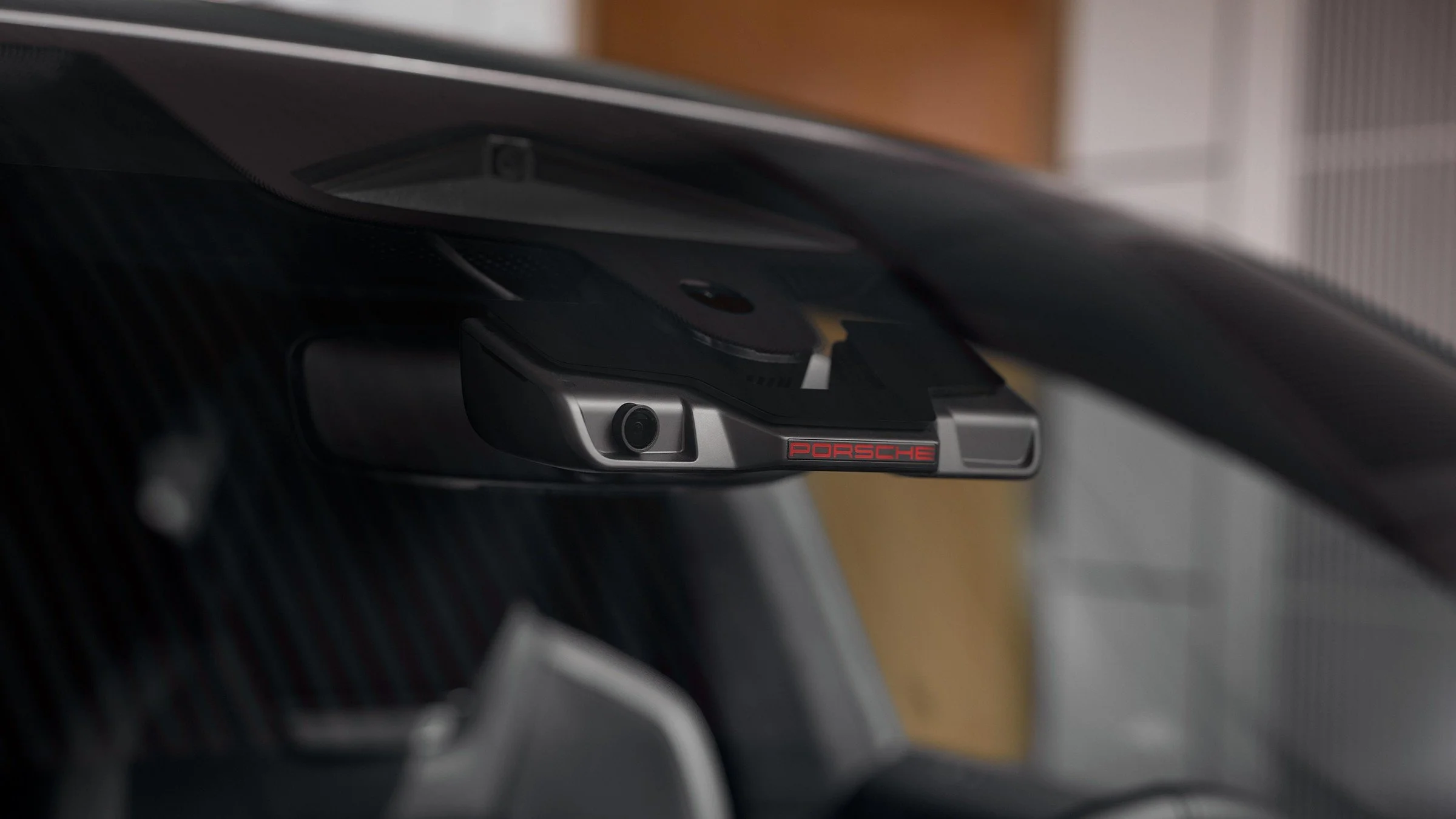
Porsche says the Dashcam Gen. 2’s illuminated logo also indicates the camera’s operating mode. Image: Porsche
How a product design firm reads a factory-fit accessory brief
An aftermarket dashcam can be designed almost in isolation: a suction cup, a power cable and a box that looks acceptable on any windshield. A factory-fit accessory has to fit a host product that already exists, built by other teams on other schedules. When we take on accessories for an existing platform, these are the constraints we look at first.
The host product is the platform. Porsche's phrase "camera preparation" points to a pre-defined interface in the vehicle. Interfaces like this are usually captured in an interface control document (ICD), which fixes mounting points, connector type, power, data and keep-out zones. Once the host is in production, the accessory has to adapt to the ICD, not the other way round.
One mounting zone, many vehicles. The area behind the mirror is crowded, often shared with sensors and trim. Designing one accessory "across the model range" means checking fit, sightlines and cable routing in every body style. Front-only fitment for Cabriolet and Targa models shows that variant planning starts on day one.
Optics behind glass. A camera behind a windshield fights dashboard reflections and glare, which Porsche addresses with a polarizing filter. For any camera product, the lens, filter, housing shroud and glass angle have to be designed together and tested in real lighting, not only on a bench.
The status light is part of the interface. Porsche uses its illuminated logo to show operating mode. With an interior camera, occupants should be able to tell at a glance whether it is recording. Brightness and visibility at night and in sunlight are user-experience decisions, not just branding.
Parking mode: electronics that work while the car is off
Recording parking events means the camera stays alert while the car is parked, locked and possibly in the sun. Porsche's release does not cover these details, but every team building an always-on device should answer three questions early.
Power budget. A parked car has no alternator charging the battery. Any standby or parking-mode draw has to be small, and the design needs a cutoff so the camera never leaves the driver with a car that will not start.
Heat. A closed cabin in sunlight can get far hotter than the outside air, and a camera behind the windshield takes direct sun. Many aftermarket dashcams use supercapacitors instead of lithium-ion cells for backup power because they tolerate heat better. Storage media, adhesives and plastics also need temperature ratings that match the worst case, not the average day. We covered how heat follows power in compact cameras in our analysis of the OBSBOT Tail 2 ADV PTZ camera.
Trigger tuning. An accelerometer alone tends to trigger on door slams and potholes. Pairing it with radar, as Porsche describes, can help separate real events from noise, but someone still has to set the thresholds. Too sensitive, and storage fills with useless clips; too dull, and the one event that matters is missed. Tuning needs field data from real streets and car parks.
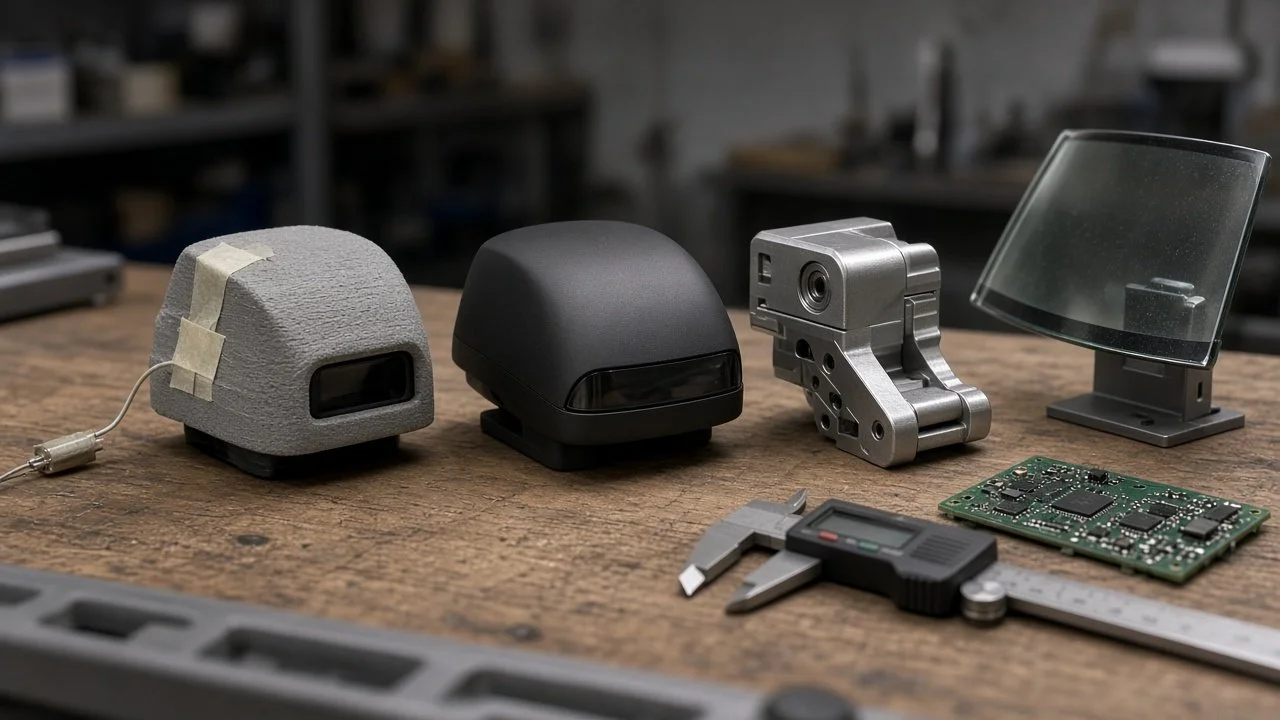
Concept render (illustration) of generic windshield-camera prototypes and a heat test setup, not Porsche hardware.
What this means for product teams
Many teams build products that live inside or attach to someone else's system: a vehicle, an appliance, a phone or industrial equipment. The same steps apply.
- Write the interface down first. Agree on an ICD with the host product's team covering mechanical mounting, connectors, power, data and keep-out zones before industrial design is frozen.
- Build a variant matrix. List every host model, body style and market the accessory must fit, and decide which features apply to each. Fit-check printed prototypes in real hosts, not just CAD.
- Budget power and heat for the worst day. Write down standby current, peak load and the hottest and coldest conditions, then choose components and materials to match. This is the core of good electronic product design.
- Plan validation in stages. EVT (engineering validation test) proves the design works; DVT (design validation test) checks production-intent parts against thermal, vibration and compliance tests; PVT (production validation test) proves the factory can build at rate. Include parking-mode and trigger testing in all three.
- Design for the installer. If technicians install the product, apply DFM (design for manufacturing) thinking to installation: clear cable routing, keyed connectors and a short, repeatable procedure. Lock these details before ordering tooling, the steel molds that form production parts.
FAQ
What is the Porsche Dashcam Gen. 2? It is a factory accessory camera system announced by Porsche on November 24, 2026. It mounts beneath the rear-view mirror, records driving and parking events automatically, and offers front, rear and interior views depending on the model.
How does the Dashcam Gen. 2 know when to record? Porsche says a G-sensor and radar detect relevant driving and parking events and trigger a recording automatically. GPS data logs the car's location when recording begins.
What is the hardest part of designing a vehicle accessory? Usually the interfaces rather than the styling. Mounting, power, heat, optics behind glass and installation are set by the vehicle, so the accessory has to be engineered around constraints it cannot change.
Why do always-on devices need a power budget? A device that runs while its host is off draws from a limited source, such as a car battery. A power budget sets limits for standby and peak current so the device stays useful without draining the host.
Work with us
Developing an accessory, connected device or product that has to fit someone else's platform? As a product design firm, we take products from interface definition and industrial design through prototyping, validation and production. Contact us to talk through your project.
Jackson Hedden is a product design, development and manufacturing firm helping founders and product teams take consumer and industrial products from concept to production.
Sources
- Porsche Newsroom, "Porsche presents new-generation dashcam," November 24, 2026: https://newsroom.porsche.com/en/2026/products/porsche-dashcam-gen-2-43800.html
- Porsche Newsroom, media package for "Porsche presents new-generation dashcam" (text PDF and images), November 24, 2026: https://pmdb.porsche.de/newsroomzips/45380676-5b78-40a4-8d16-624f8c262925.zip