On November 17, 2026, Natural Cycles introduced NC° Band 2, a 4 mm thick, screenless smart band it says is designed for women's wrists, and launched NC° Ring, its first smart ring, outside the United States on the same day.
Key takeaways
- Natural Cycles is selling both wearables on fit and comfort: the company calls NC° Band 2 the thinnest and lightest smart band on the market and NC° Ring the lightest and narrowest smart ring.
- "Designed for women" is a design brief, not a color option. It starts with the bodies and habits of the people who will wear the product.
- The sensor list shapes the form. Measuring temperature and movement without optical heart-rate lights let Natural Cycles drop the raised sensor bump on the ring and avoid a glow at night.
- Thinness and battery life pull against each other. Moving the screen to the phone and sizing the battery to real wear habits help resolve it.
- Both devices feed the Natural Cycles app, which the company says is FDA-cleared in the U.S., while sleep and activity insights are labeled general wellness. That split has to be planned into the product.
What consumer product design teams can learn from wearables built for women
A wearable sits on a body day and night. Size, weight, edges, skin contact, charging and claims all decide whether someone keeps wearing it. Below, reported facts come first, then our analysis.
What was reported
The band. In its November 17 U.S. release, Natural Cycles says NC° Band 2 measures temperature and heart rate overnight and syncs with its app, which combines that data with cycle data to give a daily fertility status. The company lists the band at 0.16 inches (4 mm) thick and about 0.35 ounces (9.9 grams) with its strap, with a screenless design "proportioned for women's wrists," up to 21 days of battery life, magnetic wireless charging, compatibility with standard 12 mm watch straps and water resistance for full immersion. It says the band was developed in-house as a smaller successor to the 2025 original, for day and night wear. Pre-orders opened in the U.S., with shipping expected in December 2026.
Wear time. Natural Cycles says about 80% of its active users measure with a wearable. Manuel Åberg Cobo, its head of hardware, said: "Comfort and battery life decide whether someone keeps a wearable on."
The ring. In a separate release from London, the company says NC° Ring weighs as little as 1.9 grams depending on size, is 5.8 mm wide with no raised sensor bump, and uses temperature and movement sensors "without the lights used by optical heart rate sensors." It lists up to 14 days of battery life and a magnetic wireless charger. Natural Cycles says the ring is backed by two U.S. patents covering its manufacturing process and charger design. Åberg Cobo said the team "removed the sensor bump, kept the ring as light as possible and developed our own manufacturing process to build it."
Claims. In the U.S. release, Natural Cycles describes its app as FDA-cleared and a Class II medical device, and says sleep and activity insights "support general wellness and are separate from the app's contraceptive function."
Why designing for women is a design problem, not a size option
This section and the next are Jackson Hedden analysis based on general product development practice. We have not tested NC° Band 2 or NC° Ring and are not describing Natural Cycles' internal design.
Start with the body, not the last product. Many "women's versions" are a smaller, recolored copy of a product sized for men. Designing for women starts with anthropometrics, the measured ranges of body dimensions such as wrist circumference and finger size, plus how people sleep, what else they wear and when they take things off. Our look at K2's women's ski boots shows the same principle in a very different product.
The sensor list comes before the sketch. Every sensor costs shape. Optical heart-rate sensing needs LEDs and a window against the skin, which is why many rings have an inner bump. Choosing temperature and movement only for the ring is what makes a smooth inner surface and a dark bedroom possible. The trade-off is fewer metrics, so the product promise has to match what the sensors can support.
Thin and long-lasting pull in opposite directions. The battery is usually the largest single part in a small wearable. Reaching 4 mm while promising weeks of use means removing what draws power or adds height, such as a display, and tuning how often sensors and radios wake up. Good consumer product design sets the battery target from real behavior, such as how often people will actually charge.
Standards can be a feature. Supporting standard 12 mm watch straps lets people change the look and replace the part that wears out fastest without buying a new device.
Weight changes with size. "As little as 1.9 grams depending on size" is a reminder that a ring is a family of products, each with its own layout and comfort. Our smart ring design article covers why fit has to be tested at both the loose and tight ends of every size.
Claims are part of the architecture. When one device feeds a regulated function and wellness features, teams must decide which data supports which claim and keep app, packaging and marketing consistent.
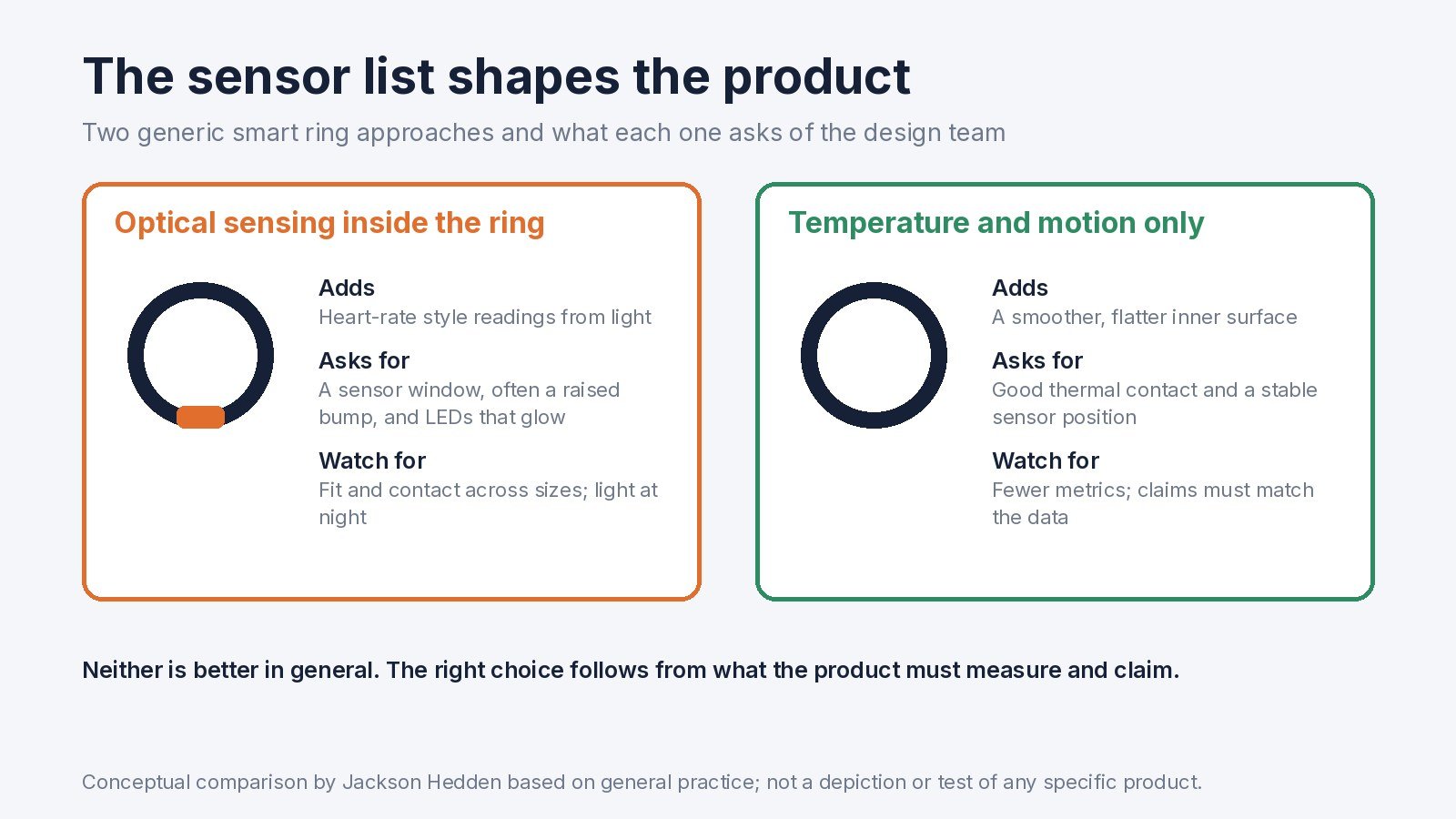
The sensor list shapes the product. Conceptual comparison by Jackson Hedden; not a depiction or test of any specific product.
What this means for product teams
For founders and teams building a wearable, or any product that sits on the body for hours, six practical steps help:
- Define who will wear it. Write down target users and body ranges before industrial design starts, and recruit matching testers.
- Write the sensor list first. Decide what the product must measure and claim, then let that drive the shape, not the other way around.
- Set a power budget from real wear habits. Link battery size, sensor timing and charging method to how often people will realistically charge.
- Prototype on real bodies early. Use 3D printed fit models on a range of wrists or fingers, including overnight wear, before tooling, the costly steel molds that form production parts.
- Test the edges in EVT and DVT. In EVT (engineering validation test, proving the design works) and DVT (design validation test, proving production-intent parts meet requirements), check sensor contact, immersion, sweat and charger alignment at the smallest and largest sizes. PVT (production validation test) then confirms the factory can hold thickness and finish consistently.
- Separate wellness and medical claims early. Get regulatory advice on intended use before the hardware is frozen.
If you are planning a wearable or personal health product, see how our consumer product design team approaches fit, comfort and manufacturability from the start, or contact us to talk through your project.
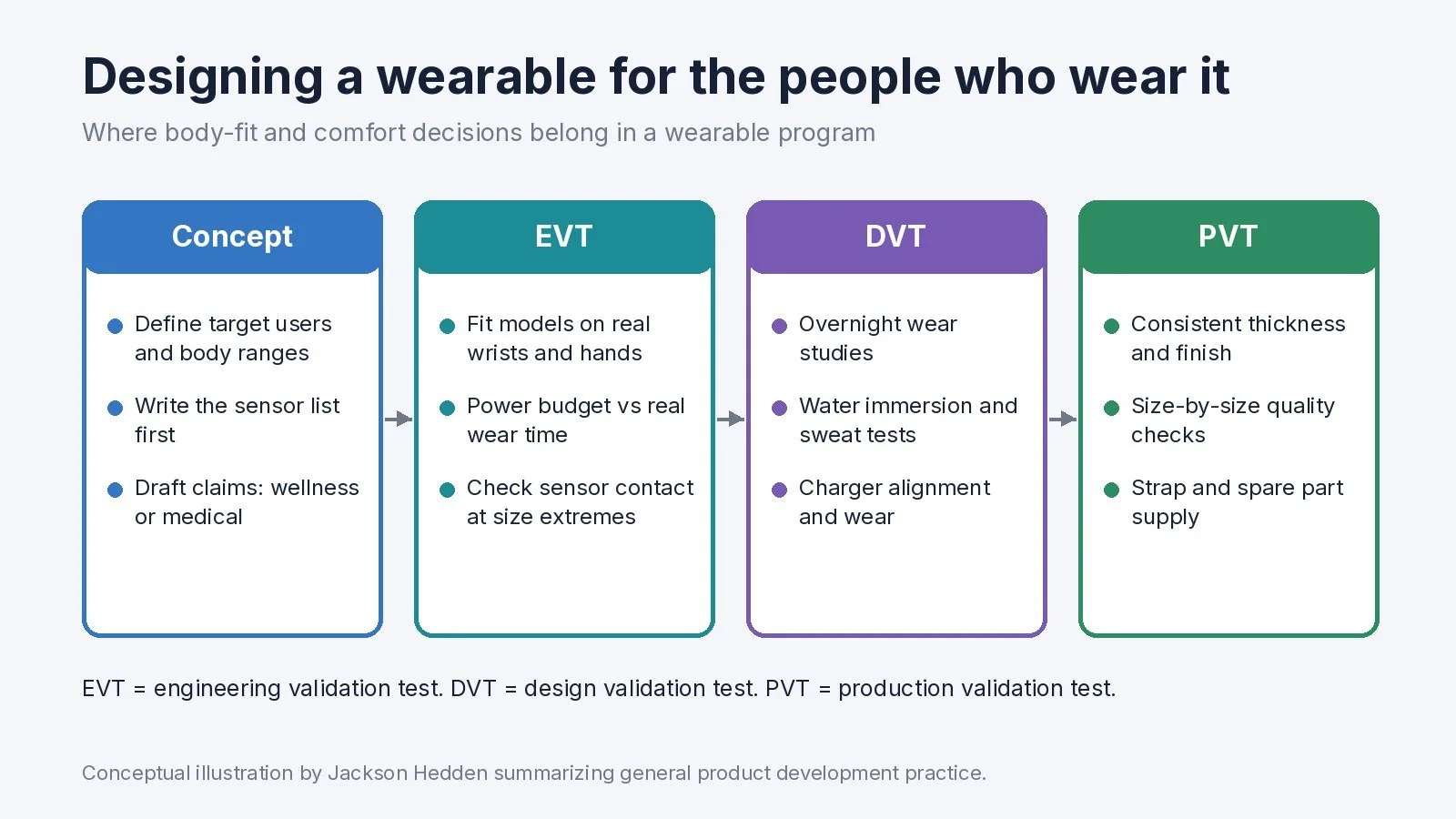
Where fit and comfort decisions belong in a wearable program. Conceptual illustration by Jackson Hedden summarizing general product development practice.
Frequently asked questions
What are NC° Band 2 and NC° Ring? They are wearables Natural Cycles announced on November 17, 2026. Both measure overnight temperature and sync with the Natural Cycles app; the band launched for pre-order in the U.S. and the ring became available to order in Europe, Canada and Australia.
What does it mean to design a wearable for women? It means starting from the body sizes, comfort needs and habits of the women who will wear it, rather than shrinking a product designed around men. That shapes size ranges, weight, thickness, edges and overnight comfort.
Why don't all smart rings have a sensor bump? A bump usually houses optical sensors and LEDs that need close skin contact. A ring measuring only temperature and movement can be smoother inside but collects fewer types of data.
How do product teams test wearable fit? They build fit models early and test them on people who match the target users, checking comfort, sensor contact and durability at the smallest and largest sizes. Overnight wear and water exposure are tested before production tooling is cut.
Jackson Hedden is a product design, development and manufacturing firm helping founders and product teams take consumer and industrial products from concept to production.
Sources
- Natural Cycles USA Corp., "Natural Cycles° introduces NC° Band 2, its next-generation smart band designed for women's wrists," PR Newswire, November 17, 2026: https://www.prnewswire.com/news-releases/natural-cycles-introduces-nc-band-2-its-next-generation-smart-band-designed-for-womens-wrists-302941387.html
- Natural Cycles USA Corp., "Natural Cycles° launches NC° Ring, its first smart ring designed for women's hands," PR Newswire UK, November 17, 2026: https://www.prnewswire.co.uk/news-releases/natural-cycles-launches-nc-ring-its-first-smart-ring-designed-for-womens-hands-302941466.html