On November 16, 2026, MiniMed announced FDA clearance of MiniMed Fit, its first tubeless insulin pump, which the company says offers up to seven days of wear and a 300-unit insulin capacity with no charging or cartridge changes during that time.
Key takeaways
- MiniMed Fit pairs up to 7-day wear with a 300-unit reservoir; MiniMed says competing tubeless pumps hold 200 units and that 7-day wear depends on using less than 42 units a day.
- "No charging for up to seven days" turns battery capacity, radio use and pump motor energy into one fixed budget the hardware must meet.
- Waterproofing, adhesive wear on five body locations and app control all have to work together on a device worn around the clock.
- MiniMed is building manufacturing capacity alongside regulatory work, a reminder that scale-up planning starts long before launch.
- For product teams, the lesson is to set the wear-time, volume and size targets early, because they constrain almost every other decision.
What medical device design companies can learn from MiniMed Fit
A patch pump puts a drug reservoir, a pumping mechanism, a battery, a radio and an adhesive into one sealed body worn on the skin for days. That makes MiniMed Fit a useful case study for any wearable that has to be small, reliable and comfortable at once. Below we separate what was reported from our own analysis. Nothing here is medical advice.
What was reported
Wear time and capacity. According to MiniMed's release, MiniMed Fit can be worn for up to seven days and holds 300 units of insulin. The company's footnotes say seven-day wear is achievable with a total daily dose under 42 units, and that Omnipod, Mint and Tandem Mobi tubeless devices hold 200 units.
Automation and app control. MiniMed says the pump uses its SmartGuard technology to adjust insulin delivery and can deliver correction doses every five minutes, with a Meal Detection feature for missed or underestimated meal doses. It is controlled from an app on compatible iOS and Android phones, and at launch works with two all-in-one sensors: Simplera Sync (up to 7 days) and Abbott's Instinct (up to 15 days).
Wear, water and access. The release lists wear locations on the back of the arm, lower back, upper buttocks, abdomen and thigh, and says the pump is waterproof up to 8 feet for 1 hour and 45 minutes. It will be sold through pharmacies and is cleared for people with Type 1 and Type 2 diabetes ages 7 and older. A phased US rollout is expected in spring 2027.
Manufacturing. MiniMed says it has been building manufacturing capacity alongside the regulatory process and plans to expand it significantly. MedTech Dive reported the same day that CEO Que Dallara has called manufacturing one of the biggest challenges of a patch pump launch, because it requires sterile-product experience and high-volume production. The outlet also notes that Tandem's Mobi patch option has seven-day wear with more frequent cartridge changes, and that Insulet's Omnipod has three-day wear.
A note on terms: FDA "clearance" is the word the agency uses when it finds a device substantially equivalent through a 510(k) premarket notification. MiniMed's release does not detail the submission itself.
Our analysis: one fixed envelope, many competing demands
Wear time, reservoir volume and size pull against each other
Longer wear needs more drug on board, more battery and a stronger adhesive, and all three add volume. Users want the device smaller. MiniMed's footnote is honest arithmetic: 300 units over 7 days is roughly 42 units a day, so wear time is set by whichever runs out first, the reservoir, the battery or the adhesive. Experienced medical device design companies lock these three targets together early, because changing one later forces a redesign of the others.
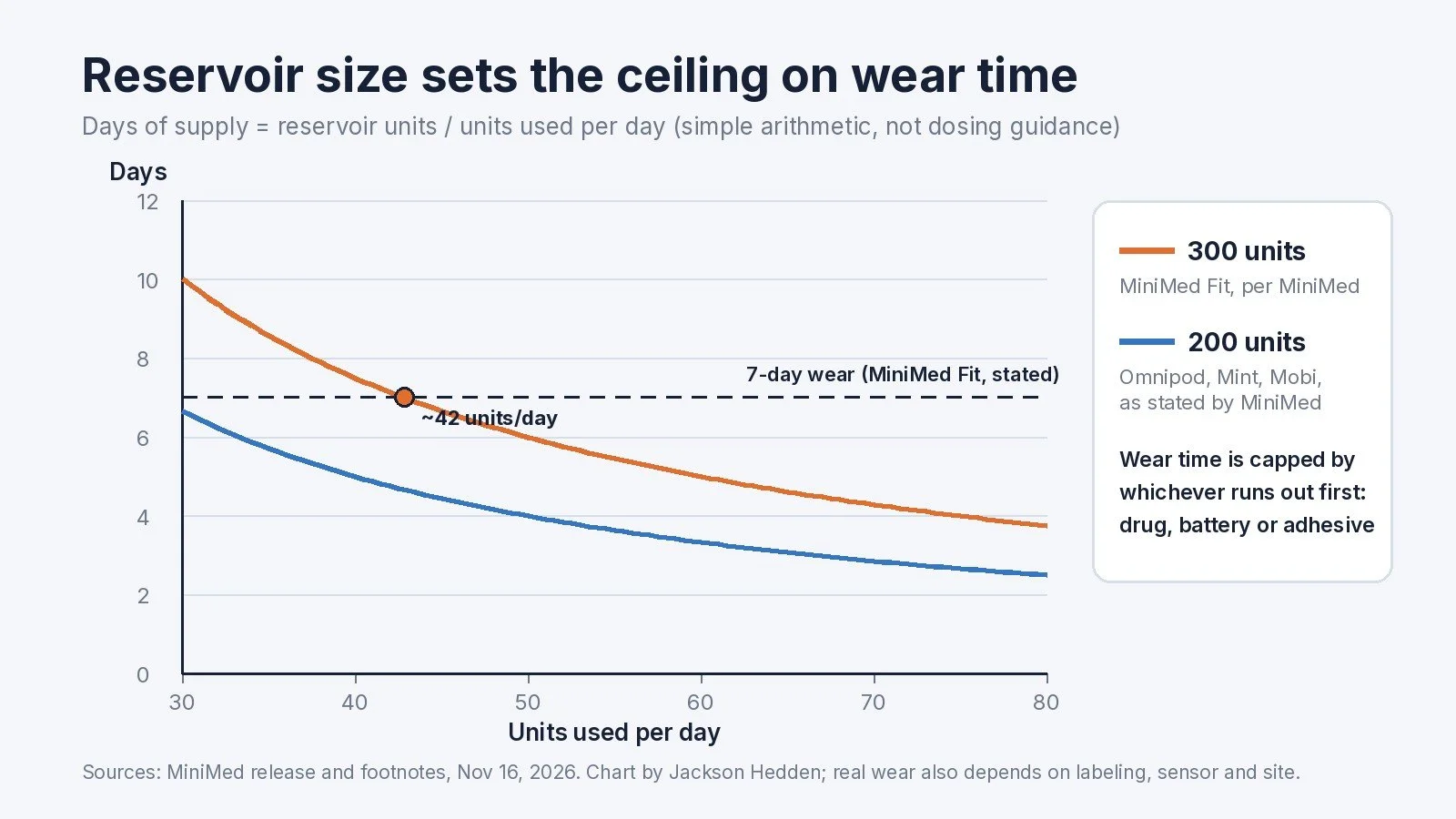
Simple capacity-divided-by-daily-use arithmetic using reservoir sizes stated by MiniMed (November 16, 2026). Chart by Jackson Hedden; not dosing guidance.
"No charging" is a power budget, not a feature
When a wearable is never charged during its wear period, every motor stroke, radio connection and alarm comes out of a fixed energy budget. That shapes how often the device talks to the phone, how the pumping mechanism is driven and what happens when the battery runs low.
Sealing, skin and software are one experience
Waterproofing a device with a fill port, a vent path and a cannula is a sealing problem at every seam. An IP rating (Ingress Protection, the IEC 60529 code for dust and water resistance) is one common way to state that, alongside a plain-language claim like MiniMed's depth and time. Adhesive comfort across five body sites, and an app that makes status obvious, decide whether people trust the device.
What this means for product teams
- Set the envelope first. Fix wear time, payload volume and maximum size as linked targets before industrial design starts.
- Build a power budget on day one. Model battery capacity against every motor, radio and alert event across the full wear period, with margin.
- Design every seam for water. Plan gaskets, welds and vents early and test seals on early prototypes.
- Treat adhesive and skin contact as design inputs. Test adhesion, removal and comfort across real body locations, and choose skin-contact materials with biocompatibility evaluation in mind.
- Design the app and device together. Human factors (usability engineering) studies how people actually use, and misuse, a device; FDA guidance expects this work to reduce use errors.
- Plan for scale and quality systems. Use DFM (design for manufacturing) reviews, and stage builds through EVT, DVT and PVT (engineering, design and production validation tests), under a quality system such as ISO 13485.
- Leave room for the platform. MiniMed says Fit is built for future features; reserve memory, power and mechanical space for updates.
For related reading, see what we learned from a tiny Bluetooth hearing aid, smart ring health sensing and our practical guide to medical equipment design.
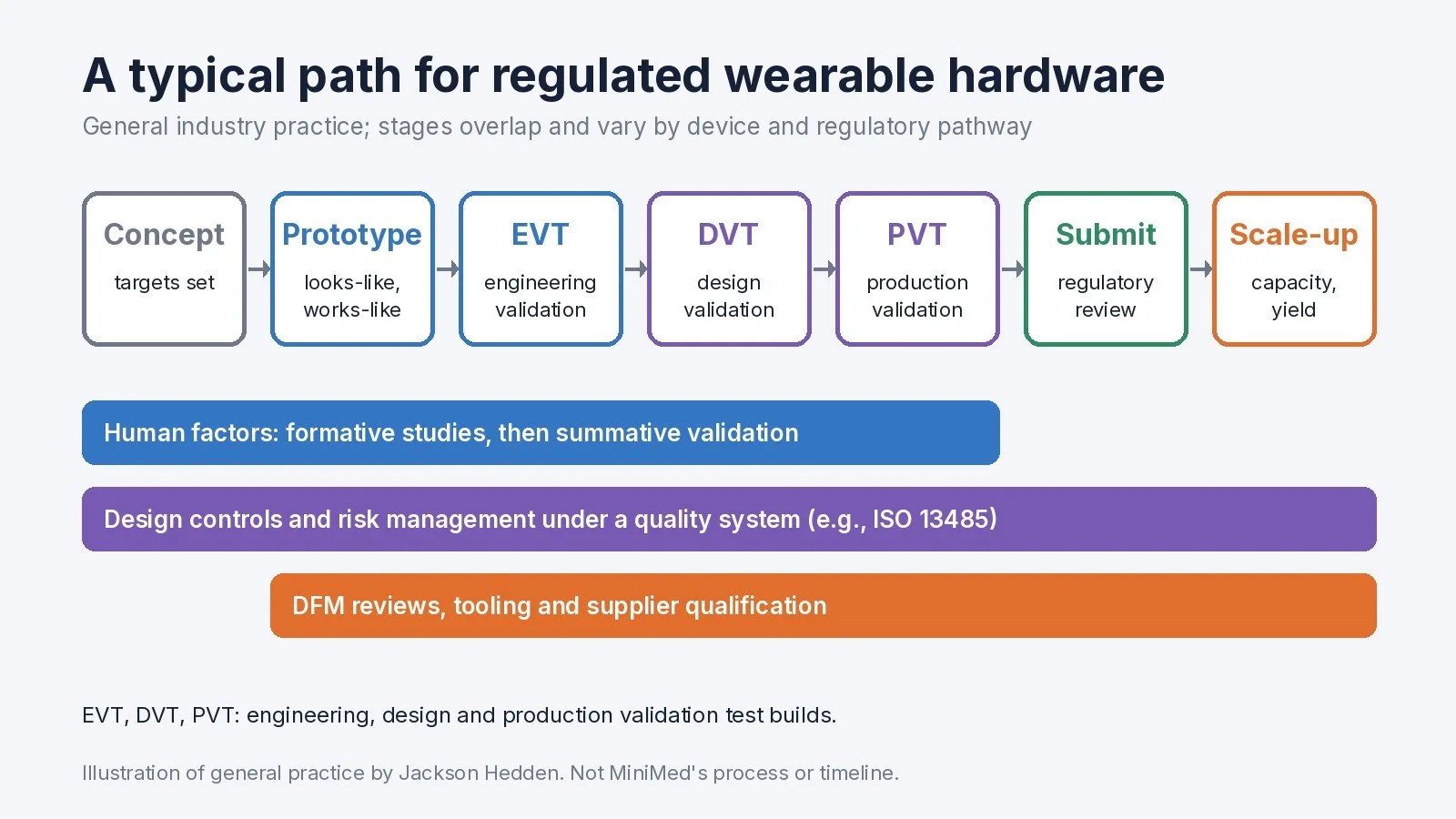
A general development path for regulated wearable hardware, drawn by Jackson Hedden. Stages overlap and vary; this is not MiniMed’s process or timeline.
Frequently asked questions
What is MiniMed Fit? MiniMed Fit is MiniMed's first tubeless insulin pump, cleared by the FDA on November 16, 2026. The company says it offers up to seven days of wear, a 300-unit capacity and app control, with a phased US rollout expected in spring 2027.
What is the difference between a tubeless and a tubed insulin pump? A tubed pump sits in a pocket or on a belt and delivers insulin through tubing to an infusion set on the skin. A tubeless, or patch, pump sticks directly to the body and contains the reservoir and pumping mechanism in one wearable unit.
What is human factors engineering for medical devices? Human factors, also called usability engineering, studies how intended users interact with a device in real conditions and designs out likely use errors. FDA guidance describes how manufacturers should apply it to new devices.
What makes wearable medical devices hard to design? Size, battery life, sealing, skin contact and software all compete inside one small body that is worn for days. Each choice also has to hold up through testing, quality systems and high-volume manufacturing.
If your team is developing a connected health product or a body-worn device and comparing medical device design companies, see how we approach product design or contact our team to talk through size, power and manufacturing trade-offs before tooling.
Jackson Hedden is a product design, development and manufacturing firm helping founders and product teams take consumer and industrial products from concept to production.
Sources
- MiniMed (PR Newswire), "FDA Clears MiniMed Fit™ — World's First and Only Tubeless Insulin Pump with Up to Seven-Day Wear and Zero Interruptions," November 16, 2026: https://news.minimed.com/2026-11-16-FDA-Clears-MiniMed-Fit-TM-Worlds-First-and-Only-Tubeless-Insulin-Pump-with-Up-to-Seven-Day-Wear-and-Zero-Interruptions
- MedTech Dive, "MiniMed gets FDA nod for tubeless insulin pump," November 16, 2026: https://www.medtechdive.com/news/minimed-gets-fda-nod-for-tubeless-insulin-pump/874766/
- US FDA, "Premarket Notification 510(k)," accessed November 16, 2026: https://www.fda.gov/medical-devices/premarket-submissions-selecting-and-preparing-correct-submission/premarket-notification-510k
- US FDA, "Applying Human Factors and Usability Engineering to Medical Devices," guidance, accessed November 16, 2026: https://www.fda.gov/regulatory-information/search-fda-guidance-documents/applying-human-factors-and-usability-engineering-medical-devices