On November 17, 2026, ecozy launched the Mistalo DropCore Smart Nugget Ice Maker Dispenser, a countertop nugget ice maker that pairs touch-free dispensing, one-touch self-cleaning and app maintenance reminders with a footprint the company says is half the size of its flagship model.
Key takeaways
- ecozy is selling hygiene as a headline feature: touch-free dispensing that removes the ice scoop, one-touch self-cleaning, and app reminders every 50 hours of use.
- Ice is food. Any appliance that makes and stores it is really a food-contact water system, and cleanability has to be designed in, not added to the manual.
- A commercial ice machine standard, NSF/ANSI 12, now requires a visible indicator showing when a machine is due for cleaning. Home appliances are moving the same way through app reminders.
- A TDS (total dissolved solids) readout tells users about minerals in their water, not about bacteria or biofilm. Teams should be careful what a sensor is allowed to imply.
- Shrinking an appliance while keeping output is mostly a packaging problem: compressor, water path, ice storage and service access all compete for the same space.
What consumer product design companies can learn from a touch-free ice maker
Countertop nugget ice makers are a small category, but they concentrate several hard problems in one box: refrigeration, moving water, food contact, moisture and electronics side by side, and a user who rarely reads a cleaning manual. Below we separate what ecozy reported from our analysis.
What was reported
The product. In its November 17 press release, ecozy describes the Mistalo DropCore as a compact, Wi-Fi-connected nugget ice maker with a full-color touchscreen, control through the EcozyHome app, and Alexa and Google Assistant voice support. The company says it makes nugget ice in about 8 minutes and up to 45 pounds a day, the same production capacity as its larger Mistalo DropLuxe, at half the size.
The hygiene features. ecozy says touch-free dispensing "eliminates the need for an ice scoop or direct hand contact with ice," which it says helps reduce the risk of bacterial and cross-contamination. The release also lists a child lock, one-touch self-cleaning, app maintenance reminders every 50 hours of use, and a pull-out water tank with an anti-overflow design. The product page adds dual self-cleaning and descaling modes, a dust guard, a night light and a TDS water quality display, and lists the unit (model IM-ND332B) at 16.38 inches deep, 6.69 inches wide and 13.46 inches tall.
Price. The product page lists $399.99, and ecozy says the unit is on Amazon at a limited-time promotional price of $299.99 through December 24, 2026.
The regulatory backdrop. These rules are context, not requirements ecozy cited. The FDA regulates packaged ice as a food, made under the same good manufacturing practices as other foods. For commercial machines, an Intertek notice on NSF/ANSI 12:2024, the sanitation standard for automatic ice making equipment, describes a new clause requiring an indicator that shows when equipment is ready for its next cleaning, plus manufacturer instructions with detailed cleaning procedures and recommended frequencies. Intertek lists the effective date for those changes as September 1, 2027.
Why hygiene is a design problem, not a manual problem
This section and the next are Jackson Hedden analysis based on general product development practice. We have not tested the DropCore and are not describing ecozy's internal design.
Every wet surface is a design decision. In an ice maker, water sits in a reservoir, moves through pumps and tubing, freezes on an evaporator and rests in a basket. Anywhere water pools, a slimy layer of bacteria called biofilm can grow. The best way to clean a dead-end pocket or an internal corner is not to have it. Generous radii, drain paths that slope, and parts that come apart without tools do more than any cleaning cycle.
Removing a touchpoint moves the risk. Touch-free dispensing takes the scoop and hands out of the bin, which is a real improvement. But the risk shifts to the dispensing chute, which is now a hidden path the user cannot see or wipe. Designing a touch-free feature means also designing how that path is cleaned and dried.
Self-cleaning cycles need a defined target. A cycle that flushes water and cleaner through the system only reaches the surfaces in its flow path. Teams should map which surfaces a cycle actually wets, and which still need a hand, before marketing calls it self-cleaning. Our look at a self-cleaning automatic litter box covers the same lesson from a messier product: automation needs fail-safes and honest limits.
Reminders are the home version of a cleaning indicator. NSF/ANSI 12 asks commercial machines to show when cleaning is due. A 50-hour app reminder does a similar job at home, as long as users connect the app. Good consumer product design adds an on-device cue too, so the reminder still works for people who never pair their phone.
Sensors should not overpromise. TDS measures dissolved minerals and salts. It says nothing about microbes. A TDS display can help users understand scale and taste, but product teams should be careful that wording near it does not suggest the ice has been checked for safety.
Small footprints squeeze service access. Keeping 45 pounds a day of output in half the size means the compressor, condenser airflow, water tank, ice basket and electronics are packed tightly. Tight packaging is where moisture and electronics get too close and where cleaning access gets sacrificed. Defining the parts the user must remove, and keeping them easy to reach, is a layout choice made early.
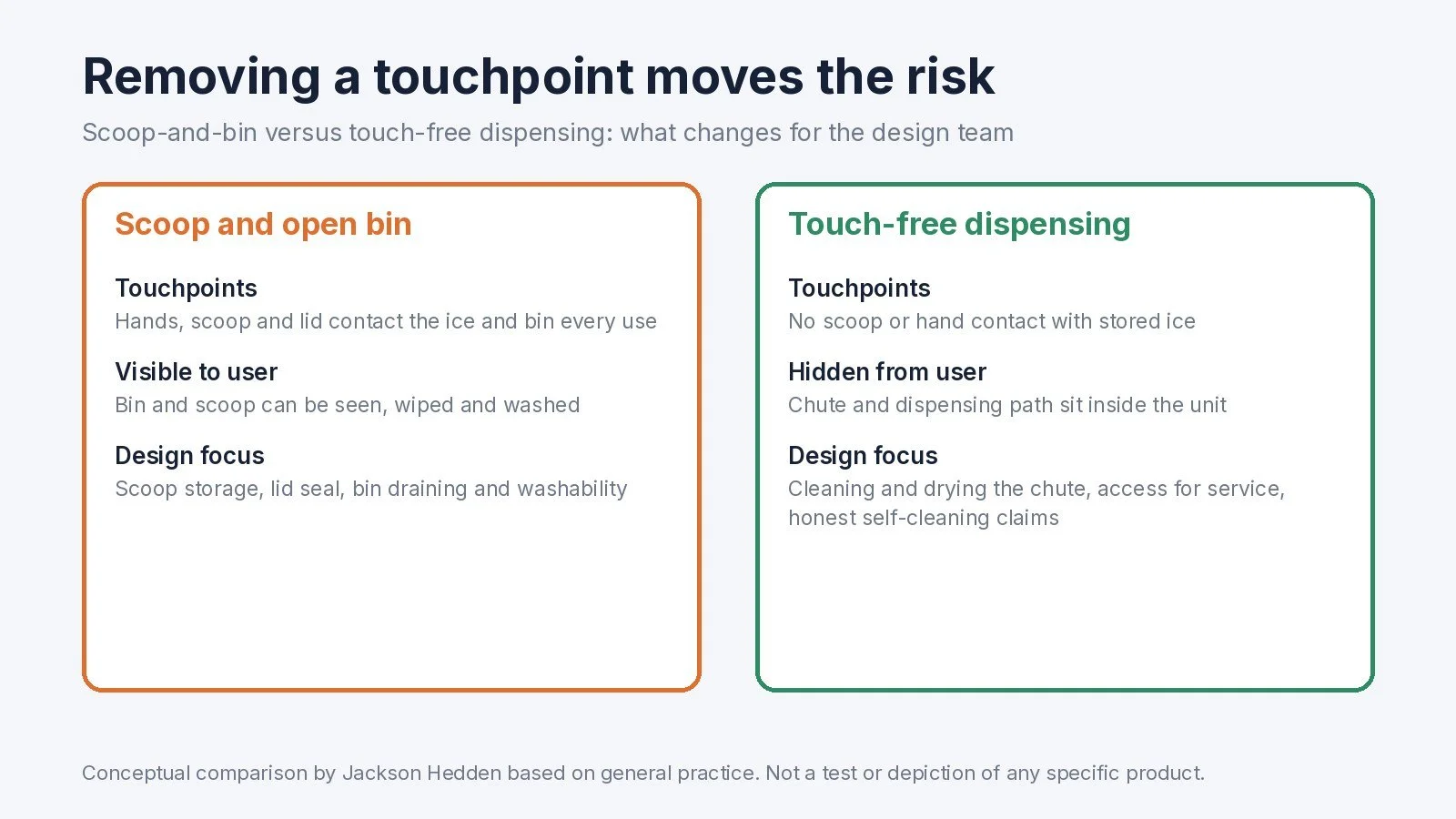
Touch-free dispensing removes the scoop but moves the cleaning challenge inside the unit. Conceptual comparison by Jackson Hedden; not a test of any specific product.
What this means for product teams
For founders and teams working with consumer product design companies on any appliance that touches water or food, five practical steps help:
- Draw the water path first. Map every surface water or ice touches, then remove dead ends, sharp internal corners and pockets that cannot drain.
- Design the cleaning, then the cleaning cycle. Decide which parts users remove and wash, and make them tool-free and dishwasher-friendly where materials allow. Then define what an automatic cycle must reach.
- Pick food-contact materials early. Choose plastics, seals and coatings suited to food contact and cleaning chemicals before tooling, the costly molds that form production parts. Our article on glass air fryers and PFAS-free coatings explains why material claims need evidence.
- Test hygiene with real use. In EVT (engineering validation test, the first builds proving the design works) and DVT (design validation test, proving it meets requirements with production-intent parts), run units through weeks of realistic use and skipped cleanings, then open them up.
- Write claims you can support. Keep marketing language about health and cleanliness tied to what you have tested.
If you are comparing consumer product design companies for a kitchen or home appliance, see how our team designs hygiene, cleanability and manufacturability in from the start, or contact us to talk through your project.
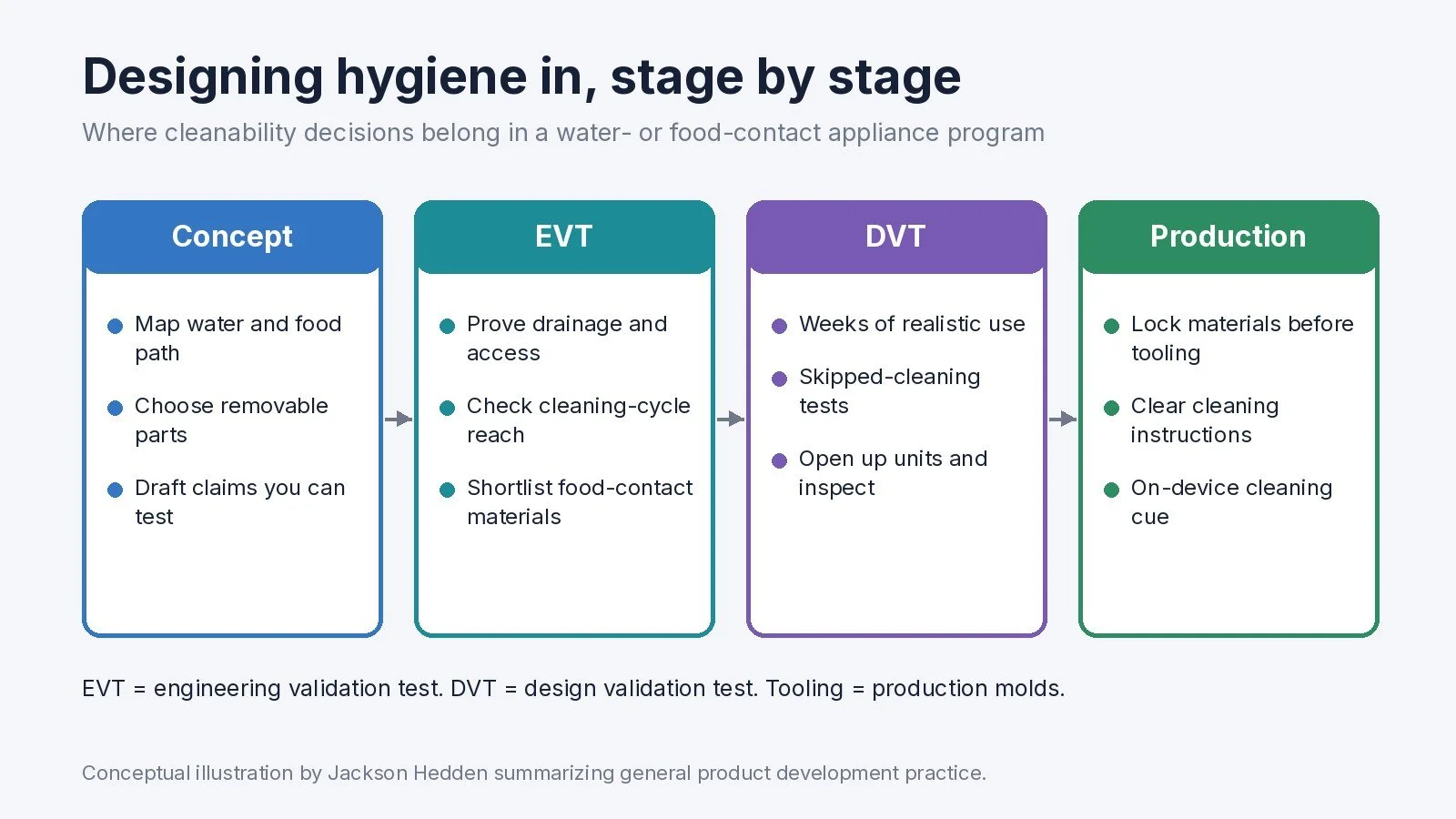
Where cleanability decisions belong in an appliance program. Conceptual illustration by Jackson Hedden summarizing general product development practice.
Frequently asked questions
What is the ecozy Mistalo DropCore? It is a countertop smart nugget ice maker that ecozy launched on November 17, 2026. ecozy says it makes up to 45 pounds of ice a day, dispenses ice without a scoop, and has one-touch self-cleaning and app control.
Why is cleanability so important in ice makers? Ice is treated as a food, and ice makers keep water moving through cold, damp parts where biofilm can grow. If parts are hard to reach or do not drain, cleaning cycles and users may miss them.
Does a TDS display mean ice is safe? No. TDS measures dissolved minerals and salts, which affect taste and scale. It does not detect bacteria, so it is not a sign of sanitation.
How do consumer product design companies design appliances for hygiene? They map the water or food path early, remove spots where water can pool, make cleanable parts removable, choose suitable food-contact materials, and test units through realistic use before production.
Jackson Hedden is a product design, development and manufacturing firm helping founders and product teams take consumer and industrial products from concept to production.
Sources
- ecozy, "ecozy Launches the Mistalo DropCore Smart Nugget Ice Maker Dispenser for a New Generation of Smarter, Healthier Ice Making," PR Newswire, November 17, 2026: https://www.prnewswire.com/news-releases/ecozy-launches-the-mistalo-dropcore-smart-nugget-ice-maker-dispenser-for-a-new-generation-of-smarter-healthier-ice-making-302940314.html
- ecozy, "ecozy Mistalo Drop Core Smart Nugget Ice Maker Dispenser IM-ND332B," product page, accessed November 17, 2026: https://ecozy.com/products/ecozy-mistalo-drop-core-smart-nugget-ice-maker-dispenser-im-nd332b
- Intertek, "Standards Update Notice: NSF/ANSI 12 Automatic Ice Making Equipment," issued January 13, 2026: https://www.intertek.com/siteassets/resources/sun/2026/nsf-ansi-12-sun-rev-2-22-2024-ed-9-1-2027-amendment-1.pdf
- U.S. Food and Drug Administration, "FDA Regulates the Safety of Packaged Ice," accessed November 17, 2026: https://www.fda.gov/food/buy-store-serve-safe-food/fda-regulates-safety-packaged-ice