On November 17, 2026, Xiaomi launched the Robot Vacuum 6 Max in the UK, a robot vacuum with three extendable cleaning arms, two "bionic" legs for climbing 6 cm thresholds and a self-cleaning dock that washes its mop with 85°C water.
Key takeaways
- Xiaomi's Robot Vacuum 6 Max adds at least five deployable mechanisms to a 9 cm-tall robot: an extendable side brush, an arm-mounted roller, an extendable corner mop, two climbing legs and a retractable laser radar.
- Robot vacuums now compete on reach (edges, corners, thresholds and low furniture) more than on suction alone.
- Every moving part brings a motor, a seal, a sensor, a firmware state and a failure mode, and all of them must survive hair, water and grit.
- The dock now does heavy work, with hot-water washing, hot-air drying and auto-emptying, so the robot and dock should be designed and tested as one system.
- For product teams, the lesson is to make each new mechanism earn its place in cost, reliability and serviceability, not just in the feature list.
What consumer product design firms see in Xiaomi's arms-and-legs robot vacuum
Robot vacuums are a crowded home-robotics category, and Xiaomi's flagship shows where competition has moved. Below we separate what was reported from our analysis.
What was reported
The launch. Trusted Reviews and T3 reported on November 17 that the Robot Vacuum 6 Max is available in the UK through mi.com, Amazon and Xiaomi stores. It lists at £899.99, with an introductory price of £729.99 until November 30. T3 notes it was first announced in August.
Arms, legs and lifts. According to Xiaomi's UK product page, a "triple mechanical arm" system combines an extendable side brush for corners, an arm-mounted roller that follows walls and an extendable corner-cleaning mop pad that reaches around furniture legs. Xiaomi cites TÜV Rheinland certification for its edge-cleaning claims, and Trusted Reviews reports up to 95% whole-home edge and corner coverage in TÜV Rheinland testing. Two "bionic dual mechanical legs" let the robot climb single steps up to 6 cm. A "triple lift" design raises the brush, roller and mop automatically, such as lifting the roller mop 10 mm on carpet.
Height and sensing. The specifications page lists the robot at 350 mm in diameter and 90 mm tall with its LiDAR lowered. Xiaomi says the retractable laser radar lets the robot reach spaces as low as 9.3 cm. Xiaomi rates suction at 35,000 Pa and says a triple-camera AI system recognizes more than 200 obstacle types and 47 kinds of stains.
The dock. The omni station washes the roller and mop pad at up to 85°C, dries them with 50°C air and empties dust into a sealed bag that Xiaomi says needs replacing about every 75 days. The specs list 1,200 W of input power in hot-water washing mode and a footprint of 470 × 360 × 582 mm including the dock ramp.
A pattern, not a one-off. The same day, Impress K-tai Watch reported that Xiaomi Japan will release the Xiaomi Robot Vacuum H50 Pro on November 27 at 69,800 yen, with "dual robot arms" (an extendable side brush and mop arm). Trusted Reviews also notes that the 6 Max's climbing legs put it alongside recent flagships from rivals such as Dreame.
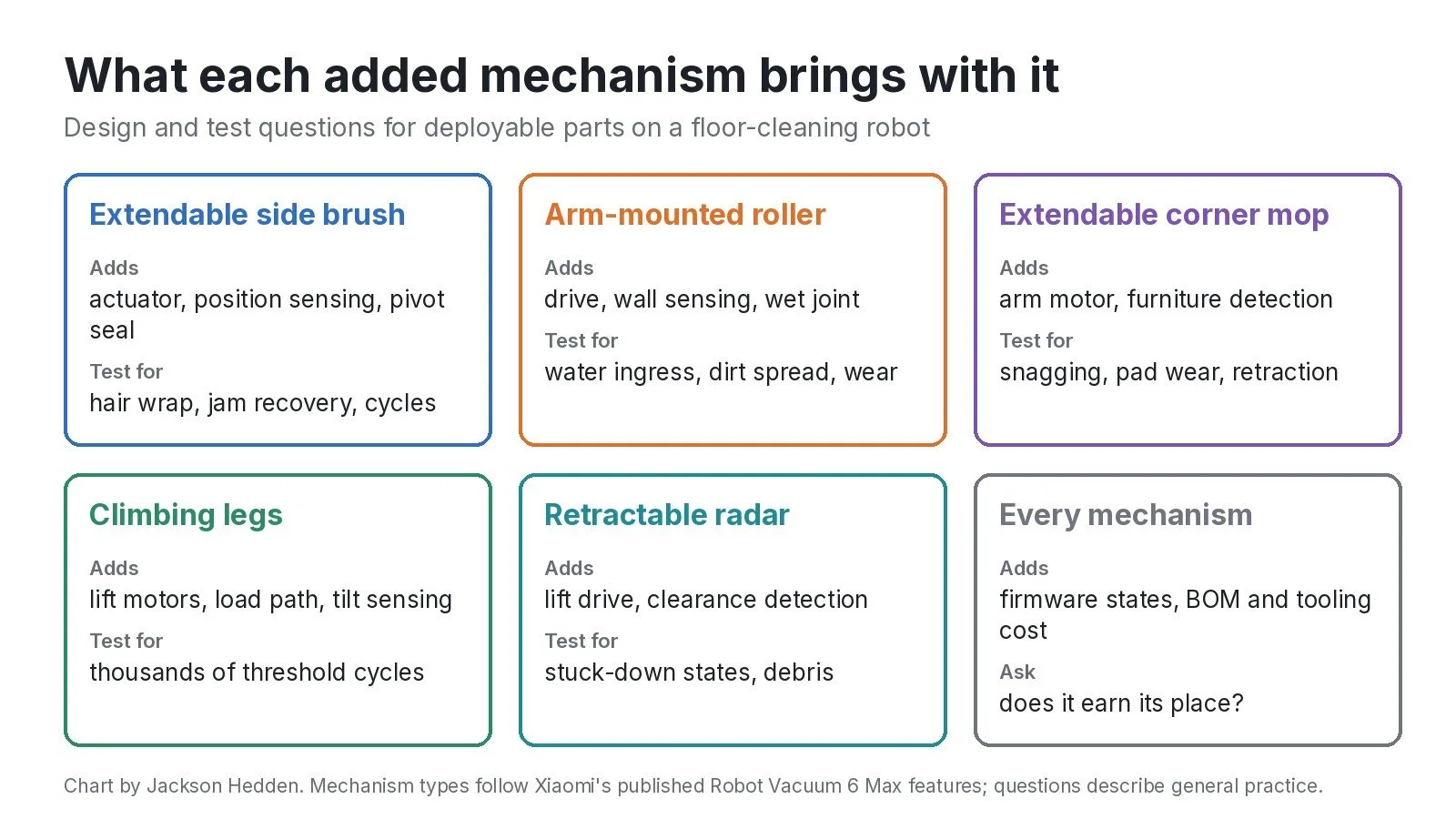
Mechanism types follow Xiaomi’s published Robot Vacuum 6 Max features; the design and test questions describe general practice. Chart by Jackson Hedden.
The engineering cost of every new mechanism
This section and the next are Jackson Hedden analysis based on general consumer product development practice, not a description of Xiaomi's internal design or test process.
Each mechanism on a robot like this is a small product of its own. An actuator (the motor or solenoid that moves a part) needs a drive train, a position sensor or limit switch, a seal where it passes through the housing, a firmware state that decides when to deploy it, and a recovery behavior for when it jams. Multiply that by five and integration work grows faster than the feature list.
The environment is hostile. A floor-cleaning robot moves through hair, pet fur, grit, liquid spills and cleaning solution. Every pivot is a place for hair to wrap and water to wick in. Experienced consumer product design firms usually treat ingress protection (keeping water and dust out of electronics) and anti-tangle geometry as primary requirements for each joint, not as late fixes.
Height is a fixed budget. A 9 cm body carrying a battery, fan, dust box, cameras, retractable radar and legs leaves little room. That budget pushes teams toward tight tolerance stacks (the way small variations in each part add up across an assembly), thin walls and custom motors, which raise tooling (the molds and fixtures used for mass production) and bill of materials (BOM) cost.
Reliability is a cycle-count problem. Arms that extend at every corner and legs that lift at every threshold accumulate many thousands of cycles over a product's life. Durability testing should mimic that on dirty, wet floors and be planned from EVT (engineering validation test, early builds that prove the design works) through DVT (design validation test, builds from production tooling that must pass reliability and compliance testing).
The dock is half the product. Washing and drying bring mains-voltage heaters, hot surfaces, pumps, water tanks and scale build-up into the home. Thermal safety, leak paths and cleaning access deserve the same attention as the robot.
Service and consumables decide long-term satisfaction. Brushes, mop pads, filters and dust bags are consumables, and arm and leg modules are likely wear points. Whether a worn arm is a snap-in module or a full teardown shapes warranty cost and repairability, a topic regulators are watching, as we covered in our look at EU repairability rules.
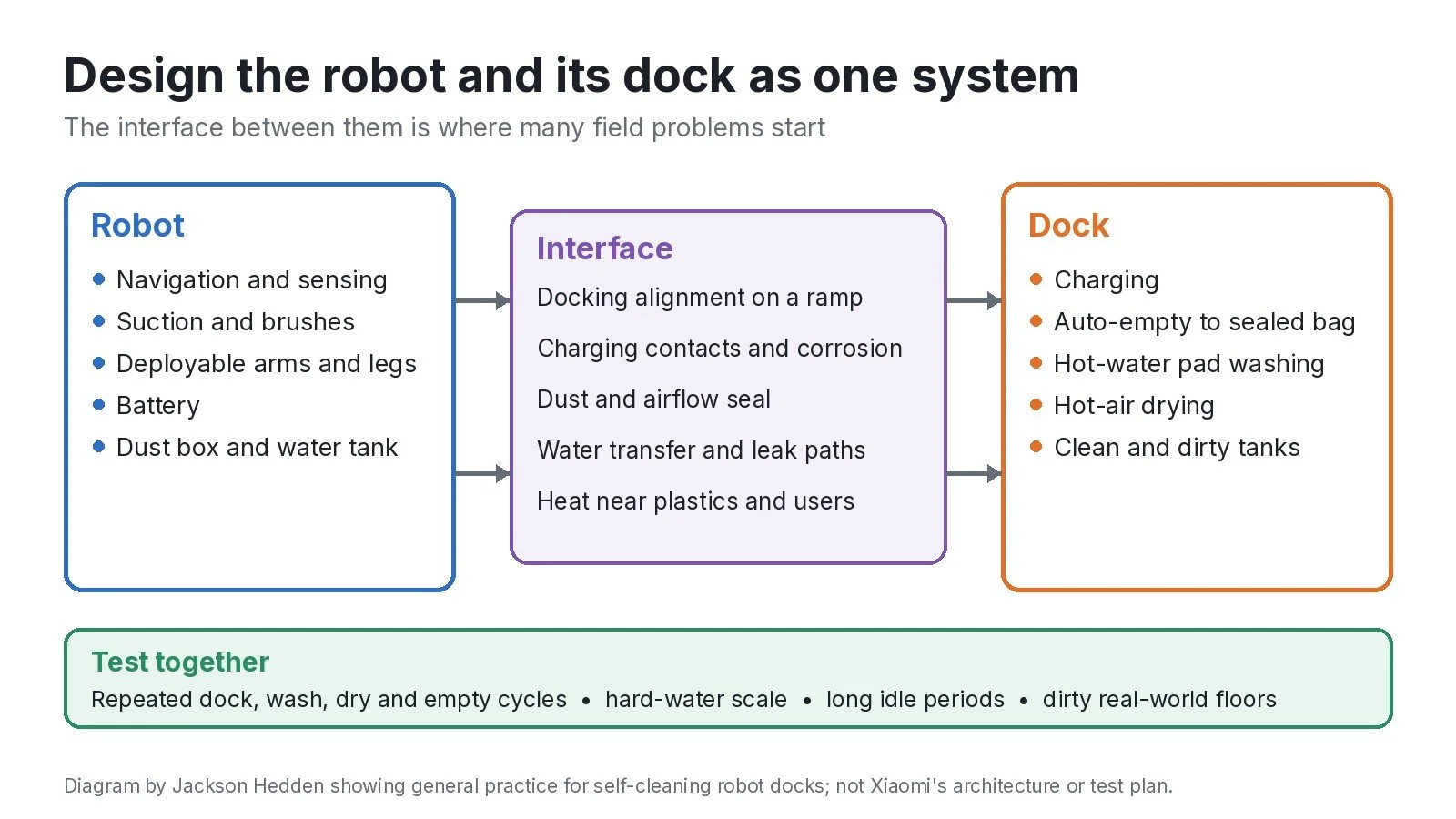
Why the robot and its dock should be designed and tested together. General practice drawn by Jackson Hedden; not Xiaomi’s architecture or test plan.
What this means for product teams
For any robot vacuum, lawn robot or motorized home device, these practices apply:
- Make each mechanism justify itself. For every actuator, document the user problem it solves, its BOM and tooling cost, and its failure modes.
- Design the failure behavior. Decide what each arm or leg does when it jams, loses position or loses power. It should stop or retract safely and tell the user.
- Seal and de-tangle every joint. Use labyrinth seals, drain paths and hair-shedding geometry at pivots, and test them with real hair, pet fur and liquids.
- Protect the height budget early. Lock the exterior envelope and key component stack-up before industrial design details, so new features fit inside it.
- Test the robot and dock together. Include docking alignment, wash, dry and empty cycles, hard-water scale and long idle periods.
- Plan DFM for small mechanisms. DFM (design for manufacturing) reviews should cover tiny gears, springs and flexible cables, where molding and assembly variation matters most.
- Make wear parts user-replaceable. Treat arms, pads and brushes as service modules with simple access, clear part numbers and instructions.
Our post on PETKIT's automatic litter box looks at fail-safe design for another motorized home appliance.
If you are planning a home robot or motorized appliance and comparing consumer product design firms to help with mechanism architecture, DFM and reliability testing, see how we approach consumer product design or contact our team to talk through your project.
Frequently asked questions
What is new about the Xiaomi Robot Vacuum 6 Max? It combines three extendable cleaning arms, two climbing legs for thresholds up to 6 cm, a retractable laser radar for low furniture and a dock that washes mop parts at up to 85°C. It went on sale in the UK in November 2026 at a standard price of £899.99.
Why are robot vacuums adding arms and legs? Suction is already high across premium models, so brands compete on coverage of edges, corners, furniture legs and thresholds. Extendable mechanisms reach areas a round body cannot.
Do more moving parts make a robot vacuum less reliable? Not necessarily, but each mechanism adds failure modes that must be designed and tested out. Sealing, anti-tangle features, jam recovery and long cycle testing on dirty floors determine whether added features last.
What should a team look for in a design partner for a home robot? Look for mechanical, electrical and firmware integration experience, a clear EVT/DVT test plan and DFM experience with small mechanisms. Ask how they plan serviceability and consumables, too.
Jackson Hedden is a product design, development and manufacturing firm helping founders and product teams take consumer and industrial products from concept to production.
Sources
- Xiaomi UK, "Xiaomi Robot Vacuum 6 Max" product page, accessed November 17, 2026: https://www.mi.com/uk/product/xiaomi-robot-vacuum-6-max/
- Xiaomi UK, "Xiaomi Robot Vacuum 6 Max Specs," accessed November 17, 2026: https://www.mi.com/uk/product/xiaomi-robot-vacuum-6-max/specs/
- Gian Estrada, "Xiaomi's new robot vacuums reach the spots most cleaners can't," Trusted Reviews, November 17, 2026: https://www.trustedreviews.com/news/xiaomis-new-robot-vacuums-reach-the-spots-most-cleaners-cant
- Lizzie Wilmot, "Xiaomi's new robot vacuum has 35,000Pa suction, and that's not even its cleverest feature," T3, November 17, 2026: https://www.t3.com/home-living/vacuum-cleaners/xiaomis-new-robot-vacuum-has-35-000pa-suction-and-thats-not-even-its-cleverest-feature
- Impress K-tai Watch, report on the Xiaomi Robot Vacuum H50 Pro (Japanese), November 17, 2026: https://k-tai.watch.impress.co.jp/docs/news/2157217.html