On November 12, 2026, PETKIT's Japanese distributor Ueni Trading announced the PETKIT Automatic Cat Litter Box P9906 (sold as the PUROBOT MAX 3), a self-cleaning litter box that went on sale in Japan on November 13 with an entrance about 43% larger than its predecessor and a safety design that keeps the exit open even if power or sensors fail.
Key takeaways
PETKIT enlarged the P9906's entrance from 20 × 25.5 cm to 26.7 × 27.3 cm while keeping the body size and weight close to the previous model, according to the company's Japanese product page.
Safety is layered: 12 sensors track a cat's movement and weight and stop the drum, and a mechanical design keeps the entrance from fully closing during power outages or sensor faults.
Pet appliances have two users with different needs. The cat needs access, space and safety; the owner needs low odor, less cleaning and useful data.
The app's alerts on changes in litter box use are explicitly positioned as not diagnosing illness, a useful model for wording any health-adjacent feature.
For product teams, the main lesson is to design failure behavior into the mechanism rather than relying on software alone.
What consumer product design firms can learn from PETKIT's new litter box
Automatic litter boxes put a motorized mechanism, sensors and connectivity in a small enclosed space with a live animal, odor and moisture. That makes the P9906 a useful case study for any home appliance that moves on its own. Below we separate what was reported from our analysis.
What was reported
A bigger door in the same footprint. According to Ueni Trading's press release, the P9906 succeeds the P9902 and keeps automatic waste removal and app-based health logging. The entrance grows from 20 × 25.5 cm to 26.7 × 27.3 cm, which the company says makes it easier for large cats, senior cats with joint concerns and short-legged breeds to get in and out. The interior offers 76 liters of space for turning and digging. PETKIT's product page lists an entrance height of 204 mm and says body size and weight are nearly unchanged from the previous model, so it fits the same floor space.
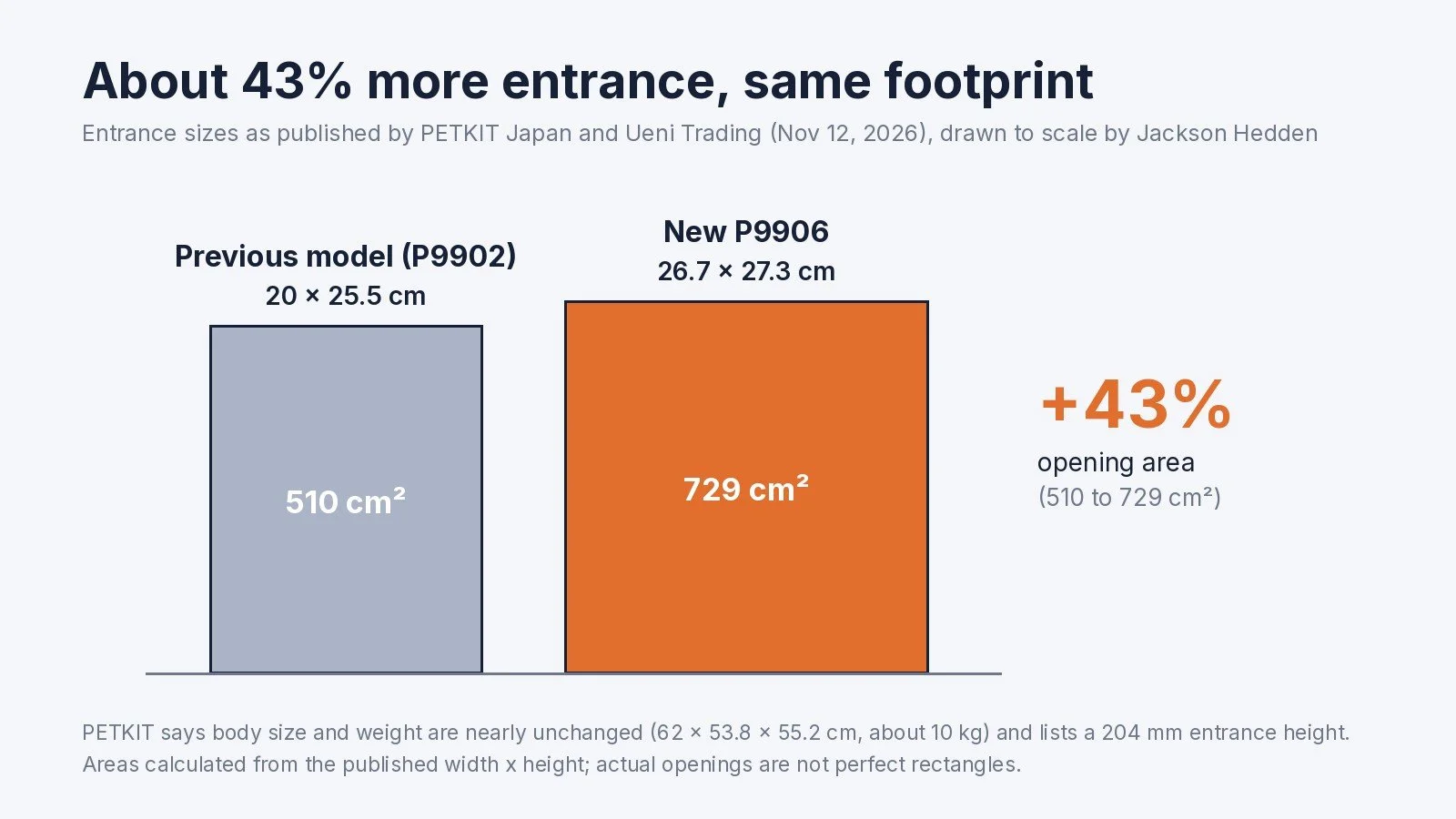
P9906 and P9902 entrance sizes as published by PETKIT Japan and Ueni Trading (November 12, 2026), drawn to scale by Jackson Hedden. Areas are calculated from width x height.
Layered safety. The release says 12 high-precision sensors detect the cat's movement and weight in real time. If a cat approaches during automatic cleaning, the drum stops rotating and only resumes after the system confirms it is safe. PETKIT also describes a structural safeguard that does not depend on sensors: the entrance is designed never to close completely during rotation. The product page explains this as a gear that is not a full circle, so an exit remains open during power outages or when sensors are not working.
Odor, cleaning and capacity. The "OdorVoid Defense System" combines automatic waste collection, a sealed 7-liter waste bin and dedicated deodorizers, with an in-drum air deodorizer included only in the full set. The company says the bin holds up to about 15 days of waste for one cat, the litter mat resists sticking about twice as well as before, and a "ShieldBase" structure helps prevent leaks.
Data, carefully worded. The app records visits, time spent and weight, and identifies cats in multi-cat homes by weight. New alerts flag changes in use patterns or extended non-use; the release says "several days," while the product page says 24 hours. Both state the feature does not diagnose illness. Pricing in Japan is 62,500 yen for the full set and 59,800 yen for the basic set.
The same week, trade outlet Pet Age reported on WAUDOG's cordless pet water fountain (November 13), which runs one to two weeks on a 4,000 mAh battery so owners can place it where pets prefer to drink rather than near an outlet. Both launches design around the animal's behavior first.
Our analysis: designing for two users and for failure
The pet is the primary user, and it cannot read the manual
Most consumer products assume a user who can learn and follow instructions. A cat does neither. If the entrance is too small or the interior too cramped, the cat goes somewhere else, and the product has failed regardless of its features. Enlarging the opening by roughly 43% without growing the footprint is the kind of change that decides whether a product gets used, and it forces hard tradeoffs between drum geometry, wall thickness and internal clearances.
Fail-safe design matters when a living thing is inside
The more instructive detail is the safety architecture. Sensors are the first layer: detect a cat, stop the motor. But sensors can fail, wiring can be damaged and power can drop. PETKIT's answer is geometry: a mechanism that cannot fully close the exit. In engineering terms, the product fails safe: it falls into a harmless state when control is lost. The same principle applies to any appliance with moving parts near people, children or pets.
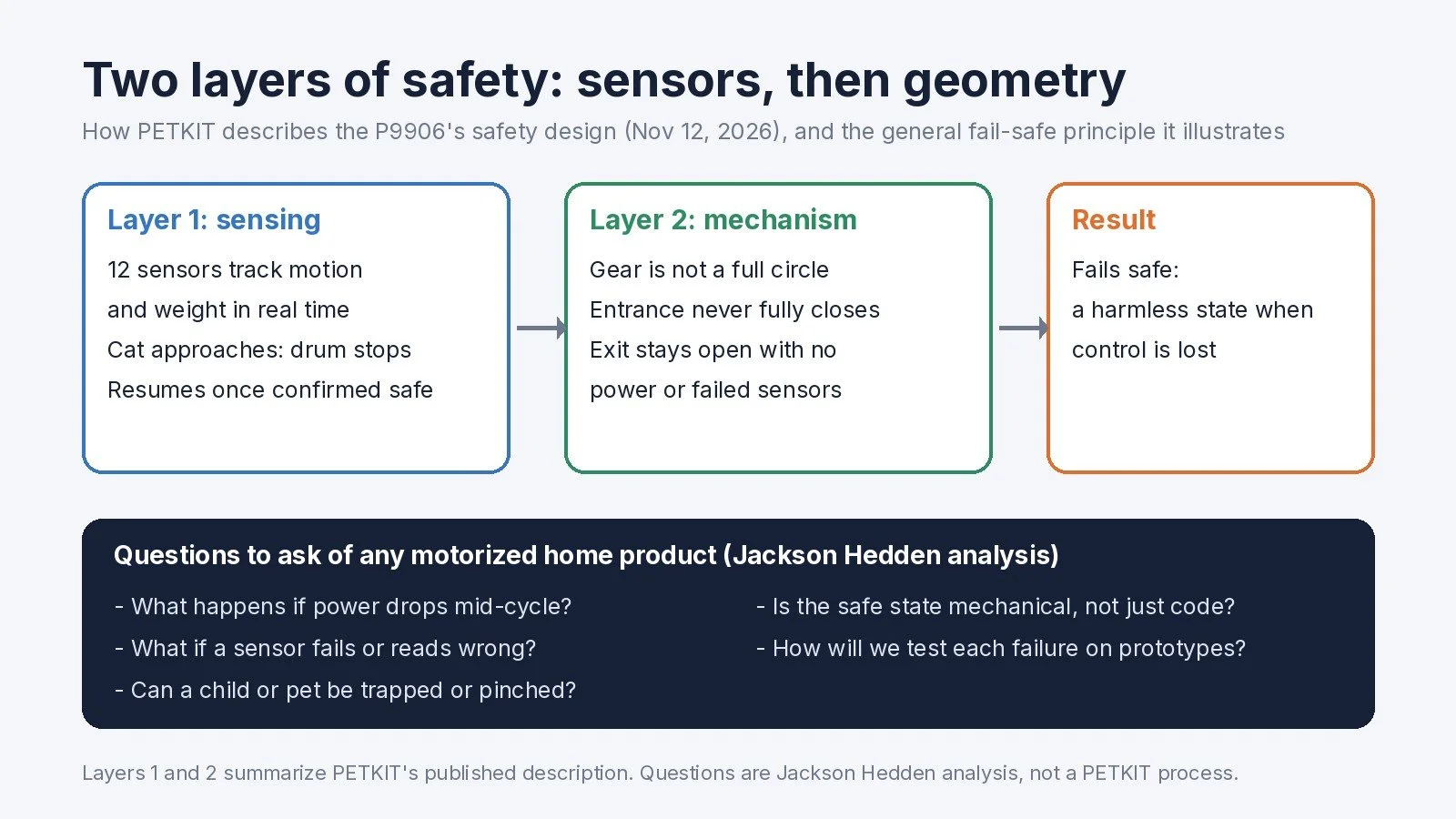
Safety layers as described by PETKIT (November 12, 2026). The design questions are Jackson Hedden analysis, not a PETKIT process.
Data that helps without overpromising
Weight-based identification and usage alerts give owners a reason to keep using the app. The careful "not a diagnosis" framing matters just as much: health-adjacent claims can change the testing, labeling and review a product needs, so settle that wording with the design, not at launch.
What this means for product teams
Whether you are developing a pet appliance, a robot vacuum, a baby product or any motorized home device, these are the questions experienced consumer product design firms should raise early.
Map every user and their failure modes. List everyone who interacts with the product, including animals and children, and what happens when each behaves unexpectedly.
Make the safe state mechanical where you can. Use geometry, clutches, spring returns or limited travel so the product stays safe with no power and no software. Treat sensors as the first layer, not the only one.
Protect ergonomic gains with packaging discipline. Set the exterior envelope early and make internal components justify their space.
Design for the mess. Moisture, odor and hair are design inputs. Specify sealing, cleanable surfaces and serviceable filters before the form is locked.
Prototype with real behavior. Test early looks-like and works-like prototypes with real users; for pet products, that means supervised trials with animals.
Validate in stages. Use EVT (engineering validation test, early builds that prove the design works) for mechanism and sensor tuning, and DVT (design validation test, builds from production tooling, the steel molds used to make plastic parts) for durability, leak and noise testing.
For related reading, see how TAO Clean designed a self-sanitizing reservoir and how Jackery designed backup power for outages at home. For another motorized home device, see what Xiaomi's arm-and-leg robot vacuum shows about adding mechanisms.
Frequently asked questions
What is the PETKIT P9906 automatic litter box?
It is a self-cleaning cat litter box, sold as the PUROBOT MAX 3, that went on sale in Japan on November 13, 2026. It rotates to separate and store waste, logs each cat's use and weight in an app, and has an entrance about 43% larger than its predecessor.
How do automatic litter boxes keep cats safe?
The P9906 uses 12 sensors to detect a cat's movement and weight and pause the drum. It also uses a mechanical design that keeps the entrance from fully closing, so a cat can exit during a power outage or sensor fault.
What is a fail-safe design?
A fail-safe design returns a product to a harmless state when power, sensors or software fail. It usually relies on mechanical features such as geometry, springs or limited travel rather than code alone.
What should I look for in a design partner for a pet or home appliance?
Look for experience with motorized mechanisms, sealing and cleanability, safety testing and taking products through EVT and DVT into production. Ask how they prototype with real users and how they handle failure modes.
If you are comparing consumer product design firms for a pet product or home appliance where safety and everyday usability have to work together, see how we approach consumer products or contact our team to talk through your mechanism and safety strategy before tooling.
Jackson Hedden is a product design, development and manufacturing firm helping founders and product teams take consumer and industrial products from concept to production.
Sources
Ueni Trading (PR TIMES, in Japanese), "PETKIT Automatic Cat Litter Box (P9906) to launch November 13," November 12, 2026: https://prtimes.jp/main/html/rd/p/000002077.000025284.html
PETKIT Japan, product page for the Automatic Cat Litter Box Full Set / P9906 (PUROBOT MAX 3), accessed November 16, 2026: https://petkit.co.jp/products/pkt-p9906
Digital Magazine (in Japanese), "PETKIT Automatic Cat Litter Box (P9906) launched; entrance about 43% larger," November 13, 2026: https://digimaga.jp/70686/
Pet Age, "WAUDOG Introduces Wireless Pet Water Fountain with Up to Two Weeks of Battery Life," November 13, 2026: https://www.petage.com/waudog-introduces-wireless-pet-water-fountain-with-up-to-two-weeks-of-battery-life/