On November 12, 2026, Jackery announced the Canadian launch of FridgeGuard, a 2.6-inch-thick refrigerator backup battery in a silver finish that the company says is designed to sit openly in the kitchen instead of being hidden in a garage.
Key takeaways
- Home backup power is being redesigned as a visible kitchen product, not utility hardware, and that changes the brief from "rugged and portable" to "quiet, slim and permanent."
- FridgeGuard drops Jackery's familiar orange-and-black look for silver, a deliberate color, material and finish (CMF) decision tied to where the product will live.
- Packing a 1,024 Wh battery into a 67 mm profile pushes hard on thermal design, acoustics, mounting and safety certification at the same time.
- A dedicated product that does one job well (keep the fridge running) can be simpler to use than a general-purpose power station, but it also gives up flexibility, such as a single AC outlet.
- For an industrial design company, the lesson is that a product category can be repositioned by its environment as much as by its specs.
What an industrial design company sees in Jackery's fridge battery
Refrigerator backup batteries are not new; Jackery's product is already sold in the US, and Bluetti sells a competing FridgePower unit. What makes this launch worth reading closely is how openly Jackery frames it as a design move. Below we separate what was reported from our own analysis.
What was reported
The launch. According to Jackery's November 12 press release, FridgeGuard debuts in Canada as an online Costco exclusive at CAD $699.99, reaches select Costco warehouses from November 18 to 21, and expands to Jackery's Canadian site and Amazon.ca with pre-orders from November 24 ahead of a December 11 launch. Jackery says the product has received an iF Design Award 2026 and a place in Japan's Good Design Best 100.
The design language. The release says the unit "departs from Jackery's established orange-and-black, utility-focused visual signature" with a silver finish meant to sit alongside stainless steel appliances. It is 2.6 inches (67 mm) thick and weighs 23 lbs (10.5 kg), and can be floor-standing, bracket-mounted or wall-mounted. It plugs in between the wall outlet and the refrigerator and stays on standby.
The engineering. Jackery lists a 1,024 Wh lithium iron phosphate (LiFePO4) battery rated to keep at least 70% capacity after 6,000 cycles, a switchover to battery in 10 ms or less, a bypass mode that sends grid power straight to the fridge once the battery is full, 800 W continuous output on a single AC outlet with 1,600 W peak for compressor start-up, and up to 15 hours of runtime (30 with an expansion battery). It cites UL 1778, UL 1741 and UL 1973 certifications, UL 94-5VA flame-retardant materials, paint- and VOC-free materials, and operation below 40 dB. Jackery's spec sheet lists a PC + ABS housing, 60 x 32.5 x 6.7 cm dimensions and a cooling fan rated at 30 dB or less.
How it compares. In a September 2026 hands-on comparison, Business Insider found the Jackery ran a 26-cubic-foot refrigerator for 15 hours and 45 minutes and was easy to lift onto a fridge alone. The Bluetti FridgePower offered roughly twice the capacity and two AC outlets, but at about 43 pounds and a 3-inch-thick chassis.
From the garage to the kitchen: why placement rewrites the brief
The most interesting design decision here is not the battery. It is the decision about where the product lives. A portable power station is designed to be carried, dropped and stored, so it earns bright colors, handles and rugged corners. A product that sits beside the refrigerator every day is judged like an appliance: how it looks next to stainless steel, how much space it takes, whether anyone notices it humming.
That shift changes almost every requirement at once. Slimness becomes a headline feature because counter, wall and fridge-top space is scarce. Noise matters because the product runs all day in a room people talk in. Mounting options matter because kitchens vary. And the visual identity has to work for a renter's galley kitchen as well as a renovated one, which usually pushes toward quiet neutral finishes rather than strong brand colors.
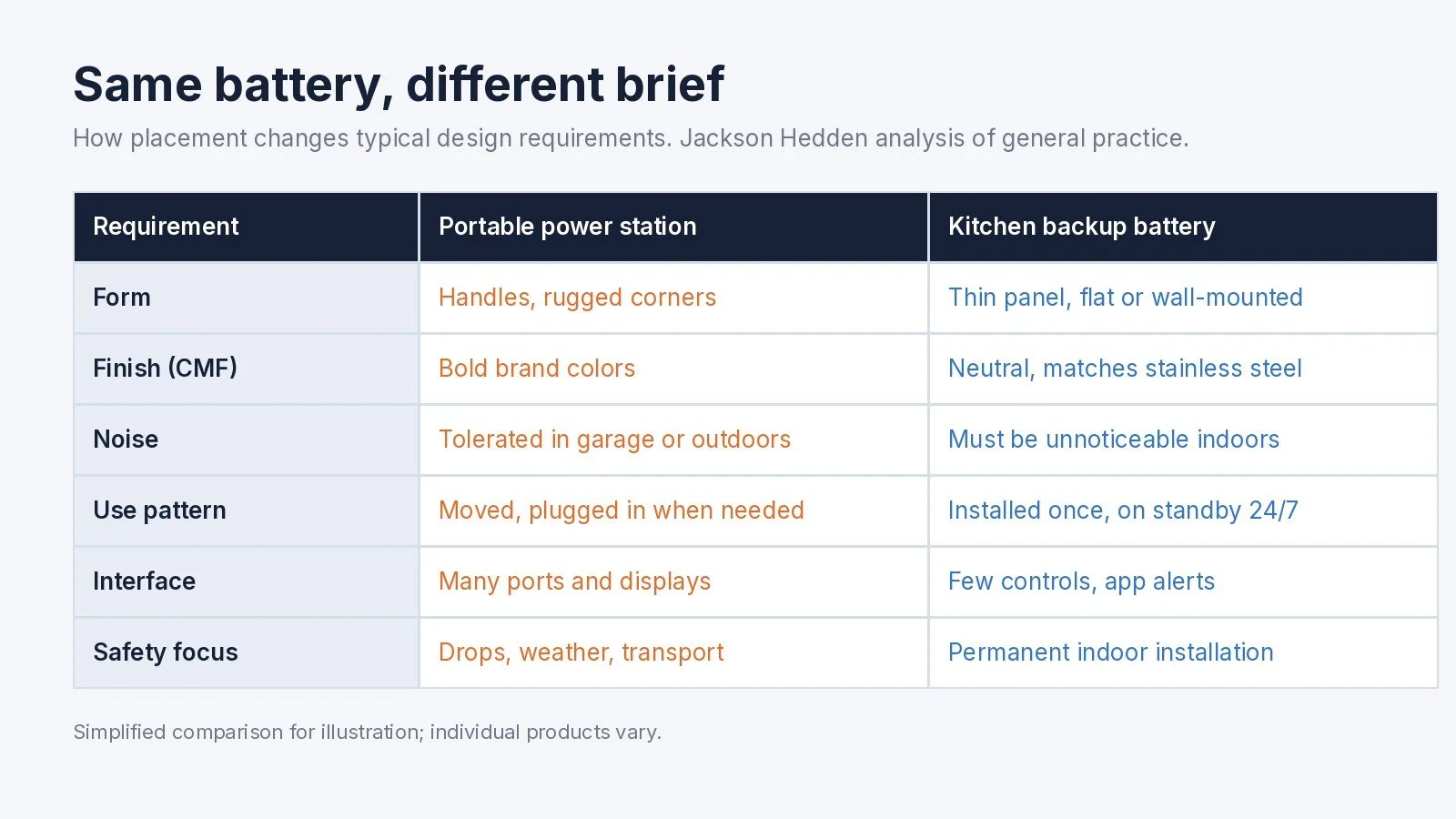
How placement changes typical design requirements. Simplified Jackson Hedden analysis of general practice; individual products vary.
The engineering trade-offs behind a 2.6-inch battery
Here is our analysis of the trade-offs a team faces when it designs this kind of product. We have not torn down FridgeGuard; these are the general constraints of the category.
Thermal design. A thin enclosure has less internal air volume and a short path from cells and electronics to the outer skin. Heat has to be spread and moved without the surfaces feeling hot or the fan becoming audible. Business Insider noted the unit reached about 80 degrees in its testing while the fan exhaust felt only slightly warm, which suggests airflow was a priority.
Acoustics. Fans and inverters that would go unnoticed in a garage become obvious in a quiet kitchen at night. Fan curves, enclosure stiffness and where vents point all affect how loud a product feels, not only how loud it measures. It is worth noticing that Jackery's release and spec sheet quote different noise figures, under 40 dB and 30 dB or less, which likely reflect different conditions. Teams should define exactly how and where they will measure noise before it becomes a marketing claim.
Safety and materials. A battery that lives inside the home permanently carries a different risk profile than one used occasionally outdoors. Flame-rated plastics, cell chemistry choice (LiFePO4 is generally chosen for thermal stability and cycle life), and certification to the relevant UL standards shape the enclosure design early. They are not stickers added at the end.
Doing one job well. A dedicated fridge backup can be much simpler to use than a general power station: plug it in once and forget it. The cost is flexibility. FridgeGuard has one AC outlet and 800 W continuous output, which Business Insider listed as limitations. Deciding what to leave out is a core industrial design choice, and it should be made with the target user, not the spec sheet, in mind.
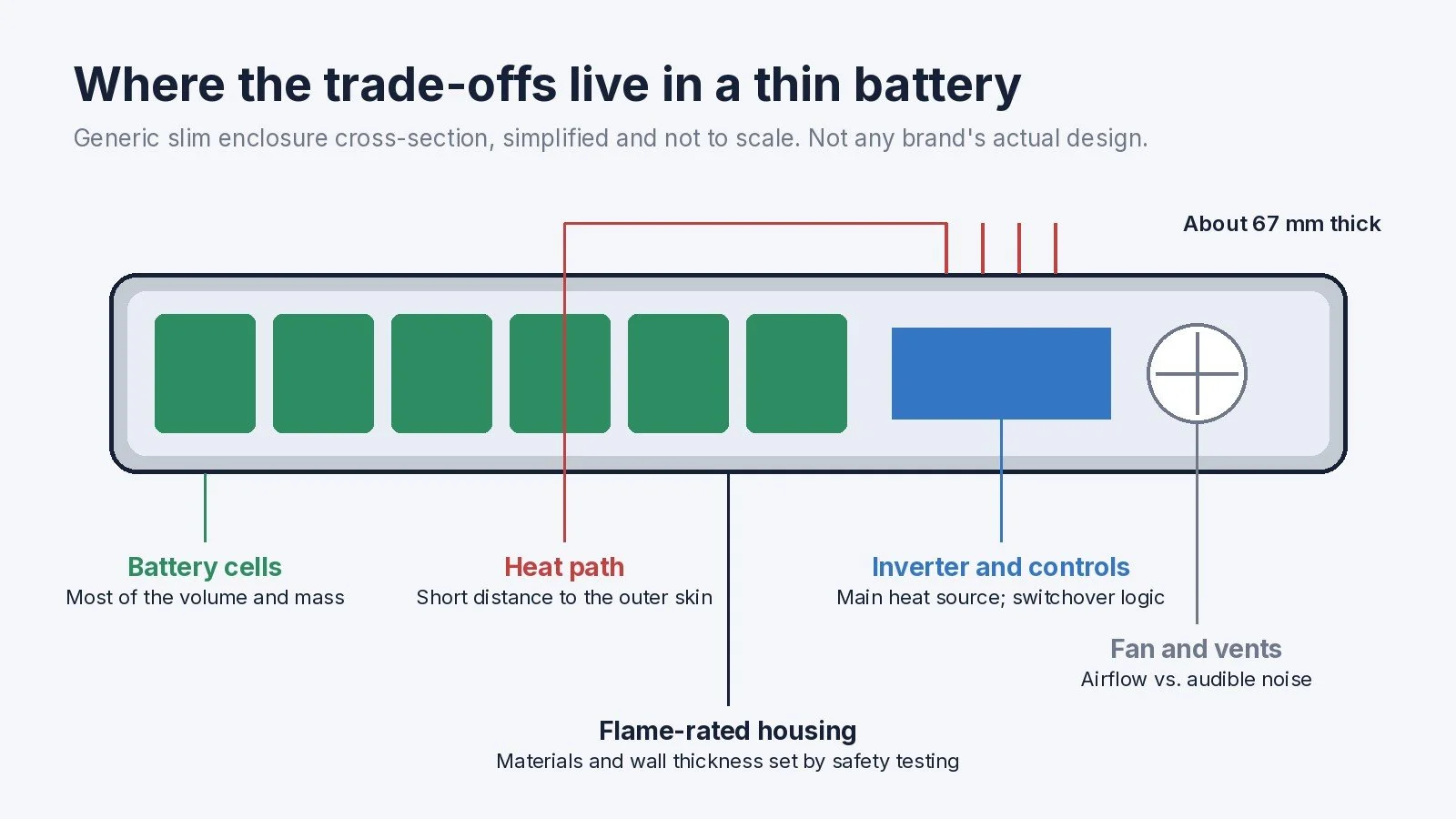
Generic slim battery enclosure, simplified and not to scale, showing where thermal, acoustic and safety trade-offs sit. Not any brand’s actual design.
What this means for product teams
If you are developing a product that is moving from a utility space into a living space, such as a battery, air purifier, water filter, router or charging station, a few practical lessons apply.
- Write the brief around the room, not just the function. Define where the product will sit, who will see it every day and what it sits next to. That will drive size, finish, noise and mounting more than you expect.
- Treat CMF as a positioning tool. Changing color, material and finish can move a product into a new channel and price point without changing what it does. We looked at a similar move in our article on Logitech's CMF-only special editions.
- Prototype for thermals and sound early. Build an engineering prototype with real heat loads in the final enclosure thickness before the industrial design is locked. Thin products leave little room to fix problems later.
- Plan certification into the enclosure. Material choices, venting and wall thickness all affect safety testing. Bring in compliance planning before tooling, the steel molds used to mass-produce plastic parts, is ordered.
- Decide what you will leave out. A focused product is easier to use, but every omission (ports, output, expandability) needs a clear reason that customers will accept.
Kitchen products face similar pressures on materials and safety; our recent piece on glass air fryers and PFAS-free coatings covers that side. Working with an experienced industrial design company helps connect these decisions so the look, the engineering and the certification plan support each other instead of fighting late in development.
Frequently asked questions
What is a refrigerator backup battery? It is a battery and inverter that sits between the wall outlet and the refrigerator. When grid power fails, it switches the fridge to battery power automatically, usually within milliseconds, so food and medications stay cold without anyone moving equipment.
Why would a battery maker change a product's color for the kitchen? Products that live in shared rooms are judged by how they look and sound next to other appliances. Jackery says FridgeGuard's silver finish was chosen to sit beside stainless steel appliances, moving away from its orange-and-black outdoor look.
Why is it hard to make a backup battery thin? A thin enclosure leaves less space to spread heat, route air and isolate noise, while the battery cells and electronics still need safe spacing and flame-rated materials. Every millimeter removed makes thermal, acoustic and safety design harder.
When should a hardware startup involve an industrial design firm? Ideally before the architecture is fixed, while size, placement, materials and certification needs can still shape the internal layout. Bringing industrial design in after the electronics are finished usually limits what can change.
If you are developing a home product that has to look good and perform in a living space, see our industrial design and product design services or contact our team to talk through form, thermals and manufacturability before you commit to tooling.
Jackson Hedden is a product design, development and manufacturing firm helping founders and product teams take consumer and industrial products from concept to production.
Sources
- Jackery via GlobeNewswire, "Jackery Introduces FridgeGuard: The World's Slimmest Refrigerator Backup Battery, Always Ready for Instant Outage Protection," November 12, 2026: https://www.globenewswire.com/news-release/2026/11/12/3402031/0/en/jackery-introduces-fridgeguard-the-world-s-slimmest-refrigerator-backup-battery-always-ready-for-instant-outage-protection.html
- Jackery, "Jackery FridgeGuard Basic Information" (spec sheet): https://faq.jackery.com/hc/en-us/articles/52303690947739-Jackery-FridgeGuard-Basic-Information
- Jackery, FridgeGuard product page: https://www.jackery.com/products/jackery-fridge-guard
- Business Insider, "Bluetti FridgePower vs Jackery FridgeGuard: Gimmick, luxury, or power outage lifesaver?," September 22, 2026: https://www.businessinsider.com/guides/home/bluetti-fridgepower-vs-jackery-fridgeguard-fridge-backup