On November 12, 2026, K2 announced the Anthem Collection, a women's ski boot line the company says was built on its own shell tooling, cuff geometry and stance rather than adapted from an existing unisex boot.
Key takeaways
- K2 says Anthem was designed "from a blank page" for women, with dedicated shell tooling, a redesigned cuff and a women's-specific ramp angle and forward lean, instead of the common approach of reusing a men's or unisex shell.
- The biggest change is where fit lives: K2 moved anatomical differences into the hard shell instead of relying on thicker liners to fill the gaps.
- Dedicated tooling is an expensive commitment in an injection-molded product, so the decision only pays off when user research shows the shared platform is failing a large group of customers.
- K2's engineer has described grading women's boots from a smaller base size, which reduces the distortion that comes from scaling one design across every size.
- For any industrial design agency or product team, the lesson is to test at the edges of the size range early, before steel molds lock in the geometry.
What an industrial design agency notices in K2's Anthem launch
Women's versions of sporting goods have often been built on the same platform as the men's product, with a different color, a softer liner or a smaller size run. The industry shorthand for this is "shrink it and pink it." K2's launch is worth studying because it describes, in unusual detail, what changed when a brand stopped sharing the platform. Below we separate what K2 and its partners reported from our own analysis.
What was reported
The launch. According to K2's November 12 press release, the Anthem Collection was developed under the leadership of K2 boot engineer Christie Burrow, and "almost every aspect of Anthem was purpose-built for women, including unique shell tooling, cuff geometry, stance alignment, and fit architecture." It is available online and at select retailers.
Three named features. The release describes a TrueForm Last, a female-specific shell shape with a secure heel and ankle pocket, mid-volume fit and a roomier toe box, built into the shell rather than created with a thicker liner. A TrueForm Cuff uses a conical cuff profile shaped for the lower position of the female calf, with an updated calf adjustment system. True Align Geometry combines a women's-specific ramp angle (the forward tilt of the footbed), increased forward lean and repositioned cuff pivots.
Range and options. Anthem comes in sizes 21.5 through 26.5, which K2 says makes it one of the only non-race alpine boot lines in a true 21.5, in Single BOA and Zonal BOA dial-closure versions, with flex ratings from 85 to 125. K2's Anthem 105 Zonal BOA product page lists it at $799.95 with heat-moldable shell and cuff.
How the brief changed. In a November 3 interview with Sundance Ski & Snowboard Shop, Burrow said the team first expected to change only the shell shape. Testing with women skiers, including looking at the custom modifications testers had already made to their own boots, surfaced recurring complaints about being pushed into the back seat, calf pressure and fit. The scope grew to stance, cuff, buckle placement and liner.
Why a separate platform is a big decision
Ski boots are made largely from injection-molded plastic, so each new shell needs its own molds, often called tooling: precisely machined steel tools. Because boot shells and cuffs are large, complex parts made in many sizes, tooling is one of the biggest up-front costs in the program. Sharing a shell across men's and women's models spreads that cost. Splitting them doubles a large part of it.
That is why the shared-platform approach persists across many categories, from boots and bike saddles to power tools and gloves. It is not laziness; it is a reasonable cost trade-off when the shared design fits most users. K2's account suggests the trade-off had stopped working. In a January 2025 Powder7 interview, Burrow described an earlier women's boot sample that male testers liked while women testers said "we're not feeling what you're feeling," leading the team to scrap that sample and redesign it from the ground up.
The lesson for product teams is that a dedicated platform should be justified by evidence, not by marketing. K2's evidence came from structured testing, tester debriefs and the modifications skiers had already made themselves. User workarounds like these are among the most reliable signals that a product is failing a specific group.
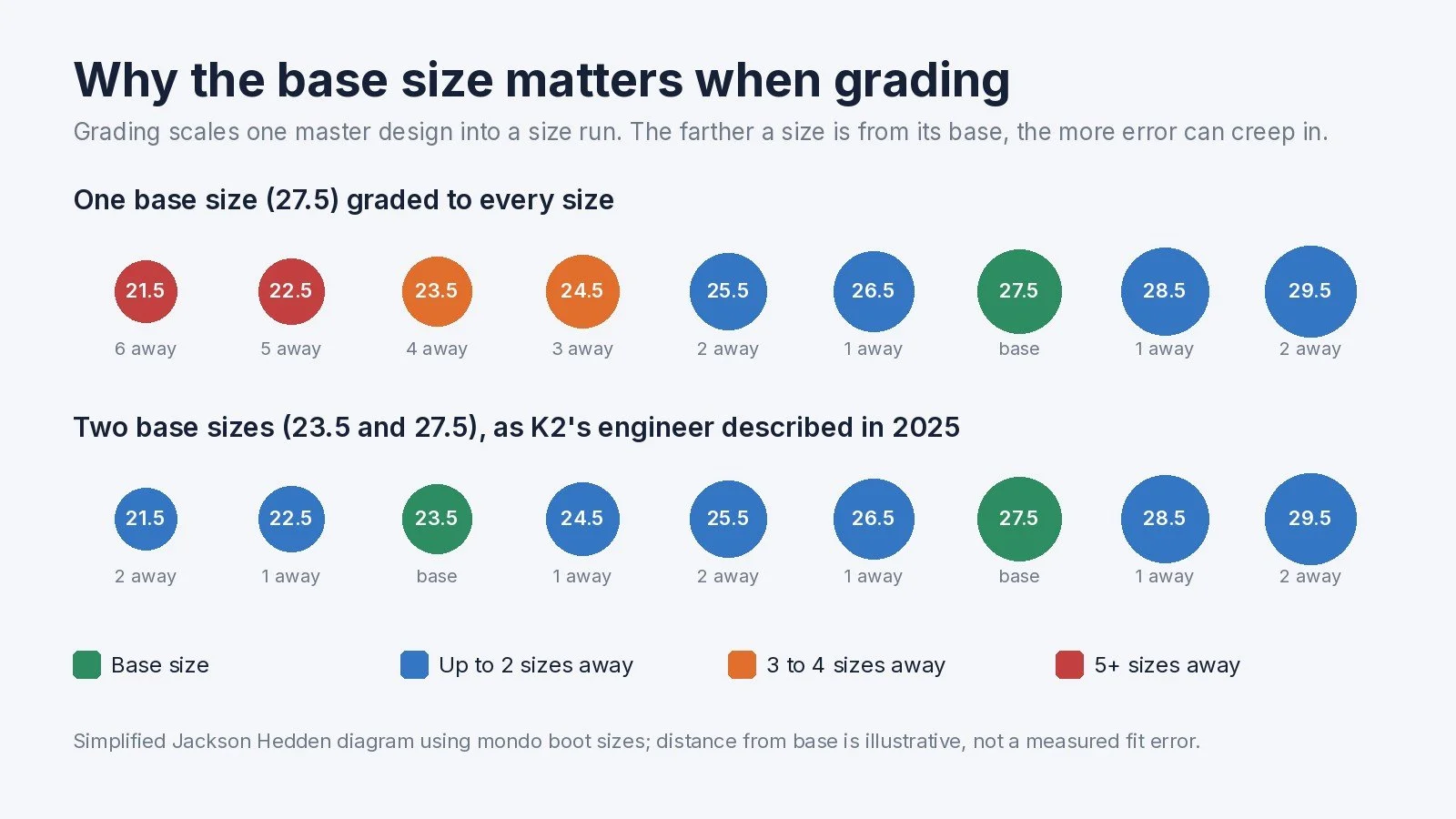
Grading from one base size versus two. Simplified Jackson Hedden diagram; distances are illustrative, not measured fit error.
Grading, base sizes and where fit lives
Two details in K2's story apply well beyond skiing.
Grading from the right base size. Grading is the process of scaling one master design up and down into a full size run. In the Powder7 interview, Burrow said most brands develop a product in one size, while K2 now starts with two, grading women's boots from a 23.5 and men's from a 27.5 to reduce how far any one design has to be stretched. She also described 3D printing each size and checking it on differently shaped feet before molds are created. Geometry that is right in a middle size can be wrong at the edges, because human bodies do not scale proportionally.
Fit in the structure, not the padding. Putting the heel pocket and calf shape into the hard shell is harder and costlier than adding foam to a liner, but it changes how the product behaves. Padding compresses over time and can dull feedback; structure holds its shape. The same choice shows up in helmets, headphones, wearables and handles: teams can compensate for a poor base shape with soft materials, or fix the base shape. Our recent article on smart rings and fit looks at a similar sizing problem in a very different product.
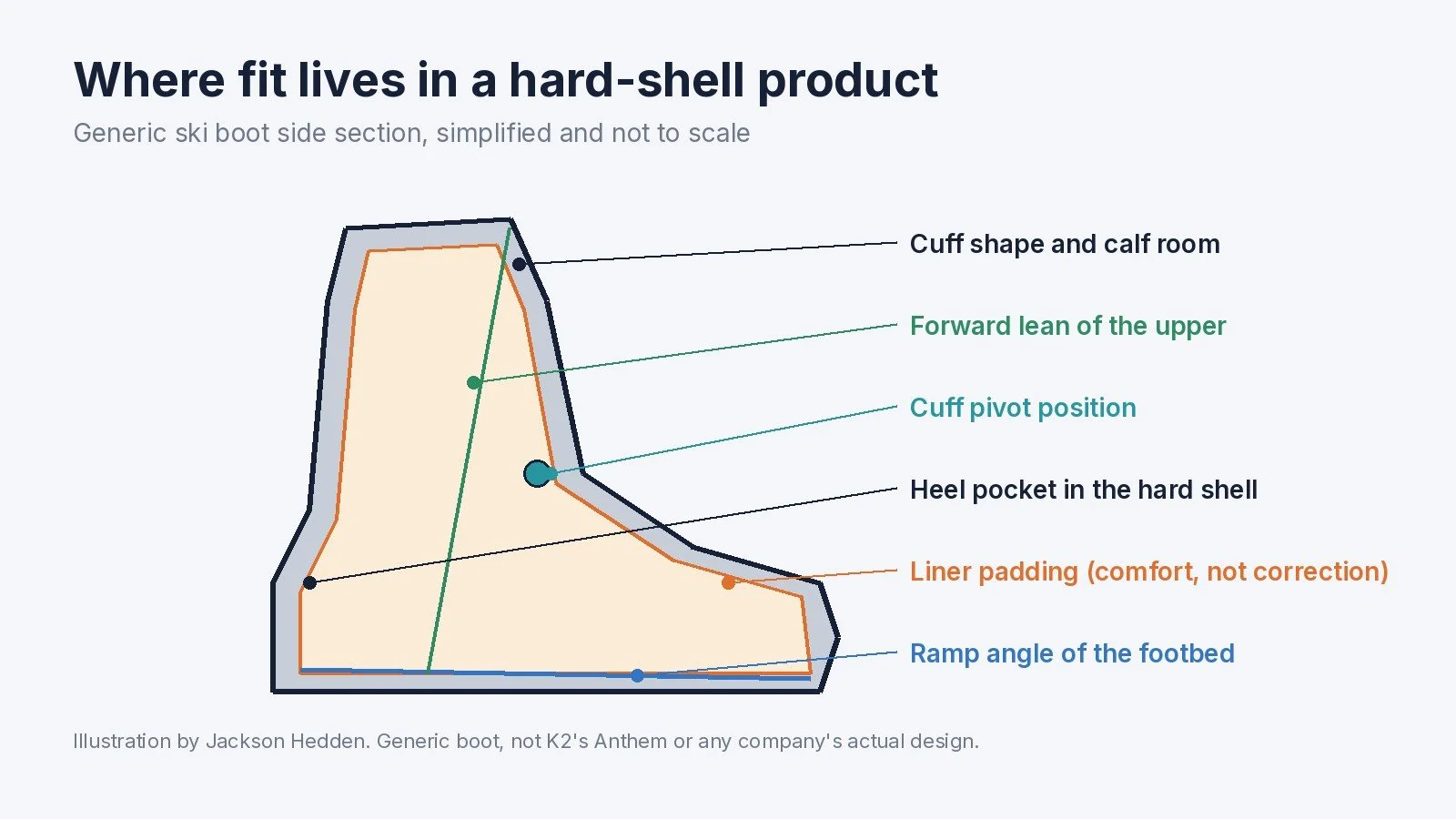
Where fit lives in a hard-shell product. Generic boot, simplified and not to scale; not K2’s Anthem or any company’s actual design.
What this means for product teams
If you are developing a product that people wear, hold or fit their bodies into, K2's approach suggests a practical sequence.
- Study workarounds before writing the brief. Collect the modifications users already make, such as added padding, cut straps or aftermarket parts. They show where the current platform fails and for whom.
- Decide early whether to share or split the platform. Model the tooling and inventory cost of a dedicated version against the returns, fit complaints and lost customers of a shared one. Make the call before industrial design is locked, not after.
- Prototype the edge sizes, not just the middle one. Build fit prototypes, often 3D printed, in the smallest and largest sizes alongside the base size, and test them with real users before committing to steel.
- Put critical geometry into the structure. Where fit or alignment drives performance, design it into the rigid parts and use soft materials for comfort, not correction.
- Plan validation where no standard exists. Burrow noted in 2025 that ski boots have few regulatory standards, so K2 relies on its own internal tests. Many consumer products are similar: teams should define their own durability and safety tests and benchmark competitors against them.
Arc'teryx's bonded climbing harness, which we covered in our look at nearly stitch-free construction, is another recent example of an outdoor brand rethinking a product's structure rather than its surface. Working with an experienced industrial design agency helps connect user research, fit prototyping, and tooling plans so a platform decision like this is made with real evidence.
Frequently asked questions
What does "shrink it and pink it" mean in product design? It describes making a women's version of a product by scaling down and recoloring a men's or unisex design without changing its underlying geometry. It is cheaper, but it can fail users whose bodies or use patterns differ from the original design target.
Why are women's-specific products expensive to develop? Products made by injection molding need separate steel tools for every new part shape and size. A dedicated women's platform adds tooling, testing and inventory costs, so brands usually need strong evidence that a shared design is not working.
What is grading in product design? Grading is scaling a master design into a full range of sizes. Because bodies do not scale proportionally, a design graded too far from its base size can fit poorly at the edges, which is why teams test the smallest and largest sizes early.
When should a sporting goods brand involve an industrial design firm? Ideally during user research and before the platform decision, when shell shape, sizing strategy and tooling plans can still change. Bringing design in after molds are ordered limits fixes to soft parts and adjustments.
If you are developing wearable, sporting or outdoor products where fit drives performance, see our industrial design and product design services or contact our team to plan fit prototypes and tooling before you commit to steel.
Jackson Hedden is a product design, development and manufacturing firm helping founders and product teams take consumer and industrial products from concept to production.
Sources
- K2 via Shop Eat Surf Outdoor, "K2 Introduces the All-New Anthem Collection," November 12, 2026: https://shop-eat-surf-outdoor.com/press-releases/k2-introduces-the-all-new-anthem-collection/624680/
- K2, Anthem 105 Zonal BOA Ski Boots 2027 product page: https://k2snow.com/en-us/p/anthem-105-zonal-boa-ski-boots-ks261930
- Sundance Ski & Snowboard Shop, "More Than a Women's Ski Boot: The Story Behind K2 Anthem," November 3, 2026: https://sundanceskishop.com/en-us/blogs/news/more-than-a-womens-ski-boot-the-story-behind-k2-anthem
- Powder7, "Interview with a Badass: Christie Burrow, Boot Engineer at K2," January 24, 2025: https://www.powder7.com/ski-blog/interview-with-a-badass-christie-burrow/