On November 18, 2026, LG Electronics announced that its LG System Ironing, an all-in-one steam iron, handheld steamer and powered ironing board, won the Grand Prix at the 2026 Ergonomic Design Awards run by the Ergonomics Society of Korea, with the ceremony set for November 19.
Key takeaways
- LG's System Ironing won the top prize at the Ergonomics Society of Korea's 26th Ergonomic Design Awards, which judge products on ease of use, efficiency, safety and emotional quality from the user's point of view.
- LG says the ironing board's height adjusts electrically in 10 steps, based on Korean body measurement data, to match a user's height and elbow position.
- Juicer maker Hurom says its Best of Best-winning H90 was developed by analyzing every step of juicing and cleaning, using customer feedback, user research and expert evaluation.
- Ergonomics is not a finish applied at the end. Body data, task steps and adjustability decide a product's architecture, so they belong in the brief before industrial design is frozen.
- Adjustability adds motors, mechanisms and cost. Teams should decide what must fit everyone, what can adjust and what can be offered in sizes.
What consumer product design companies can learn from the 2026 Ergonomic Design Awards
Ergonomics, also called human factors, is the practice of designing products around the people who use them: their bodies, their strength and reach, and how they actually perform a task. The Ergonomics Society of Korea, an academic society founded in 1982, has run its Ergonomic Design Awards since 1998.
According to the society's November 3 announcement, this year's awards picked seven products launched in 2026 or due to launch, in four categories: Grand Prix, Best of Best, Best Innovation and Special. Expert judges focused on whether each product lets people use it comfortably and safely. The ceremony and an exhibition of the winners take place on November 19 at the society's fall conference in Jeju, which runs November 18 to 21.
LG's System Ironing took the Grand Prix. LG's AI Objet Collection dishwasher and Hurom's H90 juicer received Best of Best. Best Innovation went to a Bodyfriend product, an LG water purifier and the LG ePaper Display, and a second Bodyfriend product received the Special award.
What LG and Hurom reported
The System Ironing. LG's newsroom and Seoul Economic Daily describe a garment care product that combines a steam iron, a handheld steamer and a styling board. Using Korean body measurement data, the board's height adjusts electrically across 10 levels to suit the user's height and elbow position. Seven courses set steam temperature by fabric, including cotton, wool and rayon. A fan in the board either holds fabric down with suction or lifts it on air, which LG says reduces slipping and wrinkling. The board can be stored upright or unfolded, it rolls on four wheels, and the wheels lock so the product does not move during use. LG's January launch release adds a 4.3-inch touch display on the board and a removable, washable board cover, with a factory price of 2.99 million won in Korea.
The other LG winners. LG says the dishwasher uses a turbidity sensor, which measures how cloudy the wash water is, to adjust wash strength and time, and has dedicated holders for items such as pans, wine glasses and bottles. The 3.1-kilogram ePaper Display has a curved back to make it easier to hold and carry, installs without tools and charges wirelessly, which LG says reduces the risk of tripping over power cables.
Hurom's H90. In an Asia Economy report on November 3, Hurom said the H90, launched in September, was developed by analyzing the whole juicing process, from preparing and loading ingredients to juicing and cleaning. The company points to a 155 mm feed opening, a 2.5-liter hopper, jam detection, and ergonomic choices in the hopper lid, handle, juice cap and drum assembly.
Why ergonomics is an architecture decision
The analysis below is Jackson Hedden's view, based on general product development practice. We have not tested these products and are not describing LG's or Hurom's internal design work.
Body data sets the dimensions. Anthropometrics is the measurement of human body sizes, such as standing height, elbow height and hand length. Designers usually work to a range of users, often from the 5th to the 95th percentile, meaning the smallest 5% and largest 5% of a target group fall outside it. LG built on data for Korean users; a product sold in several markets may need a wider range, because body sizes differ by population.
A fixed size is a design choice. A standard ironing board forces most people to stoop or reach. An adjustable board solves that, but it needs a lift mechanism, a motor, controls, a stable base and wheel locks. Each one adds parts, weight, cost and failure points. Those parts also shape the enclosure and the tooling, the custom molds and fixtures made for production.
The whole task matters, not just the main moment. Hurom's description is a useful model. Loading, cleaning and reassembly are where many kitchen and home products frustrate users, and those steps decide part count, how parts lock together and how easy they are to clean.
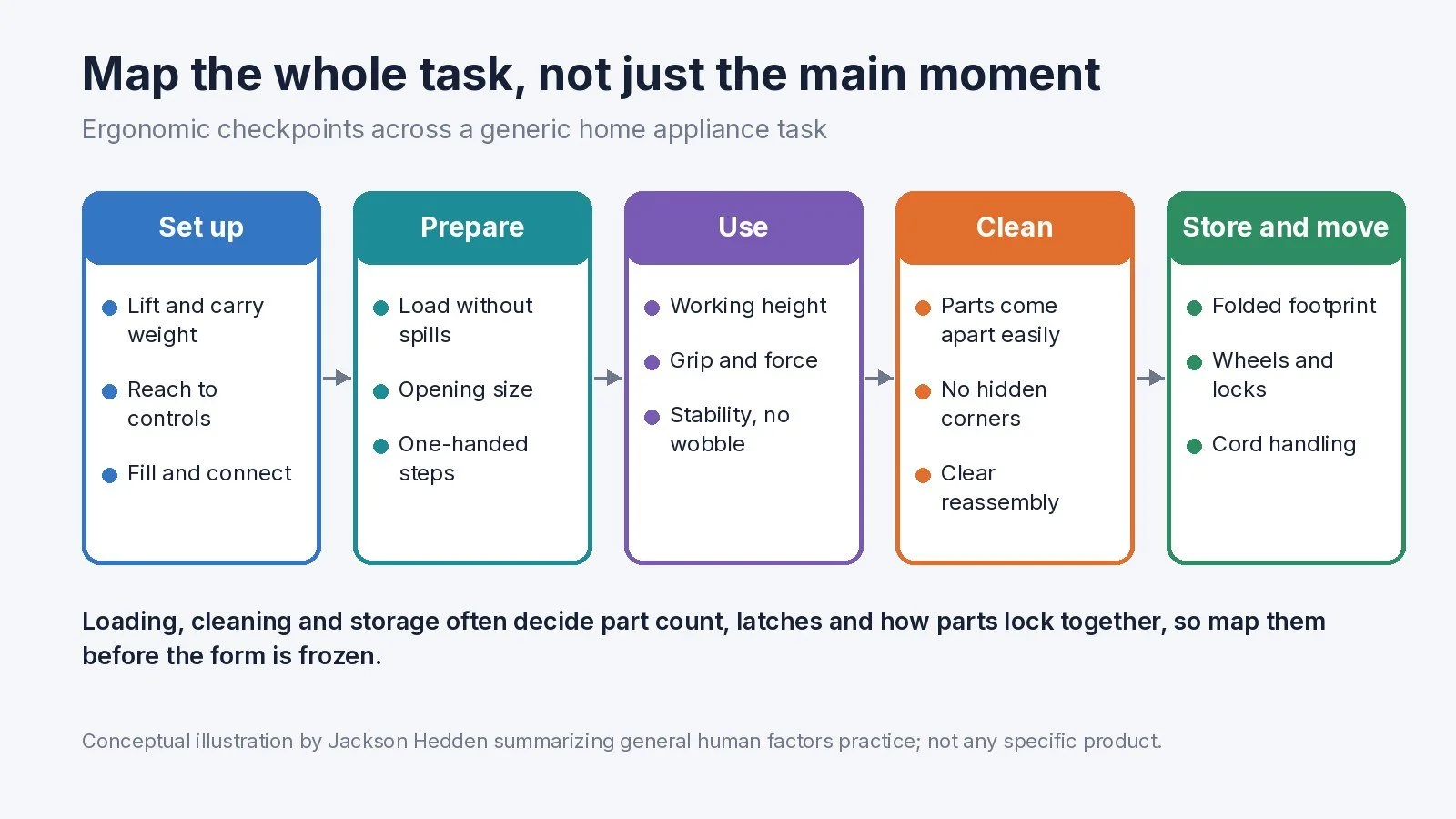
Ergonomic checkpoints across a whole task. Conceptual illustration by Jackson Hedden; generic and not based on any specific product.
What this means for product teams
Write the user range into the requirements. Before concept design, define who the product is for, where it will be sold and which body dimensions drive it. Experienced consumer product design companies treat these numbers like any other engineering requirement.
Map the task, step by step. List every action from unboxing to storage. Mark where users bend, lift, grip, reach or need to see. Our article on the touch-free ice maker from ecozy shows how cleaning steps become design inputs, and our look at K2's women's ski boot covers designing for different body sizes.
Decide fixed, adjustable or sized. Fix what can fit almost everyone. Adjust what cannot. Offer sizes when adjustment would cost too much or compromise the product.
Test with real people, early and often. Use rough foam and 3D-printed models to check reach, height and grip before detailed engineering. Then repeat usability checks in later validation builds: EVT (engineering validation test) proves the design works, and DVT (design validation test) checks production-intent parts.
Design for manufacturing with the mechanism in mind. Design for manufacturing (DFM) means shaping parts so they can be built reliably and affordably at volume. Lift mechanisms, hinges and locking wheels need tolerances and assembly steps that hold up in the factory, not just in the prototype shop.
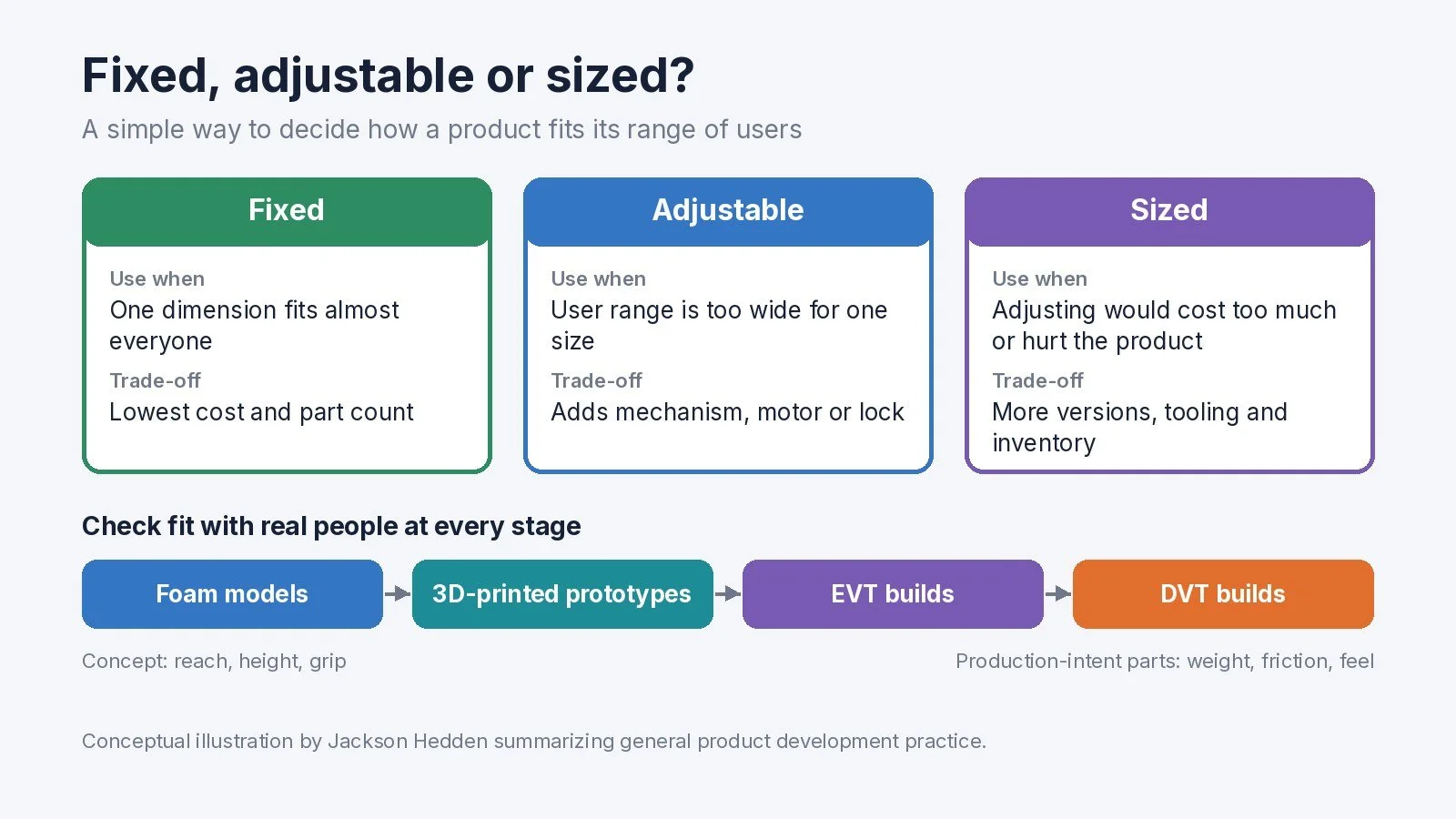
Choosing how a product fits its range of users. Conceptual illustration by Jackson Hedden summarizing general product development practice.
Frequently asked questions
What did LG's System Ironing win? It won the Grand Prix, the top award, at the 2026 Ergonomic Design Awards run by the Ergonomics Society of Korea. LG highlights features such as the height-adjustable board based on Korean body data, fabric-specific steam courses and lockable wheels.
What is ergonomic design in consumer products? It is designing a product around the bodies, abilities and habits of the people who use it. It covers size and reach, grip and force, visibility, safety and how easy each step of a task is.
What does anthropometric data mean for product design? Anthropometric data describes body measurements across a population. Designers use it to set dimensions such as working height, handle size and reach, usually covering a defined percentile range rather than an average person.
When should a product team test ergonomics? Start with rough models during concept design, before industrial design is frozen and tooling is ordered. Then retest with production-intent parts, because small changes in size, weight or friction can change how a product feels.
Work with us
If you are developing a home or kitchen product where comfort and ease of use matter as much as features, our consumer product design services cover user research, industrial design, engineering and DFM through production. Contact us to talk through your project.
Jackson Hedden is a product design, development and manufacturing firm helping founders and product teams take consumer and industrial products from concept to production.
Sources
- LG Electronics Newsroom (in Korean), "LG System Ironing wins Grand Prix at Ergonomic Design Awards," November 18, 2026: https://www.lge.co.kr/story/newsroom/236245
- Koo Kyung-woo, "LG System Ironing Wins Grand Prix at Ergonomic Design Awards," Seoul Economic Daily, November 18, 2026: https://en.sedaily.com/business/2026/11/18/lg-system-ironing-wins-grand-prix-at-korea-ergonomic-design
- Ergonomics Society of Korea via Newswire (in Korean), "26th Ergonomic Design Awards winners selected," November 3, 2026: https://www.newswire.co.kr/newsRead.php?no=1046105
- Han Jin-ju, "Hurom H90 juicer wins top prize at Ergonomic Design Awards" (headline translated; the society lists the H90 as Best of Best), Asia Economy (in Korean), November 3, 2026: https://www.asiae.co.kr/article/2026110308231982958
- LG (in Korean), "Garment care solutions widen choice to fit lifestyles" (LG System Ironing launch release), January 20, 2026: https://www.lg.co.kr/media/release/29785