On November 13, 2026, LightMake founder Vic published a production update saying a trial production run of the Kickstarter-funded L4 multi-tool 3D printer surfaced six issues, from off-spec housing color to an injection-mold gate defect, and that backer shipments will now begin in late January 2027.
Key takeaways
- LightMake's trial run used only molded production parts and a full line flow: module assembly, a 48-hour print test, transport vibration and drop simulation, and unboxing inspection.
- The issues it found were cosmetic, tooling, connector-reliability, mechanism, tuning and assembly-training problems, the kinds of defects early prototypes rarely reveal.
- LightMake had planned to start mass production on November 15; it now plans user test units in late December and shipping from late January.
- For product teams, the lesson is to budget time and money for at least one fix-and-reverify loop after the first production-tooled build, and to keep delivery promises flexible until that build is done.
What a product development company expects from a trial production run
A trial production run, also called a pilot build, is a small batch built on the real assembly line with production tooling, meaning the steel injection molds, fixtures and test stations used for volume manufacturing. Its job is to find problems while they are still cheap to fix. LightMake's unusually specific update makes it a useful case study. Below we separate what was reported from our own analysis.
What LightMake reported
The build. According to the November 13 update, every part in the trial run was a molded production part. The team assembled four modules (linear motor, tool head, heated bed and upper frame) and then complete machines. The line ran the full flow from assembly through a 48-hour print test, vibration and drop testing to simulate shipping, and an unboxing inspection. LightMake says its contract assembly partner, Sunwoda, manages incoming inspection of all materials. Machines from this run stay in R&D testing rather than filling Kickstarter orders.
The six issues. LightMake listed these findings and fixes:
- The housing color did not meet the industrial designer's CMF (color, material and finish) requirements; molding color and surface finish need improvement.
- The gate design on the power-box mold, the point where molten plastic enters the cavity, leaves surface flaws; the gate will be revised.
- The folding screen passed an aging test, but the quality team judged that its USB-C connection could lose contact over long-term use; a small retaining part for the cable has already gone into tooling.
- The original nozzle-wiping design could not clean the nozzle completely; a redesign is in testing.
- Layer lines on a cylindrical test print could be better under a microscope; print parameters are being tuned.
- Assembly workers are still learning the assembly SOP (standard operating procedure); the company is ramping a new 3,000 square meter line and improving jigs and automated tools.
The founder wrote that none of these issues is fatal, but that shipping with them would mean machines not at their best.
The schedule. About 15 users will receive test machines in late December 2026. Fixes based on their feedback and re-verification of revised materials are planned for early January 2027, with mass-production shipping in batches, in order sequence, from late January.
The context. In an October 12 update, LightMake said the L4 was in DVT, planned to start mass production on November 15, and had secured long-lead components for 5,000 printers. That post also described inspection standards for more than 600 parts and upgraded the Kickstarter warranty to 24 months. A September 23 post said the campaign had passed $3 million. NadinMacht reported the delay on November 15.
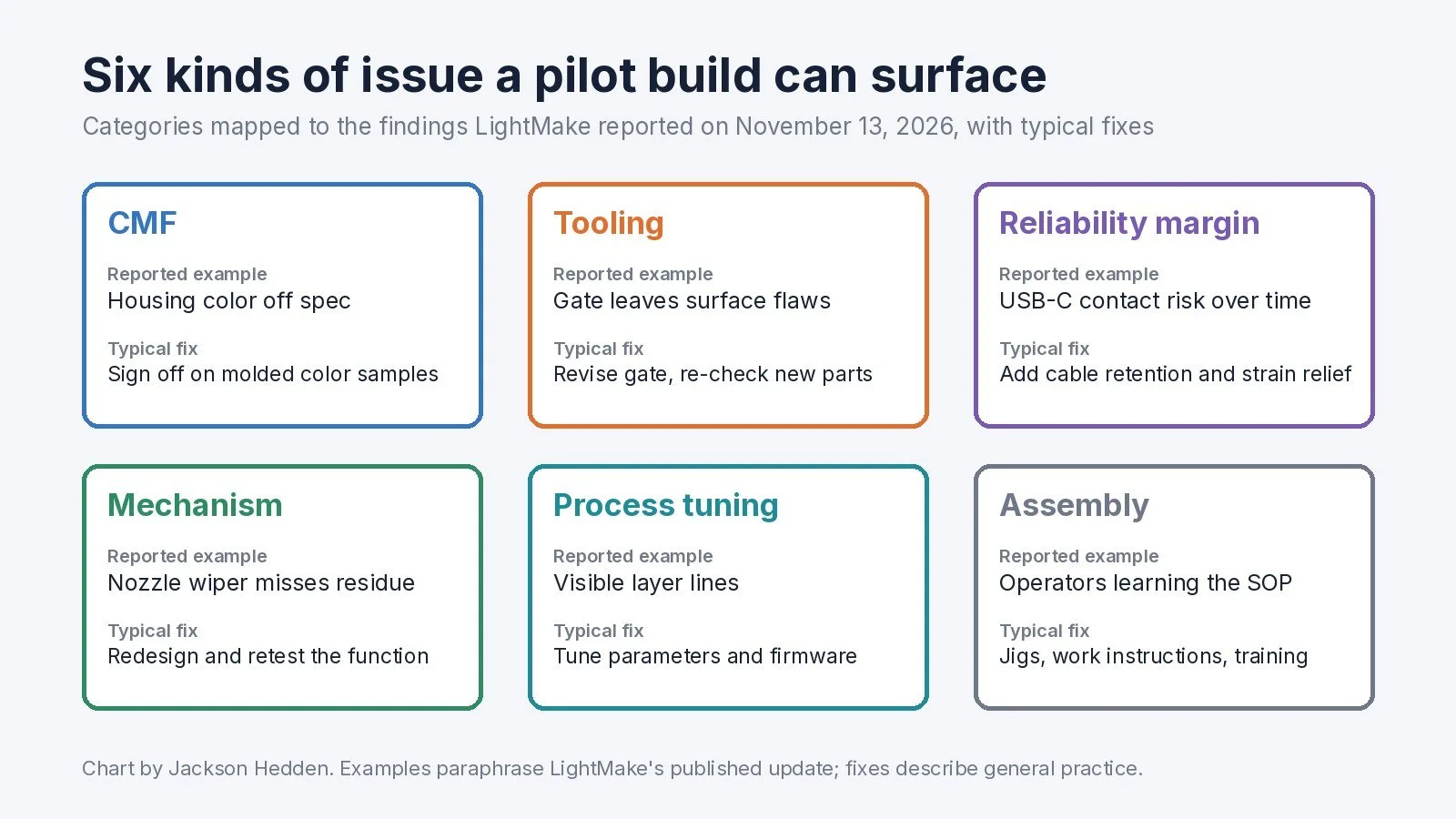
Issue categories mapped to findings in LightMake's November 13, 2026 update. Examples are paraphrased; the fixes describe general practice. Chart by Jackson Hedden.
Why pilot builds find what prototypes miss
This section and the next are Jackson Hedden analysis based on general product development practice, not a description of LightMake's internal process.
Consumer hardware usually moves through staged builds, and an experienced product development company plans each one around the questions it must answer. EVT (engineering validation test) checks that the design works, often with printed or machined parts. DVT (design validation test) checks that parts from production tooling pass reliability and compliance tests. PVT (production validation test) checks that the factory can build the product at rate, with consistent quality. Almost every item on LightMake's list is something a hand-built prototype would hide:
Color and finish only exist in molded parts. Painted prototypes can look right while the molded resin, colorant and mold texture do not. Color depends on resin lot, molding conditions and tool texture, so it must be approved on real parts against a physical standard.
Tooling defects show up at first shots. Gate location and size affect flow lines, sink marks and the mark left where the gate is trimmed. Mold-flow simulation helps, but gate problems usually become visible in the first parts off a new tool (T1 samples), and fixing them means modifying steel.
Passing a test is not the same as having margin. The USB-C finding is notable: the design passed an aging test, but the quality team still saw a long-term risk. Connectors on moving or folding parts need strain relief and positive retention, and reviewers should ask how much margin exists, not just whether a test passed.
Mechanisms, firmware and people are part of the product. A wiper that leaves residue, parameters that need tuning and operators still learning the SOP are all production issues. Jigs, clear work instructions and training determine whether unit 2,000 matches unit 20.
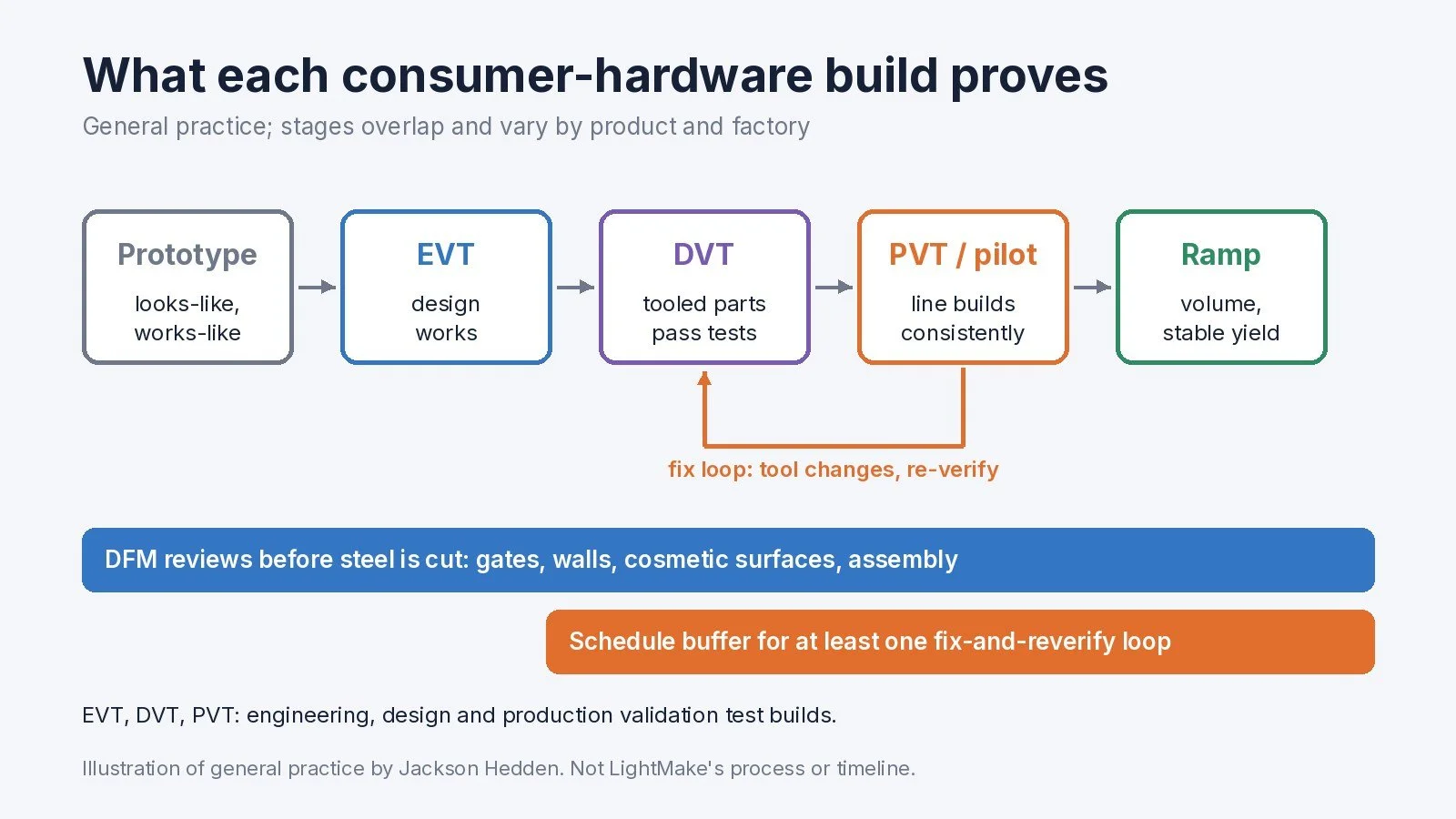
What each consumer-hardware build proves, with the fix loop teams should schedule for. General practice drawn by Jackson Hedden; not LightMake's process or timeline.
What this means for product teams
- Plan for a fix loop after the first tooled build. Assume the first production-tooled build will find issues, and put time for tool changes and re-verification into the schedule before announcing a ship date.
- Approve CMF on real parts. Agree physical color and texture standards with the molder early, and sign off on molded samples, not renders or painted prototypes.
- Review tooling with DFM in mind. A design for manufacturing (DFM) review, the practice of shaping parts so they can be made reliably at the target cost, should cover gate locations, wall thickness and cosmetic surfaces before steel is cut.
- Design retention into every connection that moves. Add strain relief and mechanical retention for cables and connectors on hinges, folding screens and removable modules.
- Test the whole journey, including shipping. LightMake's burn-in, transport simulation and unboxing inspection flow is a good template; transit damage is a product failure to the customer.
- Invest in assembly tooling and training. Jigs, fixtures and clear SOPs reduce variation; budget for them as part of the product.
- Communicate in stages. Crowdfunding and preorder timelines are safest when they are tied to build milestones rather than fixed dates.
We looked at a faster crowdfunding-to-retail path in our post on Mondo Robotics' Beni camera robot, and at why color and finish decisions deserve their own process in our article on Logitech's CMF-only special editions.
Our look at Welly's reshored drinkware factory explains why a first good part is not yet a stable production line.
Frequently asked questions
What is a trial production run? A trial production run, or pilot build, is a small batch made on the real production line with production tooling and processes. It checks that the product can be assembled, tested and packed consistently before mass production begins.
What is the difference between EVT, DVT and PVT? EVT confirms the design works, DVT confirms production-tooled parts pass reliability and compliance testing, and PVT confirms the factory can build the product at rate with consistent quality. Each stage typically finds issues the previous one could not.
Why do injection-molded parts look different from prototypes? Prototypes are often printed, machined or painted, while molded parts get color and texture from the resin, colorant, mold surface and process. Gate position and cooling can also leave marks that only appear on real molded parts.
How long does it take to fix problems found in a pilot build? It depends on whether the fix is a setting, firmware or tooling. Parameter tweaks can take days, while modifying a mold and re-verifying parts often takes weeks, so schedules need buffer after the first tooled build.
If your team is preparing for its first production-tooled build and comparing a product development company to help plan builds, tooling reviews and verification, see how we approach product development or contact our team to talk through your path to production.
Jackson Hedden is a product design, development and manufacturing firm helping founders and product teams take consumer and industrial products from concept to production.
Sources
- LightMake, "L4 Production Update & Delivery Schedule," November 13, 2026: https://lightmake.tech/blogs/news/l4-production-update-delivery-schedule
- LightMake, "Progress Update — Warranty Upgraded to 24 Months," October 12, 2026: https://lightmake.tech/blogs/news/progress-update-warranty-upgraded-to-24-months
- LightMake, "$3 Million Is Just the Beginning, Delivery Is Our Responsibility," September 23, 2026: https://lightmake.tech/blogs/news/3-million-is-just-the-beginning-delivery-is-our-responsibility
- NadinMacht, "LightMake L4: delivery of the Kickstarter printer slips to late January 2027," November 15, 2026: https://news.nadinmacht.de/en/lightmake-l4-delivery-delayed/